



Cyproconazole
Based on 1 publication(s) in Google Scholar
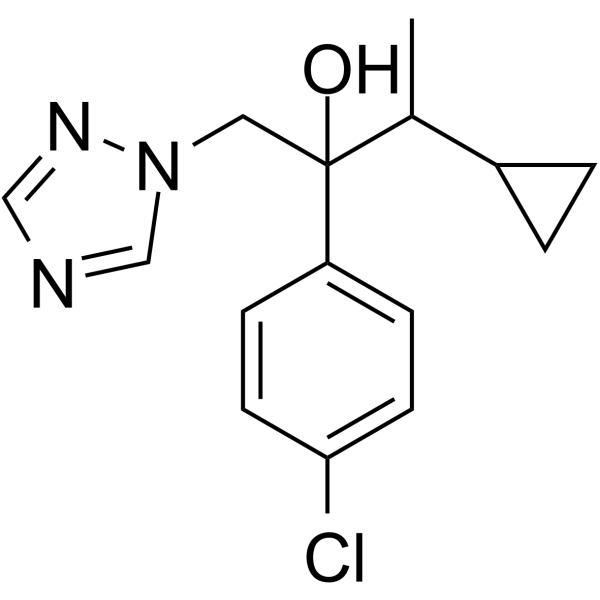
Cyproconazole is a triazole fungicide used to protect crops, fruits and vegetables against a wide range of fungal pathogens. Cyproconazole can cause hepatocellular adenomas and carcinomas in CD-1 mice. Cyproconazole also exhibits low toxicity to zebrafish embryos and affects locomotor activity.
Nur für Forschungszwecke. Wir verkaufen nicht an Patienten.
- Reinheit : 98.72%
- CAS. Nr.: 94361-06-5
- Formel: C15H18ClN3O
- Molecular Weight:291.78
-
Speicherung:Powder -20°C, 3 years , 4°C, 2 years ; In solvent -80°C, 2 years , -20°C, 1 year

To place orders, for customer services and technical support, please contact: MedChemExpress USA
Tel: 609-228-6898 E-mail: [email protected] [email protected]


-
 Biologische Aktivität
-
Chemical Information
-
Lösungsmittel & Löslichkeit
- Protokoll
- Reinheit & Dokumentation
- Verweise
-
 Help & FAQs




Publications Citing Use of MedChemExpress (MCE) Cyproconazole
More

Biologische Aktivität
Beschreibung
In Vitro
Cyproconazole (10-500 μM, 96 h) results in a time- and dose-dependent response in mortality in zebrafish embryos[2].
Cyproconazole (100-500 μM, 24 h) significantly inhibits the spontaneous movement in zebrafish embryos[2].
Cyproconazole (50-250 μM, 24 h) results in a significant increase in the rate of pericardial edema and increased cumulative deformity rate in zebrafish embryos/larvae at 48, 72, and 96 hpf[2].
Cyproconazole (500 μM, 24 h) results in significant decreases in basal respiration and oligomycin-induced ATP respiration compared with the control group[2].
MedChemExpress (MCE) has not independently confirmed the accuracy of these methods. They are for reference only. Further protocols information, click here.
In Vivo
MedChemExpress (MCE) has not independently confirmed the accuracy of these methods. They are for reference only.
-
Animal Model:CD-1, C57BL/6J and C3H/HeNClrBR strains of male mice[1]
-
Dosage:200 and 450 ppm
-
Administration:Added to diet for 2, 7 or 14 days
-
Result:Increased incidence and severity of single cell necrosis in the 450 ppm dose group.
Produced a larger and more sustained decrease in plasma cholesterol levels, and a greater effect on fat deposition in the liver.


Chemical Information
-
CAS. Nr. 94361-06-5
-
Appearance Solid
-
Molecular Weight 291.78
-
Formel C15H18ClN3O
-
Color White to off-white
-
SMILES
ClC1=CC=C(C(C(C)C2CC2)(O)CN3N=CN=C3)C=C1
-
Versand
Room temperature in continental US; may vary elsewhere.
-
Speicherung
Powder -20°C 3 years 4°C 2 years In solvent -80°C 2 years -20°C 1 year


Publications (1)
-
Journal Impact Factor
-
Most Recent
-
Chem Biol Interact
A combined in silico and in vitro new approach methodology for early detection of liver steatogenic chemicals. [Abstract]2026 Jul 25:435:112153. PMID: 42173389


Lösungsmittel & Löslichkeit
In Vitro:
DMSO : 100 mg/mL (342.72 mM; Need ultrasonic; Hygroscopic DMSO has a significant impact on the solubility of product, please use newly opened DMSO)
Please refer to the solubility information to select the appropriate solvent. Once prepared, please aliquot and store the solution to prevent product inactivation from repeated freeze-thaw cycles.
Storage method and period of stock solution: -80°C, 2 years; -20°C, 1 year. When stored at -80°C, please use it within 2 years. When stored at -20°C, please use it within 1 year.
Please refer to the solubility information to select the appropriate solvent. Once prepared, please aliquot and store the solution to prevent product inactivation from repeated freeze-thaw cycles.
Storage method and period of stock solution: -80°C, 2 years; -20°C, 1 year. When stored at -80°C, please use it within 2 years. When stored at -20°C, please use it within 1 year.
Konzentration (Stammlösung) × Volumen (Stammlösung) = Konzentration (Ziellösung) × Volumen (Ziellösung)
In Vivo:
Select the appropriate dissolution method based on your experimental animal and administration route.
- For the following dissolution methods, please ensure to first prepare a clear stock solution using an In Vitro approach and then sequentially add co-solvents:
- To ensure reliable experimental results, the clarified stock solution can be appropriately stored based on storage conditions. As for the working solution for In Vivo experiments, it is recommended to prepare freshly and use it on the same day.
- The percentages shown for the solvents indicate their volumetric ratio in the final prepared solution. If precipitation or phase separation occurs during preparation, heat and/or sonication can be used to aid dissolution.
Add each solvent one by one: 10% DMSO 40% PEG300 5% Tween-80 45% Saline
Solubility: 2.5 mg/mL (8.57 mM); Clear solution; Need ultrasonic
This protocol yields a clear solution of 2.5 mg/mL.
Taking 1 mL working solution as an example, add 100 μL DMSO stock solution (25.0 mg/mL) to 400 μL PEG300, and mix evenly; then add 50 μL Tween-80 and mix evenly; then add 450 μL Saline to adjust the volume to 1 mL.
Preparation of Saline: Dissolve 0.9 g sodium chloride in ddH₂O and dilute to 100 mL to obtain a clear Saline solution.
Add each solvent one by one: 10% DMSO 90% (20% SBE-β-CD in Saline)
Solubility: ≥ 2.5 mg/mL (8.57 mM); Clear solution
This protocol yields a clear solution of ≥ 2.5 mg/mL (saturation unknown).
Taking 1 mL working solution as an example, add 100 μL DMSO stock solution (25.0 mg/mL) to 900 μL 20% SBE-β-CD in Saline, and mix evenly.
Preparation of 20% SBE-β-CD in Saline (4°C, storage for one week): 2 g SBE-β-CD powder is dissolved in 10 mL Saline, completely dissolve until clear.
In Vivo Dissolution Calculator
Please enter the basic information of animal experiments:
-
-
-
-
Recommended: Prepare an additional quantity of animals to account for potential losses during experiments.
Please enter your animal formula composition:
-
%DMSO +
Recommended: Keep the proportion of DMSO in working solution below 2% if your animal is weak.
-
%+
-
+%Tween-80 + +
-
%Saline +
The co-solvents required include: DMSO, . All of co-solvents are available by MedChemExpress (MCE). , Tween 80. All of co-solvents are available by MedChemExpress (MCE).
Working solution concentration: 0.22 mg/mL
Method for preparing stock solution: mg drug dissolved in μL DMSO. Stock solution concentration: mg/mL.
1. Take μL DMSO stock solution;
2. Add μL .
μL , mix evenly;
3. Then add μL Tween 80, mix evenly;
4. Then add μL
Please ensure that the stock solution in the first step is dissolved to a clear state, and add co-solvents in sequence. You can use ultrasonic heating (ultrasonic cleaner, recommended frequency 20-40 kHz), vortexing, etc. to assist dissolution.

Protokoll
-
Protocol for Open Field Test (OF)
The Open Field Test is a rodent behavioral assay that measures spontaneous locomotion, exploratory behavior, and anxiety-like behavior when an animal is placed in a novel open arena. The main readouts are total distance traveled, movement time, velocity, center-zone entries, center-zone time, peripheral-zone time, and thigmotaxis. The assay is based on the conflict between exploration of a novel environment and avoidance of exposed open areas; higher center exploration is commonly interpreted as lower anxiety-like behavior, whereas increased wall-following or peripheral occupancy is interpreted as higher anxiety-like behavior.


Reinheit & Dokumentation
-
Data Sheet (278 KB)
-
SDS (788 KB)
- English - EN (788 KB)
- Français - FR (788 KB)
- Deutsch - DE (788 KB)
- Norwegian - NO (788 KB)
- Español - ES (788 KB)
- Swedish - SV (788 KB)
- Italian - IT (788 KB)
- Korean - KR (788 KB)
- Portuguese - PT (788 KB)
-
Handling Instructions (2659 KB)
Verweise
[1]. Peffer, R. C., et al., (2007). Mouse liver effects of cyproconazole, a triazole fungicide: role of the constitutive androstane receptor. Toxicological sciences: an official journal of the Society of Toxicology, 99(1), 315–325. [Content Brief]
[2]. Cao, F., et al., (2019). Developmental toxicity of the triazole fungicide cyproconazole in embryo-larval stages of zebrafish (Danio rerio). Environmental science and pollution research international, 26(5), 4913–4923. [Content Brief]


Complete Stock Solution Preparation Table
Please refer to the solubility information to select the appropriate solvent. Once prepared, please aliquot and store the solution to prevent product inactivation from repeated freeze-thaw cycles.
Storage method and period of stock solution: -80°C, 2 years; -20°C, 1 year. When stored at -80°C, please use it within 2 years. When stored at -20°C, please use it within 1 year.
| Optional Solvent | Concentration Solvent Mass | 1 mg | 5 mg | 10 mg | 25 mg |
|---|---|---|---|---|---|
| DMSO | 1 mM | 3.4272 mL | 17.1362 mL | 34.2724 mL | 85.6810 mL |
| 5 mM | 0.6854 mL | 3.4272 mL | 6.8545 mL | 17.1362 mL | |
| 10 mM | 0.3427 mL | 1.7136 mL | 3.4272 mL | 8.5681 mL | |
| 15 mM | 0.2285 mL | 1.1424 mL | 2.2848 mL | 5.7121 mL | |
| 20 mM | 0.1714 mL | 0.8568 mL | 1.7136 mL | 4.2840 mL | |
| 25 mM | 0.1371 mL | 0.6854 mL | 1.3709 mL | 3.4272 mL | |
| 30 mM | 0.1142 mL | 0.5712 mL | 1.1424 mL | 2.8560 mL | |
| 40 mM | 0.0857 mL | 0.4284 mL | 0.8568 mL | 2.1420 mL | |
| 50 mM | 0.0685 mL | 0.3427 mL | 0.6854 mL | 1.7136 mL | |
| 60 mM | 0.0571 mL | 0.2856 mL | 0.5712 mL | 1.4280 mL | |
| 80 mM | 0.0428 mL | 0.2142 mL | 0.4284 mL | 1.0710 mL | |
| 100 mM | 0.0343 mL | 0.1714 mL | 0.3427 mL | 0.8568 mL |


Cyproconazole Related Classifications
HY-A0277 Related Classifications
 Powered by Bioz