



Aducanumab

Based on 1 Customer Validation
Aducanumab (BIIB037) is a human monoclonal antibody that selectively targets aggregated amyloid-beta (Aβ). Aducanumab shows blood-brain-barrier penetration, and can be used for Alzheimer's disease (AD) research.
Nur für Forschungszwecke. Wir verkaufen nicht an Patienten.
- Reinheit : 99.25%
- CAS. Nr.: 1384260-65-4
- Molecular Weight:146.2 kDa
-
Speicherung:Shipping with dry ice
Please store the product under the recommended conditions in the Certificate of Analysis.


To place orders, for customer services and technical support, please contact: MedChemExpress USA
Tel: 609-228-6898 E-mail: [email protected] [email protected]


-
 Biologische Aktivität
-
Chemical Information
- Protokoll
- Reinheit & Dokumentation
- Verweise
-
 Help & FAQs


-

HY-P99022
GantenerumabAnti-Aβ Monoclonal Antibody -

HY-P99859
DonanemabAnti-Aβ Antibody -
HY-P99185
BapineuzumabAmyloid Beta Binder -

HY-P99317
SolanezumabAnti-Aβ Antibody -
HY-P99835
CrenezumabAnti-Aβ Antibody -

HY-P990110
Lecanemab (Mouse IgG2a)Monoclonal Antibody -
HY-P99001
Human IgG1 kappa, Isotype ControlIgG1κ Isotype Control -

HY-P9999
TrontinemabAβ/TFRC Antibody -
HY-15162
Monomethyl auristatin EAntimitotic Agent -
HY-P9902
PembrolizumabPD-1 Inhibitor -
HY-50767
PalbociclibCDK4/6 Inhibitor -

HY-P9913
RituximabCD20 Inhibitor


Biologische Aktivität
Beschreibung
Isotype
Human IgG1 kappa
Recommend Isotype Controls
Species Reactivity
Human
IC50 & Target
Amyloid Beta/Aβ
In Vivo
Aducanumab (0.3-30 mg/kg, i.p., weekly, 6 months) reduces soluble and insoluble Aβ in a dose-dependent manner in 9.5- to 15.5-month-old Tg2576 transgenic mice[1].
Aducanumab (10 mg/kg, i.p., weekly, 6 months) restores intracellular calcium to control levels in 18-month-old Tg2576 mice[2].
Aducanumab (0.4-1 mg/mL, ICV, 20 min) leads to rapid decrease in amyloid burden, plaque clearance in Tg2576 mice[2].
MedChemExpress (MCE) has not independently confirmed the accuracy of these methods. They are for reference only.
-
Animal Model:9.5- to 15.5-month-old Tg2576 transgenic mice [1]
-
Dosage:0.3-30 mg/kg
-
Administration:Intraperitoneal injection (i.p.), weekly, 6 months
-
Result:Increased recruitment of Iba-1-positive microglia to Aβ plaques.
-
Animal Model:18-month-old Tg2576 mice[2]
-
Dosage:10 mg/kg
-
Administration:Intraperitoneal injection (i.p.), weekly, 6 months
-
Result:Restored neurite baseline calcium to control levels.
Decreased the number of neurites with elevated levels of calcium after 2 weeks.
Decreased the percentage of cell bodies with calcium overload.
Restored the levels of VILIP and SERCA to control levels.
Increased the cell numbers of NR1 and NR2A.
-
Animal Model:22-month-old transgenic Tg2576 mice[2]
-
Dosage:0.4-1 mg/mL
-
Administration:Intracerebroventricular injection (ICV), 20 min
-
Result:Decreased the number of amyloid plaque.
Decreased the size of the remaining individual plaques.
Reduced amyloid plaque burden.
Clinical Trial
| NCT Number | Sponsor | Condition | Start Date |
Phase

|
|---|---|---|---|---|
| NCT01329991 | 2011-05 | PHASE1 |
Gene ID
Accession
Conjugated
Unconjugated
Reconsititution
The product can be reconstituted/diluted with sterile PBS or saline.
Format
-
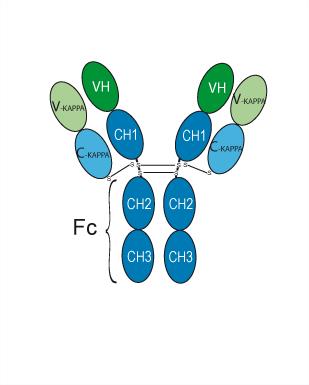
Human IgG1 kappa
Anwendung
ELISA, FACS, Functional assay
Verified Bioactivity
-
 Immobilized Human Beta-amyloid/Beta-APP Protein (hFc Tag) can bind Aducanumab. The EC50 for this effect is 603.66 ng/mL.
-
 The EC50 for this effect is 603.66 ng/mL. Flow cytometric analysis of 1.5×10⁶ HUVEC cells with Aducanumab (HY-P9967, red). Cells were fixed with 4% paraformaldehyde and permeabilised with 90% methanol. Then stained with the primary antibody at 1/200 dilution for an hour at 4℃. Goat Anti-Human IgG H&L (AF488) (HY-P83776) was used as the secondary antibody at 1/1,000 dilution for 30 minutes at 4℃. Human IgG1 kappa, Isotype Control (HY-P99001, blue) was used as the isotype control.


Chemical Information
-
CAS. Nr. 1384260-65-4
-
Appearance Liquid
-
Molecular Weight 146.2 kDa
-
Color Colorless to light yellow
-
SMILES
[Aducanumab]
-
Synonyms
BIIB037
-
Versand
Shipping with dry ice.
-
Formulation
Please refer to the lot-specific COA for specific buffer information.
-
Speicherung
Please store the product under the recommended conditions in the Certificate of Analysis.


Reinheit & Dokumentation
-
Data Sheet (261 KB)
-
SDS (251 KB)
- English - EN (251 KB)
- Français - FR (251 KB)
- Deutsch - DE (251 KB)
- Norwegian - NO (251 KB)
- Español - ES (251 KB)
- Swedish - SV (251 KB)
- Italian - IT (251 KB)
- Korean - KR (251 KB)
- Portuguese - PT (251 KB)
-
Inhibitory Antibodies User Guide (603 KB)
Verweise
[1]. Sevigny J, et al. The antibody aducanumab reduces Aβ plaques in Alzheimer's disease. Nature. 2016 Sep 1;537(7618):50-6. [Content Brief]
[2]. Kastanenka KV, et al. Immunotherapy with Aducanumab Restores Calcium Homeostasis in Tg2576 Mice. J Neurosci. 2016 Dec 14;36(50):12549-12558. [Content Brief]

Calculators
Konzentration (Stammlösung) × Volumen (Stammlösung) = Konzentration (Ziellösung) × Volumen (Ziellösung)


Aducanumab Related Classifications
HY-P9967 Related Classifications
 Powered by Bioz