



Daun02
Based on 4 publication(s) in Google Scholar
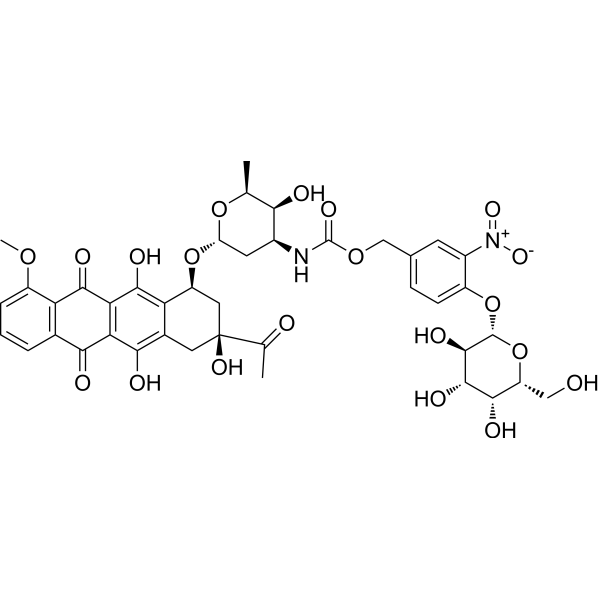
Daun02 is a proagent of the topoisomerase inhibitor Daunorubicin.
Nur für Forschungszwecke. Wir verkaufen nicht an Patienten.
- Reinheit : 98.72%
- CAS. Nr.: 290304-24-4
- Formel: C41H44N2O20
- Molecular Weight:884.79
-
Speicherung:Powder -20°C, 3 years , 4°C, 2 years ; In solvent -80°C, 6 months , -20°C, 1 month

To place orders, for customer services and technical support, please contact: MedChemExpress USA
Tel: 609-228-6898 E-mail: [email protected] [email protected]


-
 Biologische Aktivität
-
Chemical Information
-
Lösungsmittel & Löslichkeit
- Reinheit & Dokumentation
- Verweise
-
 Help & FAQs


-
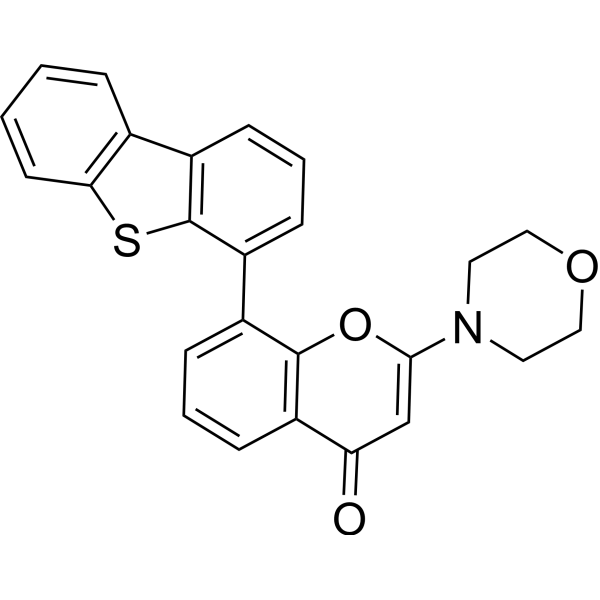
HY-11006
KU-57788DNA-PK Inhibitor -
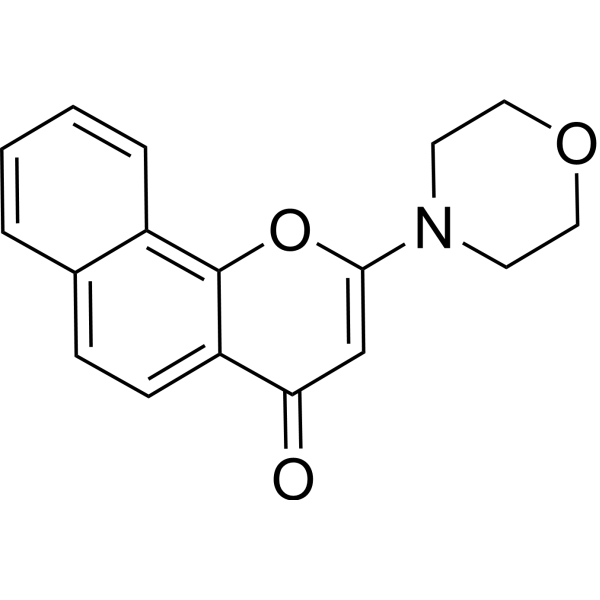
HY-15719
NU 7026DNA-PK Inhibitor -
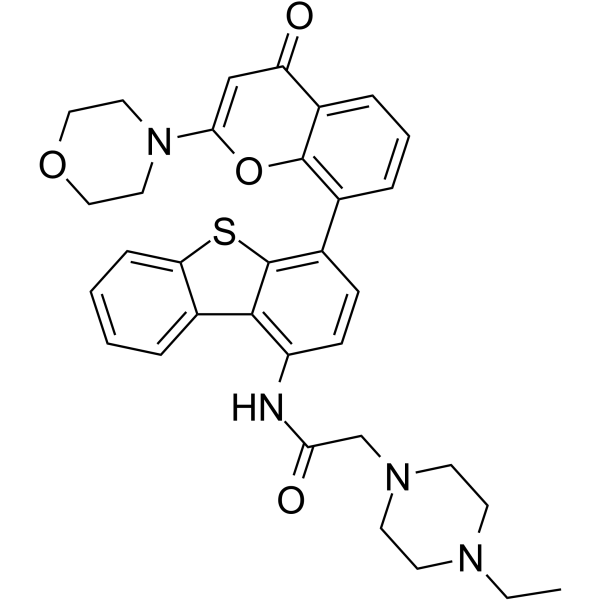
HY-13431
KU-0060648DNA-PK/PI3K Inhibitor -
HY-100705
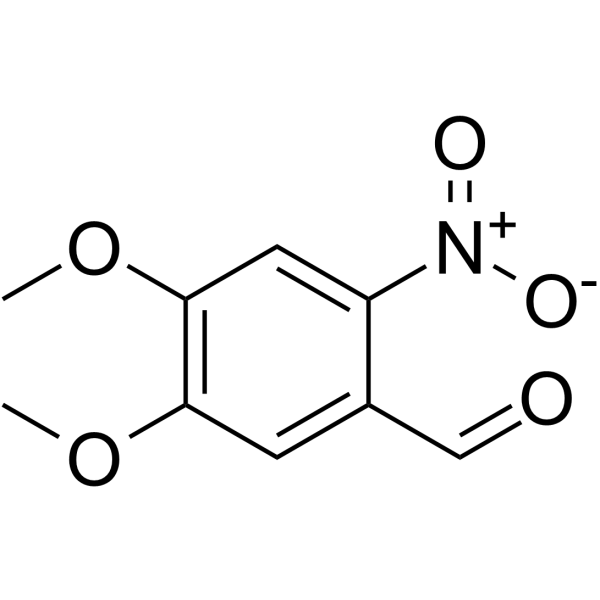
DMNBPhotolabile Proton Donor -
HY-19341
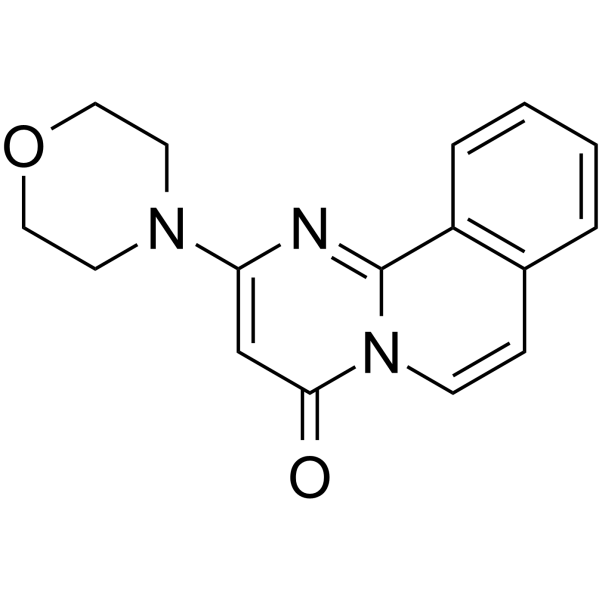
Compound 401DNA-PK Inhibitor -
HY-16962
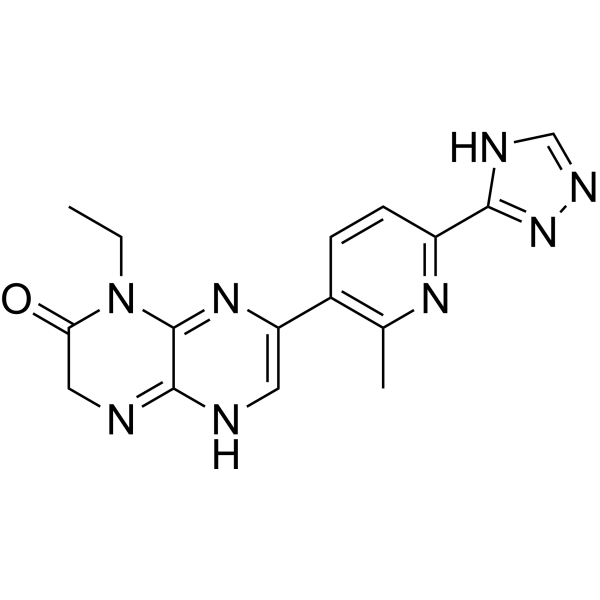
CC-115DNA-PK/mTOR Inhibitor -
HY-13631D
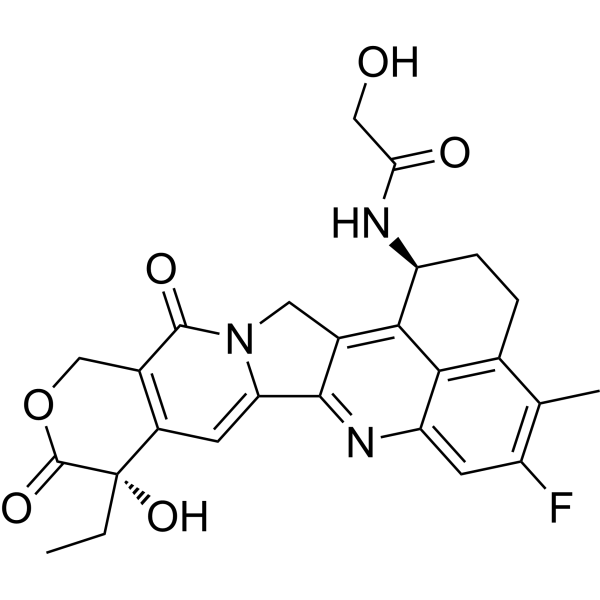
DXdTopoisomerase I Inhibitor -
HY-15521
ETP-46464mTOR/ATR Inhibitor -

HY-100705R
DMNB (Standard)No-carrier-added 6-[18F]fluoro-L-DOPA Precursor -
HY-16261
AldoxorubicinProdrug of Doxorubicin
Publications Citing Use of MedChemExpress (MCE) Daun02
More Customer Validation & Images

-
Cell Proliferation/Viability Assay
Alle Topoisomerase Isoform-spezifische Produkte anzeigen
MoreAlle ADC Payloads Isoform-spezifische Produkte anzeigen
More

Biologische Aktivität
Beschreibung
IC50 & Target
[2]|
Topoisomerase |
Daunorubicins/Doxorubicins |
In Vitro
Daun02 is a prodrug, which is converted by β-galactosidase to Daunorubicin, which has been shown to reduce calcium ion (Ca2+)-dependent action potentials in neuroblastoma cells[1]. Daunorubicin is a topoisomerase inhibitor[2]. Daun02 is a good substrate for β-galactosidase (β-gal). The concentration of Daun02 producing 50% (EC50) decrease in cell viability is 0.5 μM, 1.5 μM, and 3.5 μM for T47-D, Panc02, and MCF-7, respectively[3].
MedChemExpress (MCE) has not independently confirmed the accuracy of these methods. They are for reference only. .
In Vivo
MedChemExpress (MCE) has not independently confirmed the accuracy of these methods. They are for reference only.


Chemical Information
-
CAS. Nr. 290304-24-4
-
Appearance Solid
-
Molecular Weight 884.79
-
Formel C41H44N2O20
-
Color Brown to red
-
SMILES
O[C@H]1[C@H](O[C@H]([C@@H]([C@H]1O)O)OC2=CC=C(C=C2[N+]([O-])=O)COC(N[C@@H]3[C@@H]([C@@H](O[C@H](C3)O[C@H]4C[C@](C(C)=O)(CC5=C(C(C(C6=C7C(OC)=CC=C6)=O)=C(C(O)=C54)C7=O)O)O)C)O)=O)CO
-
Versand
Room temperature in continental US; may vary elsewhere.
-
Speicherung
Powder -20°C 3 years 4°C 2 years In solvent -80°C 6 months -20°C 1 month


Publications (4)
-
Journal Impact Factor
-
Most Recent
-
Sci Rep
Methamphetamine and Ovarian Steroid Responsive Cells in the Posteriodorsal Medial Amygdala are Required for Methamphetamine-enhanced Proceptive Behaviors. [Abstract]2017 Jan 3:7:39817. PMID: 28045134
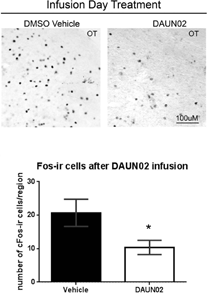
Daun02 purchased from MedChemExpress. Usage Cited in: Sci Rep. 2017 Jan 3:7:39817. [Abstract]
Photomicrographs represent cFos in the MePD after Meth and hormone administration following DAUN02 or vehicle infusions. A student’s t-test show DAUN02 significantly reduces Fos-ir cells in the MePD compared to the vehicle-treated cohort.
-
Addict Biol
Nucleus accumbens neuronal ensembles vary with cocaine reinforcement in male and female rats. [Abstract]2024 May;29(5):e13397. PMID: 38711205 -
Addict Biol
Fos-expressing neuronal ensembles in rat infralimbic cortex encode initial and maintained oxycodone seeking in rats. [Abstract]2022 Mar;27(2):e13148. PMID: 35229934 -
eNeuro
Food-Seeking Behavior Is Mediated by Fos-Expressing Neuronal Ensembles Formed at First Learning in Rats. [Abstract]2021 Apr 23;8(2):ENEURO.0373-20.2021. PMID: 33472867


Lösungsmittel & Löslichkeit
In Vitro:
DMSO : ≥ 100 mg/mL (113.02 mM; Hygroscopic DMSO has a significant impact on the solubility of product, please use newly opened DMSO)
* "≥" means soluble, but saturation unknown.
Please refer to the solubility information to select the appropriate solvent. Once prepared, please aliquot and store the solution to prevent product inactivation from repeated freeze-thaw cycles.
Storage method and period of stock solution: -80°C, 6 months; -20°C, 1 month. When stored at -80°C, please use it within 6 months. When stored at -20°C, please use it within 1 month.
Please refer to the solubility information to select the appropriate solvent. Once prepared, please aliquot and store the solution to prevent product inactivation from repeated freeze-thaw cycles.
Storage method and period of stock solution: -80°C, 6 months; -20°C, 1 month. When stored at -80°C, please use it within 6 months. When stored at -20°C, please use it within 1 month.
Konzentration (Stammlösung) × Volumen (Stammlösung) = Konzentration (Ziellösung) × Volumen (Ziellösung)
In Vivo:
Select the appropriate dissolution method based on your experimental animal and administration route.
- For the following dissolution methods, please ensure to first prepare a clear stock solution using an In Vitro approach and then sequentially add co-solvents:
- To ensure reliable experimental results, the clarified stock solution can be appropriately stored based on storage conditions. As for the working solution for In Vivo experiments, it is recommended to prepare freshly and use it on the same day.
- The percentages shown for the solvents indicate their volumetric ratio in the final prepared solution. If precipitation or phase separation occurs during preparation, heat and/or sonication can be used to aid dissolution.
Add each solvent one by one: 10% DMSO 40% PEG300 5% Tween-80 45% Saline
Solubility: ≥ 2.5 mg/mL (2.83 mM); Clear solution
This protocol yields a clear solution of ≥ 2.5 mg/mL (saturation unknown).
Taking 1 mL working solution as an example, add 100 μL DMSO stock solution (25.0 mg/mL) to 400 μL PEG300, and mix evenly; then add 50 μL Tween-80 and mix evenly; then add 450 μL Saline to adjust the volume to 1 mL.
Preparation of Saline: Dissolve 0.9 g sodium chloride in ddH₂O and dilute to 100 mL to obtain a clear Saline solution.
In Vivo Dissolution Calculator
Please enter the basic information of animal experiments:
-
-
-
-
Recommended: Prepare an additional quantity of animals to account for potential losses during experiments.
Please enter your animal formula composition:
-
%DMSO +
Recommended: Keep the proportion of DMSO in working solution below 2% if your animal is weak.
-
%+
-
+%Tween-80 + +
-
%Saline +
The co-solvents required include: DMSO, . All of co-solvents are available by MedChemExpress (MCE). , Tween 80. All of co-solvents are available by MedChemExpress (MCE).
Working solution concentration: 0.22 mg/mL
Method for preparing stock solution: mg drug dissolved in μL DMSO. Stock solution concentration: mg/mL.
1. Take μL DMSO stock solution;
2. Add μL .
μL , mix evenly;
3. Then add μL Tween 80, mix evenly;
4. Then add μL
Please ensure that the stock solution in the first step is dissolved to a clear state, and add co-solvents in sequence. You can use ultrasonic heating (ultrasonic cleaner, recommended frequency 20-40 kHz), vortexing, etc. to assist dissolution.


Reinheit & Dokumentation
-
Data Sheet (279 KB)
-
SDS (251 KB)
- English - EN (251 KB)
- Français - FR (251 KB)
- Deutsch - DE (251 KB)
- Norwegian - NO (251 KB)
- Español - ES (251 KB)
- Swedish - SV (251 KB)
- Italian - IT (251 KB)
- Korean - KR (251 KB)
- Portuguese - PT (251 KB)
-
Handling Instructions (2659 KB)
Verweise
[1]. Koya E, et al. Targeted disruption of cocaine-activated nucleus accumbens neurons prevents context-specific sensitization. Nat Neurosci. 2009 Aug;12(8):1069-73. [Content Brief]
[2]. Lehmann M, et al. Activity of topoisomerase inhibitors daunorubicin, idarubicin, and aclarubicin in the Drosophila Somatic Mutation and Recombination Test. Environ Mol Mutagen. 2004;43(4):250-7. [Content Brief]
[3]. Farquhar D, et al. Suicide gene therapy using E. coli beta-galactosidase.Cancer Chemother Pharmacol. Cancer Chemother Pharmacol. 2002 Jul;50(1):65-70. [Content Brief]


Complete Stock Solution Preparation Table
Please refer to the solubility information to select the appropriate solvent. Once prepared, please aliquot and store the solution to prevent product inactivation from repeated freeze-thaw cycles.
Storage method and period of stock solution: -80°C, 6 months; -20°C, 1 month. When stored at -80°C, please use it within 6 months. When stored at -20°C, please use it within 1 month.
| Optional Solvent | Concentration Solvent Mass | 1 mg | 5 mg | 10 mg | 25 mg |
|---|---|---|---|---|---|
| DMSO | 1 mM | 1.1302 mL | 5.6511 mL | 11.3021 mL | 28.2553 mL |
| 5 mM | 0.2260 mL | 1.1302 mL | 2.2604 mL | 5.6511 mL | |
| 10 mM | 0.1130 mL | 0.5651 mL | 1.1302 mL | 2.8255 mL | |
| 15 mM | 0.0753 mL | 0.3767 mL | 0.7535 mL | 1.8837 mL | |
| 20 mM | 0.0565 mL | 0.2826 mL | 0.5651 mL | 1.4128 mL | |
| 25 mM | 0.0452 mL | 0.2260 mL | 0.4521 mL | 1.1302 mL | |
| 30 mM | 0.0377 mL | 0.1884 mL | 0.3767 mL | 0.9418 mL | |
| 40 mM | 0.0283 mL | 0.1413 mL | 0.2826 mL | 0.7064 mL | |
| 50 mM | 0.0226 mL | 0.1130 mL | 0.2260 mL | 0.5651 mL | |
| 60 mM | 0.0188 mL | 0.0942 mL | 0.1884 mL | 0.4709 mL | |
| 80 mM | 0.0141 mL | 0.0706 mL | 0.1413 mL | 0.3532 mL | |
| 100 mM | 0.0113 mL | 0.0565 mL | 0.1130 mL | 0.2826 mL |


Daun02 Related Classifications
HY-13061 Related Classifications
 Powered by Bioz