



Procyclidine
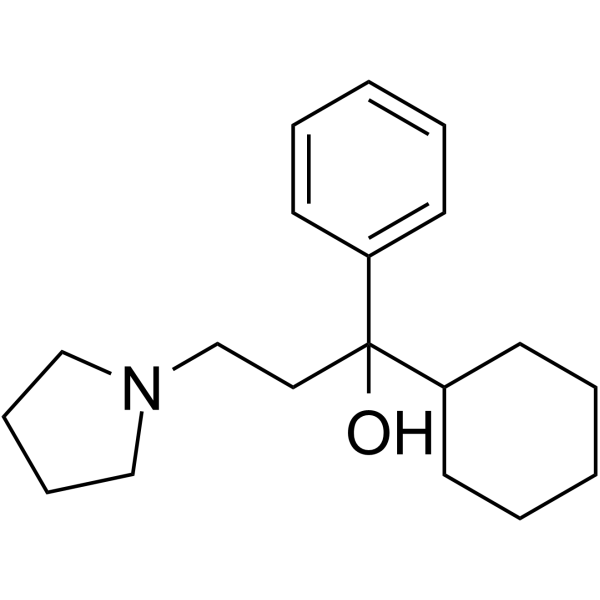
Procyclidine (Tricyclamol; (±)-Procyclidine), an anticholinergic agent, is a muscarinic receptor antagonist that also has the properties of an N-methyl-D-aspartate (NMDA) antagonist. Procyclidine can be used in studies of Parkinson's disease and related psychiatric disorders such as Soman-induced epilepsy.
Nur für Forschungszwecke. Wir verkaufen nicht an Patienten.
- CAS. Nr.: 77-37-2
- Formel: C19H29NO
- Molecular Weight:287.44
-
Speicherung:
Please store the product under the recommended conditions in the Certificate of Analysis.

To place orders, for customer services and technical support, please contact: MedChemExpress USA
Tel: 609-228-6898 E-mail: [email protected] [email protected]


-
 Biologische Aktivität
-
Chemical Information
- Protokoll
- Reinheit & Dokumentation
- Verweise
-
 Help & FAQs


Alle iGluR Isoform-spezifische Produkte anzeigen
More

Biologische Aktivität
Beschreibung
IC50 & Target
|
NMDA Receptor |
In Vivo
MedChemExpress (MCE) has not independently confirmed the accuracy of these methods. They are for reference only.
-
Animal Model:Male Sprague-Dawley rats, Dunkin-Hartley male guinea pigs[1]
-
Dosage:0.3-6.0 mg/kg
-
Administration:Subcutaneous injection; once
-
Result:Increased protection, resulting in 1.92, 2.24, 3.95 and 5.07 fold in rats, 3.00, 3.25, 4.50 and 4.70 fold in guinea pigs at the doses of 0.3, 1.0, 3.0 or 6.0 mg/kg, respectively.
Protected the neurological integrity of the brain and prevented Soman-induced severe brain damage in the hippocampus, cortex, amygdala and thalamus.


Chemical Information
-
CAS. Nr. 77-37-2
-
Molecular Weight 287.44
-
Formel C19H29NO
-
SMILES
OC(C1=CC=CC=C1)(C2CCCCC2)CCN3CCCC3
-
Synonyms
Tricyclamol; (±)-Procyclidine
-
Versand
Room temperature in continental US; may vary elsewhere.
-
Speicherung
Please store the product under the recommended conditions in the Certificate of Analysis.


Reinheit & Dokumentation
Verweise
[1]. Yun-Bae Kim, et al. Effects of combinational prophylactics composed of physostigmine and procyclidine on soman-induced lethality, seizures and brain injuries. Environ Toxicol Pharmacol. 2002 Jan;11(1):15-21. [Content Brief]
[2]. Ulrich Ettinger, et al. Effects of procyclidine on eye movements in schizophrenia. Neuropsychopharmacology. 2003 Dec;28(12):2199-208. [Content Brief]

Calculators
Konzentration (Stammlösung) × Volumen (Stammlösung) = Konzentration (Ziellösung) × Volumen (Ziellösung)


Procyclidine Related Classifications
HY-B1487A Related Classifications
 Powered by Bioz