



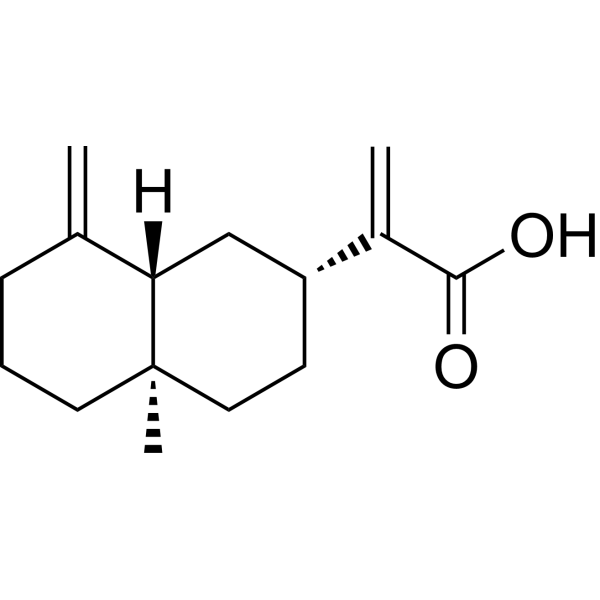
Costic acid
Costic acid (β-Costic acid) is a natural product, that can be isolated from Dittrichia viscosa. Costic acid exhibits potent in vivo acaricidal activity against the parasite. Costic acid is not toxic for human umbilical vein endothelial cells (HUVEC) at concentrations of up to 230 μM. Costic acid can be used for the research of varroosis in honey bee colonies.
For research use only. We do not sell to patients.
- CAS No.: 3650-43-9
- Formula: C15H22O2
- Molecular Weight:234.33
-
Storage:
Please store the product under the recommended conditions in the Certificate of Analysis.

To place orders, for customer services and technical support, please contact: MedChemExpress USA
Tel: 609-228-6898 E-mail: [email protected] [email protected]


-
 Biological Activity
-
Chemical Information
- Protocols
- Purity & Documentation
- References
-
 Help & FAQs


All Parasite Isoforms
More

Biological Activity
Description


Chemical Information
-
CAS No. 3650-43-9
-
Molecular Weight 234.33
-
Formula C15H22O2
-
SMILES
C[C@]12[C@@](C(CCC2)=C)([H])C[C@H](C(C(O)=O)=C)CC1
-
Synonyms
β-Costic acid
-
Structure Classification
-
Shipping
Room temperature in continental US; may vary elsewhere.
-
Storage
Please store the product under the recommended conditions in the Certificate of Analysis.


Purity & Documentation
-
Data Sheet (265 KB)
-
SDS (252 KB)
- Français - FR (252 KB)
- Deutsch - DE (252 KB)
- Norwegian - NO (252 KB)
- Español - ES (252 KB)
- Swedish - SV (252 KB)
- Italian - IT (252 KB)
- Korean - KR (252 KB)
- Portuguese - PT (252 KB)
-
Handling Instructions (2659 KB)
References

Calculators
Concentration (start) × Volume (start) = Concentration (final) × Volume (final)


Costic acid Related Classifications
HY-N2927 Related Classifications
 Powered by Bioz