



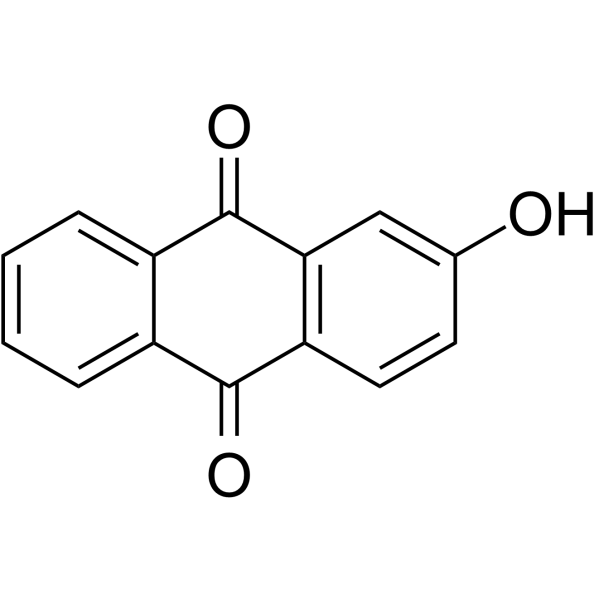
2-Hydroxyanthraquinone

Based on 1 Customer Validation
2-Hydroxyanthraquinone is a product generated by the photochemical oxidation of Anthracene (ANT) (HY-Y0299). 2-Hydroxyanthraquinone induces ferroptosis in cardiomyocytes by depleting GSH and inhibiting GPX4, leading to cardiac developmental malformations. 2-Hydroxyanthraquinone causes damage to the cerebrovascular system and blood-brain barrier in zebrafish by downregulating the Wnt/β-catenin signaling pathway, as well as inducing inflammation and neuronal apoptosis. 2-Hydroxyanthraquinone can be used in studies related to cerebrovascular diseases and cardiotoxicity.
Nos produits utilisent uniquement pour la recherche. Nous ne vendons pas aux patients.
- Pureté: 98.0%
- CAS No.: 605-32-3
- Formule: C14H8O3
- Masse moléculaire:224.22
-
Stockage:
4°C, stored under nitrogen
* In solvent : -80°C, 6 months; -20°C, 1 month (stored under nitrogen)

To place orders, for customer services and technical support, please contact: MedChemExpress USA
Tel: 609-228-6898 E-mail: [email protected] [email protected]


-
 Activité biologique
-
Chemical Information
-
Solvant et solubilité
- Pureté et documentation
- Références
-
 Help & FAQs
-

Apoptosis Compound Library
HY-L003
-
Immunology/Inflammation Compound Library
HY-L007
-
Metabolism/Protease Compound Library
HY-L012
-
Stem Cell Signaling Compound Library
HY-L017
-
Wnt/Hedgehog/Notch Compound Library
HY-L020
-
Natural Product Library
HY-L021
-
Anti-Aging Compound Library
HY-L034
-
Antioxidant Compound Library
HY-L037
-
Differentiation Inducing Compound Library
HY-L038
-
Oxygen Sensing Compound Library
HY-L045
-
Anti-Cardiovascular Disease Compound Library
HY-L046
-
Ferroptosis Compound Library
HY-L051
-
Phenols Library
HY-L057
-
Cytoskeleton Compound Library
HY-L060
-
Traditional Chinese Medicine Active Compound Library
HY-L065
-
Neuroprotective Compound Library
HY-L070
-
Anti-Breast Cancer Compound Library
HY-L074
-
Anti-Cancer Metabolism Compound Library
HY-L083
-
Transcription Factor-Targeted Library
HY-L090
-
Anti-Liver Cancer Compound Library
HY-L101
-
Anti-Colorectal Cancer Compound Library
HY-L103
-
Anti-inflammatory Traditional Chinese Medicine Active Compound Library
HY-L114
-
Plant-Sourced Natural Product Library
HY-L115
-
Anti-Prostate Cancer Compound Library
HY-L124
-
Anti-Pulmonary Fibrosis Compound Library
HY-L125
-
Cuproptosis Compound Library
HY-L133
-
Cancer Stem Cells Compound Library
HY-L135
-
Antihypertensive Compound Library
HY-L145
-
Metabolic Enzyme Compound Library
HY-L146
-
Cell Death Library
HY-L162
-
Extracellular Vesicles (EVs) Compound Library
HY-L168
-
Anti-Ovarian Cancer Compound Library
HY-L173
-
Multi-Target Compound Library
HY-L176
-
Radioprotector Library
HY-L178
-
Bioactive Compound Library Max
HY-L181
-
Natural Product Library Plus
HY-L021P
-
Natural Product and Natural Product-Like Compound Library
HY-L021M
-
Bioactive Compound Library
HY-L001
-
Anti-Gastric Cancer Compound Library
HY-L184
-
Anti-Fibrosis Compound Library
HY-L185
-
Non-Alcoholic Fatty Liver Disease (NAFLD) Compound Library
HY-L199
-
RO5 Drug-like Natural Product Library
HY-L200
-
Cell Proliferation Compound Library
HY-L201
-
High-Throughput Bioactive Compound Library
HY-L205
-
High-Throughput Natural Product Library
HY-L206
-
Ancient Chinese Classical Formulas Traditional Chinese Medicine Active Compound Library
HY-L209
-
Anti-Rheumatic Arthritis Compound Library
HY-L210
-
Diarrhea-Related Traditional Chinese Medicine Active Compound Library
HY-L224
-
Mongolian Medicine Compound Library
HY-L238
-
Quinones Library
HY-L243
-
Tonifying Traditional Chinese Medicine Monomer Compound Library
HY-L246




Activité biologique
|
Cell Line

|
Type | Value | Description | References |
|---|---|---|---|---|
| DU-145 | IC50 |
72 μM
Compound: 5
|
Cytotoxicity against Homo sapiens (human) DU145 cells assessed as inhibition of cell survival after 96 hr by MTT assay
Cytotoxicity against Homo sapiens (human) DU145 cells assessed as inhibition of cell survival after 96 hr by MTT assay
|
10.1007/s00044-012-0197-5 |
| MCF7 | IC50 |
69 μM
Compound: 5
|
Cytotoxicity against Homo sapiens (human) MCF7 cells assessed as inhibition of cell survival after 96 hr by MTT assay
Cytotoxicity against Homo sapiens (human) MCF7 cells assessed as inhibition of cell survival after 96 hr by MTT assay
|
10.1007/s00044-012-0197-5 |
| NCI-H460 | IC50 |
66 μM
Compound: 5
|
Cytotoxicity against Homo sapiens (human) H460 cells assessed as inhibition of cell survival after 96 hr by MTT assay
Cytotoxicity against Homo sapiens (human) H460 cells assessed as inhibition of cell survival after 96 hr by MTT assay
|
10.1007/s00044-012-0197-5 |
2-Hydroxyanthraquinone binds stably to zebrafish GPX4 protein with a binding energy of −8.3 kcal/mol, mediated by amino acid residues Pro-140, Lys-143, and Arg-168[2].
MedChemExpress (MCE) has not independently confirmed the accuracy of these methods. They are for reference only.
2-Hydroxyanthraquinone (0.4-1.2 mg/L; waterborne exposure; 6-96 h) induces concentration-dependent cardiac developmental toxicity in zebrafish embryos via ferroptosis, including reduced cardiomyocyte proliferation, oxidative stress, lipid metabolism disorder, iron accumulation, and cardiac structural/functional defects[2].
2-Hydroxyanthraquinone (300-400 µg/L; waterborne exposure; 28 days) induces cardiac injury in adult zebrafish, including ventricular atrophy, cardiomyocyte degeneration, fibrosis, and vacuolization[2].
MedChemExpress (MCE) has not independently confirmed the accuracy of these methods. They are for reference only.
-
Animal Model:wild-type (AB); transgenic lines Tg (kdrl:mCherry), Tg (mpeg1:GFP), Tg (fli:GFP), Tg (lyz:DsRed), Tg (elavl3:GFP) (embryos at 6 hours post-fertilization)[1]
-
Dosage:0.7 mg/L; 1.3 mg/L; 1.9 mg/L
-
Administration:waterborne; daily renewal; 6 hpf to 24 hpf or 60 hpf
-
Result:Reduced cerebrovascular area by ~40% relative to controls in medium (1.3 mg/L) and high (1.9 mg/L) dose groups at 24 hpf.
Reduced cerebrovascular area by 50% relative to controls in high dose group at 60 hpf; diminished head size by ~25% in high dose group at 60 hpf; shortened distance between intersegmental vessels at 60 hpf.
Downregulated genes involved in vascular/lymphatic development (itgb4, kdr, kdrl, vegfc, vegfa, flt4) at 60 hpf.
Increased brain microglia by ~40% relative to controls in high dose group.
Increased ROS content by over fourfold relative to controls in high dose group.
Upregulated pro-inflammatory cytokines (il1β, tnf-α, nf-κb, il6, nos2, rela) and downregulated anti-inflammatory il10.
Increased TUNEL-positive brain cells by ~twofold relative to controls in high dose group; upregulated p53 gene expression.
Increased BBB permeability in medium and high dose groups; altered expression of genes related to BBB development (spock1, abcc1, abcg2, abcb4, abcb5).
Reduced β-catenin protein expression to ~one-third of control levels; downregulated pathway target genes (lef1, β-catenin) and upregulated inhibitory genes (dkk1, wif1).
Reduced total movement distance, average swimming speed, movement time, and continuous movement duration by ~75% relative to controls in all dose groups; decreased activity frequency and cumulative activity duration, and increased immobility duration in a concentration-dependent manner.
-
Animal Model:wild-type (AB); transgenic Tg (myl7:GFP) (embryos, 6 hours post-fertilization)[3]
-
Dosage:0.4 mg/L; 0.8 mg/L; 1.2 mg/L
-
Administration:waterborne; continuous; 6 hpf to 96 hpf
-
Result:Caused concentration-dependent increases in zebrafish embryo mortality at 96 hpf.
Reduced body length to ~3500 μm (0.4 mg/L), ~3200 μm (0.8 mg/L), ~2500 μm (1.2 mg/L) vs control ~4000 μm at 96 hpf.
Increased yolk sac area at 96 hpf.
Enlarged pericardial area to ~25000 μm2 (0.4 mg/L), ~45000 μm2 (0.8 mg/L), ~65000 μm2 (1.2 mg/L) vs control ~15000 μm2 at 96 hpf.
Decreased heart rate over 20 seconds to ~45 beats (0.4 mg/L), ~35 beats (0.8 mg/L), ~30 beats (1.2 mg/L) vs control ~50 beats at 96 hpf.
Increased sinus venosus-bulbus arteriosus (SV-BA) distance to ~170 μm (0.4 mg/L), ~220 μm (0.8 mg/L), ~250 μm (1.2 mg/L) vs control ~120 μm in transgenic Tg (myl7:GFP) embryos at 96 hpf.
Reduced cardiomyocyte numbers and caused failed cardiac cyclization revealed by H&E staining.
Downregulated expression of cardiac developmental genes myl7, tbx2b, hand2, and upregulated gata4 and nppa.
Reduced cardiomyocyte proliferation by ~50% at 0.8 and 1.2 mg/L, with downregulated expression of proliferation-related genes cdk2, ccne1, and ccnd1.
Significantly elevated ROS levels in the heart, with downregulated expression of antioxidant genes nrf2, cat, sod, and gclm; decreased CAT and GSH activities, and increased SOD and MDA activities.
Increased cardiac lipid content revealed by Oil Red O staining, elevated total cholesterol (TC) at 1.2 mg/L, and dysregulated expression of lipid metabolism genes (scd, fasn, elovl4, elovl5 upregulated; cd36 downregulated).
Increased iron accumulation revealed by FerroOrange staining and tissue iron measurements, with dysregulated ferroptosis-related gene expression: gpx4, slc7a11, slc3a2 downregulated; acsl4 upregulated; iron metabolism genes fht1, tfr1, fpn1, dmt1 altered.
Significantly reduced pericardial area and restored gpx4 gene expression when co-exposed with 0.6 μM Fer-1 compared to 0.8 mg/L 2-Hydroxyanthraquinone alone.
-
Animal Model:wild-type (3-month-old adult)[3]
-
Dosage:300 µg/L; 400 µg/L
-
Administration:waterborne; daily; 28 days
-
Result:Caused ventricular atrophy with ventricular area ~650000 μm2 (300 µg/L), ~550000 μm2 (400 µg/L) vs control ~700000 μm2.
Induced partial cardiomyocyte degeneration in the 300 µg/L group revealed by H&E staining.
Induced partial fibrosis and vacuole formation in the 400 µg/L group revealed by H&E staining.


Chemical Information
-
CAS No. 605-32-3
-
Appearance Solid
-
Masse moléculaire 224.22
-
Formule C14H8O3
-
Color Yellow to green yellow
-
SMILES
OC1=CC2=C(C(C3=CC=CC=C3C2=O)=O)C=C1
-
Structure Classification
-
Initial Source
-
Livraison
Room temperature in continental US; may vary elsewhere.
-
Stockage
4°C, stored under nitrogen
* In solvent : -80°C, 6 months; -20°C, 1 month (stored under nitrogen)


Solvant et solubilité
DMSO : 100 mg/mL (445.99 mM; Need ultrasonic; Hygroscopic DMSO has a significant impact on the solubility of product, please use newly opened DMSO)
Please refer to the solubility information to select the appropriate solvent. Once prepared, please aliquot and store the solution to prevent product inactivation from repeated freeze-thaw cycles.
Storage method and period of stock solution: -80°C, 6 months; -20°C, 1 month (stored under nitrogen). When stored at -80°C, please use it within 6 months. When stored at -20°C, please use it within 1 month.
Please refer to the solubility information to select the appropriate solvent. Once prepared, please aliquot and store the solution to prevent product inactivation from repeated freeze-thaw cycles.
Storage method and period of stock solution: -80°C, 6 months; -20°C, 1 month (stored under nitrogen). When stored at -80°C, please use it within 6 months. When stored at -20°C, please use it within 1 month.
Concentration (start) × Volume (start) = Concentration (final) × Volume (final)
Select the appropriate dissolution method based on your experimental animal and administration route.
- For the following dissolution methods, please ensure to first prepare a clear stock solution using an In Vitro approach and then sequentially add co-solvents:
- To ensure reliable experimental results, the clarified stock solution can be appropriately stored based on storage conditions. As for the working solution for In Vivo experiments, it is recommended to prepare freshly and use it on the same day.
- The percentages shown for the solvents indicate their volumetric ratio in the final prepared solution. If precipitation or phase separation occurs during preparation, heat and/or sonication can be used to aid dissolution.
Add each solvent one by one: 10% DMSO 40% PEG300 5% Tween-80 45% Saline
Solubility: ≥ 2.5 mg/mL (11.15 mM); Clear solution
This protocol yields a clear solution of ≥ 2.5 mg/mL (saturation unknown).
Taking 1 mL working solution as an example, add 100 μL DMSO stock solution (25.0 mg/mL) to 400 μL PEG300, and mix evenly; then add 50 μL Tween-80 and mix evenly; then add 450 μL Saline to adjust the volume to 1 mL.
Preparation of Saline: Dissolve 0.9 g sodium chloride in ddH₂O and dilute to 100 mL to obtain a clear Saline solution.
Add each solvent one by one: 10% DMSO 90% (20% SBE-β-CD in Saline)
Solubility: 2.5 mg/mL (11.15 mM); Suspended solution; Need ultrasonic
This protocol yields a suspended solution of 2.5 mg/mL. Suspended solution can be used for oral and intraperitoneal injection.
Taking 1 mL working solution as an example, add 100 μL DMSO stock solution (25.0 mg/mL) to 900 μL 20% SBE-β-CD in Saline, and mix evenly.
Preparation of 20% SBE-β-CD in Saline (4°C, storage for one week): 2 g SBE-β-CD powder is dissolved in 10 mL Saline, completely dissolve until clear.
Please enter the basic information of animal experiments:
-
-
-
-
Recommended: Prepare an additional quantity of animals to account for potential losses during experiments.
Please enter your animal formula composition:
-
%DMSO +
Recommended: Keep the proportion of DMSO in working solution below 2% if your animal is weak.
-
%+
-
+%Tween-80 + +
-
%Saline +
The co-solvents required include: DMSO, . All of co-solvents are available by MedChemExpress (MCE). , Tween 80. All of co-solvents are available by MedChemExpress (MCE).
Working solution concentration: 0.22 mg/mL
Method for preparing stock solution: mg drug dissolved in μL DMSO. Stock solution concentration: mg/mL. * In solvent : -80°C, 6 months; -20°C, 1 month (stored under nitrogen)
1. Take μL DMSO stock solution;
2. Add μL .
μL , mix evenly;
3. Then add μL Tween 80, mix evenly;
4. Then add μL
Please ensure that the stock solution in the first step is dissolved to a clear state, and add co-solvents in sequence. You can use ultrasonic heating (ultrasonic cleaner, recommended frequency 20-40 kHz), vortexing, etc. to assist dissolution.


Pureté et documentation
-
Fiche technique (282 KB)
-
SDS (759 KB)
- English - EN (759 KB)
- Français - FR (759 KB)
- Deutsch - DE (759 KB)
- Norwegian - NO (759 KB)
- Español - ES (759 KB)
- Swedish - SV (759 KB)
- Italian - IT (759 KB)
- Korean - KR (759 KB)
- Portuguese - PT (759 KB)
-
Instruction de manipulation (2659 KB)
Références
[1].
Li H, et al. 2-Hydroxyanthraquinone exposure causes the damage of cerebrovascular and blood brain barrier in zebrafish via inducing inflammation and downregulation of the Wnt/β-catenin signaling pathway. Comp Biochem Physiol C Toxicol Pharmacol. 2026 Mar;301:110432.
[Content Brief]
[2].
Wang Z, et al. 2-Hydroxyanthraquinone induces cardiotoxicity in zebrafish via ferroptosis. Aquat Toxicol. 2025 Sep;286:107485.
[Content Brief]


Complete Stock Solution Preparation Table
Please refer to the solubility information to select the appropriate solvent. Once prepared, please aliquot and store the solution to prevent product inactivation from repeated freeze-thaw cycles.
Storage method and period of stock solution: -80°C, 6 months; -20°C, 1 month (stored under nitrogen). When stored at -80°C, please use it within 6 months. When stored at -20°C, please use it within 1 month.
| Optional Solvent | Concentration Solvent Mass | 1 mg | 5 mg | 10 mg | 25 mg |
|---|---|---|---|---|---|
| DMSO | 1 mM | 4.4599 mL | 22.2995 mL | 44.5991 mL | 111.4976 mL |
| 5 mM | 0.8920 mL | 4.4599 mL | 8.9198 mL | 22.2995 mL | |
| 10 mM | 0.4460 mL | 2.2300 mL | 4.4599 mL | 11.1498 mL | |
| 15 mM | 0.2973 mL | 1.4866 mL | 2.9733 mL | 7.4332 mL | |
| 20 mM | 0.2230 mL | 1.1150 mL | 2.2300 mL | 5.5749 mL | |
| 25 mM | 0.1784 mL | 0.8920 mL | 1.7840 mL | 4.4599 mL | |
| 30 mM | 0.1487 mL | 0.7433 mL | 1.4866 mL | 3.7166 mL | |
| 40 mM | 0.1115 mL | 0.5575 mL | 1.1150 mL | 2.7874 mL | |
| 50 mM | 0.0892 mL | 0.4460 mL | 0.8920 mL | 2.2300 mL | |
| 60 mM | 0.0743 mL | 0.3717 mL | 0.7433 mL | 1.8583 mL | |
| 80 mM | 0.0557 mL | 0.2787 mL | 0.5575 mL | 1.3937 mL | |
| 100 mM | 0.0446 mL | 0.2230 mL | 0.4460 mL | 1.1150 mL |


2-Hydroxyanthraquinone Related Classifications
HY-W012352 Related Classifications
 Powered by Bioz
- 2-Hydroxyanthraquinone
- 605-32-3
- Glutathione Peroxidase
- Ferroptosis
- Wnt
- β-catenin
- Apoptosis
- zebrafish embryos
- blood-brain barrier
- MCF-7 human breast cancer cells
- microglia
- DLD-1 human colon cancer cells
- Wnt/β-catenin signaling pathway
- cerebrovascular diseases
- adult zebrafish
- Survivin
- ferroptosis
- Inhibitor
- inhibitor
- inhibit