



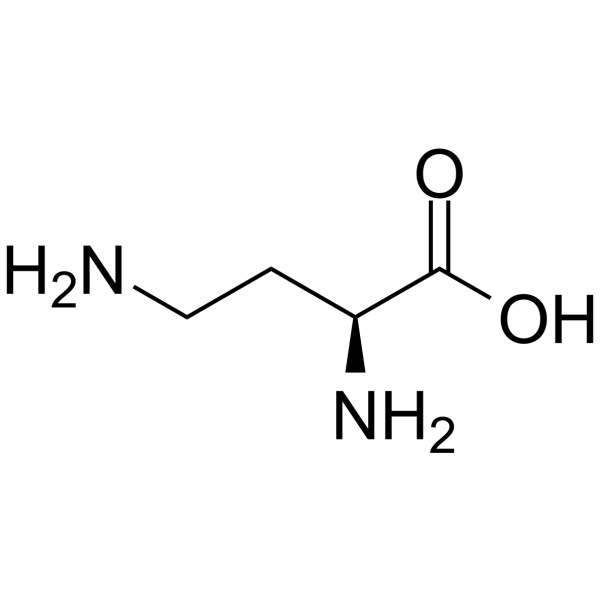
L-DABA
Based on 2 publication(s) in Google Scholar
L-DABA (L-2,4-Diaminobutyric acid) is a week GABA transaminase inhibitor with an IC50 of larger than 500 μM; exhibits antitumor activity in vivo and in vitro.
Nos produits utilisent uniquement pour la recherche. Nous ne vendons pas aux patients.
- Pureté : 99.93%
- CAS No.: 1758-80-1
- Formule: C4H10N2O2
- Masse moléculaire:118.13
-
Stockage:Powder -20°C, 3 years , 4°C, 2 years ; In solvent -80°C, 2 years , -20°C, 1 year

To place orders, for customer services and technical support, please contact: MedChemExpress USA
Tel: 609-228-6898 E-mail: [email protected] [email protected]


-
 Activité biologique
-
Chemical Information
-
Solvant et solubilité
- Protocole
- Pureté et documentation
- Références
-
 Help & FAQs


-
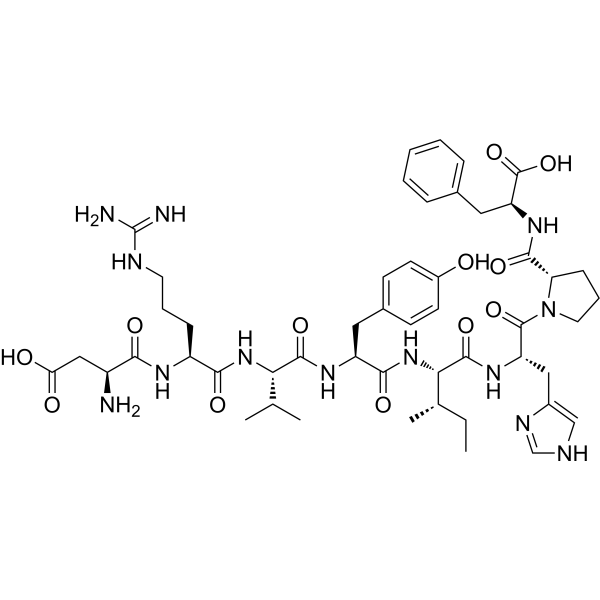
HY-13948
Angiotensin II humanVasoconstrictor -

HY-101414R
L-DABA (Standard)GABA Transaminase Inhibitor -
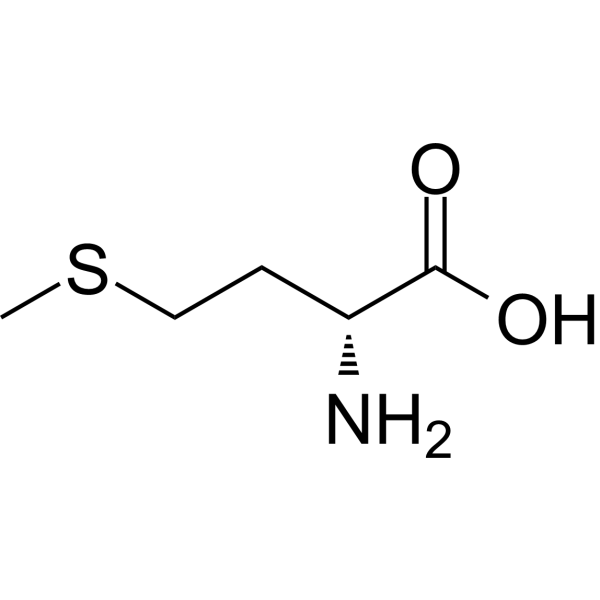
HY-13694
MethionineEndogenous Metabolite -
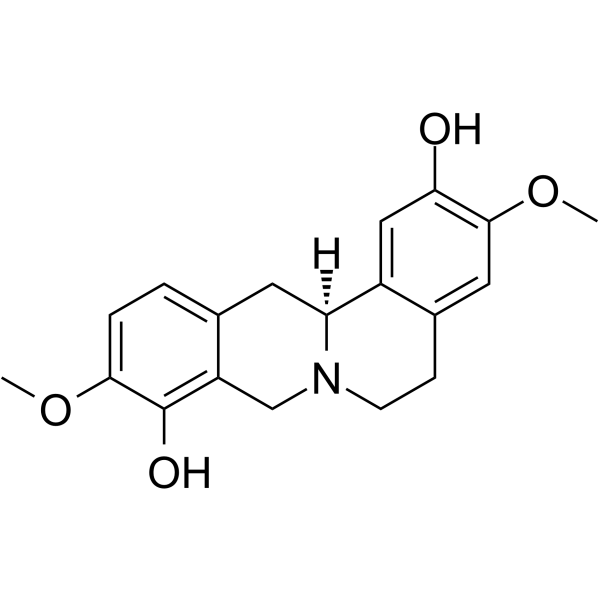
HY-N1255
ScoulerineAntimitotic Agent -
HY-100686
U93631GABA(A) Inhibitor -

HY-13694R
Methionine (Standard)Endogenous Metabolite -

HY-100686R
U93631 (Standard)GABAA Ligand
Publications Citing Use of MedChemExpress (MCE) L-DABA
MoreVoir tous les produits spécifiques à Isoform Endogenous Metabolite
More

Activité biologique
Description
IC50 & Target
|
Human Endogenous Metabolite |
In Vitro
The tumor cells are irreversibly and totally damaged by incubation with 10 mM L-2,4-Diaminobutyric acid for 24 h at 37°C. The cell-destructive effect by L-DABA is probably due to an osmotic lysis induced by the non-saturated intracellular accumulation of L-DABA. The harmful effect of L-DABA could be abolished by concomitant incubation with L-alanine and L-methionine[1]. Kinetic studies indicates that L-DABA is a non-linear, non-competitive inhibitor of GABA transaminase activity. The L-DABA-induced elevation of GABA levels parallels the inhibition of GABA transaminase activity[2]. L-2,4-Diaminobutyric acid, an amino acid analogue, produceS a cytolytic effect with a human glioma cell line, SKMG-1, and normal human fibroblasts. The concentrations of L-DABA necessary to reduce the cell count to 50% of control following a 24-h incubation at 37°C are 12.5 mM for the human fibroblasts and 20 mM for the glioma cell line[3].
MedChemExpress (MCE) has not independently confirmed the accuracy of these methods. They are for reference only.
In Vivo


Chemical Information
-
CAS No. 1758-80-1
-
Appearance Solid
-
Masse moléculaire 118.13
-
Formule C4H10N2O2
-
Color White to off-white
-
SMILES
O=C(O)[C@@H](N)CCN
-
Synonyms
L-2,4-Diaminobutyric acid
-
Structure Classification
-
Initial Source
-
Livraison
Room temperature in continental US; may vary elsewhere.
-
Stockage
Powder -20°C 3 years 4°C 2 years In solvent -80°C 2 years -20°C 1 year


Publications (2)
-
Journal Impact Factor
-
Most Recent
-
Nature
2025 Jul;643(8070):192-200. PMID: 39695227 -
Ann Bot
Integrated LC/MS-MS approaches reveal toxicity differences across seed layers of Cycas angulata. [Abstract]2026 Jun 17:mcag169. PMID: 42308138


Solvant et solubilité
In Vitro:
H2O : 50 mg/mL (423.26 mM; Need ultrasonic)
Please refer to the solubility information to select the appropriate solvent. Once prepared, please aliquot and store the solution to prevent product inactivation from repeated freeze-thaw cycles.
Storage method and period of stock solution: -80°C, 2 years; -20°C, 1 year. When stored at -80°C, please use it within 2 years. When stored at -20°C, please use it within 1 year.
* Note: If you choose water as the stock solution, please dilute it to the working solution, then filter and sterilize it with a 0.22 μm filter before use.
Please refer to the solubility information to select the appropriate solvent. Once prepared, please aliquot and store the solution to prevent product inactivation from repeated freeze-thaw cycles.
Storage method and period of stock solution: -80°C, 2 years; -20°C, 1 year. When stored at -80°C, please use it within 2 years. When stored at -20°C, please use it within 1 year.
* Note: If you choose water as the stock solution, please dilute it to the working solution, then filter and sterilize it with a 0.22 μm filter before use.
Concentration (start) × Volume (start) = Concentration (final) × Volume (final)
In Vivo:
For the following dissolution methods, please prepare the working solution directly:
It is recommended to prepare fresh solutions and use them promptly within a short period of time.
The percentages shown for the solvents indicate their volumetric ratio in the final prepared solution. If precipitation or phase separation occurs during preparation, heat and/or sonication can be used to aid dissolution.
Add each solvent one by one: PBS
Solubility: 100 mg/mL (846.53 mM); Clear solution; Need ultrasonic


Pureté et documentation
-
Fiche technique (273 KB)
-
SDS (394 KB)
- English - EN (394 KB)
- Français - FR (394 KB)
- Deutsch - DE (394 KB)
- Norwegian - NO (394 KB)
- Español - ES (394 KB)
- Swedish - SV (394 KB)
- Italian - IT (394 KB)
- Korean - KR (394 KB)
- Portuguese - PT (394 KB)
-
Instruction de manipulation (2659 KB)
Références
[1]. Ronquist G, et al. Antitumor activity of L-2,4 diaminobuturic acid against mouse fibrosarcoma cells in vitro and in vivo. J Cancer Res Clin Oncol. 1980;96(3):259-68. [Content Brief]
[2]. Beart PM, et al. l-2,4-Diaminobutyric acid and the GABA system. Neurosci Lett. 1977 Jul;5(3-4):193-8. [Content Brief]
[3]. Panasci L, et al. The cytolytic effect of L-2,4 diaminobutyric acid with malignant glioma cells and fibroblasts. Cancer Chemother Pharmacol. 1988;21(2):143-4. [Content Brief]


Complete Stock Solution Preparation Table
Please refer to the solubility information to select the appropriate solvent. Once prepared, please aliquot and store the solution to prevent product inactivation from repeated freeze-thaw cycles.
Storage method and period of stock solution: -80°C, 2 years; -20°C, 1 year. When stored at -80°C, please use it within 2 years. When stored at -20°C, please use it within 1 year.
| Optional Solvent | Concentration Solvent Mass | 1 mg | 5 mg | 10 mg | 25 mg |
|---|---|---|---|---|---|
| H2O | 1 mM | 8.4653 mL | 42.3263 mL | 84.6525 mL | 211.6313 mL |
| 5 mM | 1.6931 mL | 8.4653 mL | 16.9305 mL | 42.3263 mL | |
| 10 mM | 0.8465 mL | 4.2326 mL | 8.4653 mL | 21.1631 mL | |
| 15 mM | 0.5644 mL | 2.8218 mL | 5.6435 mL | 14.1088 mL | |
| 20 mM | 0.4233 mL | 2.1163 mL | 4.2326 mL | 10.5816 mL | |
| 25 mM | 0.3386 mL | 1.6931 mL | 3.3861 mL | 8.4653 mL | |
| 30 mM | 0.2822 mL | 1.4109 mL | 2.8218 mL | 7.0544 mL | |
| 40 mM | 0.2116 mL | 1.0582 mL | 2.1163 mL | 5.2908 mL | |
| 50 mM | 0.1693 mL | 0.8465 mL | 1.6931 mL | 4.2326 mL | |
| 60 mM | 0.1411 mL | 0.7054 mL | 1.4109 mL | 3.5272 mL | |
| 80 mM | 0.1058 mL | 0.5291 mL | 1.0582 mL | 2.6454 mL | |
| 100 mM | 0.0847 mL | 0.4233 mL | 0.8465 mL | 2.1163 mL |
* Note: If you choose water as the stock solution, please dilute it to the working solution, then filter and sterilize it with a 0.22 μm filter before use.


L-DABA Related Classifications
HY-101414 Related Classifications
 Powered by Bioz