



NSC 80467

Based on 1 Customer Validation
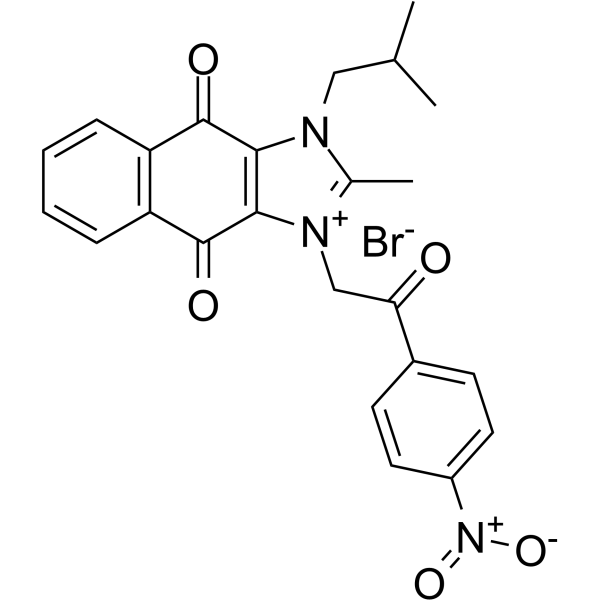
NSC 80467, a DNA damaging agent, selectively inhibits survivin. NSC 80467 preferentially inhibits DNA synthesis and results in induction of γH2AX and pKAP1, two markers of DNA damage.
Nos produits utilisent uniquement pour la recherche. Nous ne vendons pas aux patients.
- Pureté : 98.39%
- CAS No.: 101982-51-8
- Formule: C24H22BrN3O5
- Masse moléculaire:512.35
-
Stockage:Powder -20°C, 3 years , 4°C, 2 years
* The compound is unstable in solutions, freshly prepared is recommended.

To place orders, for customer services and technical support, please contact: MedChemExpress USA
Tel: 609-228-6898 E-mail: [email protected] [email protected]


-
 Activité biologique
-
Chemical Information
-
Solvant et solubilité
- Protocole
- Pureté et documentation
- Références
-
 Help & FAQs


Voir tous les produits spécifiques à Isoform DNA/RNA Synthesis
More

Activité biologique
Description
In Vitro
NSC 80467 has a similar spectrum of activity against the NCI-60 cell line panel, suppresses survivin expression, shows COMPARE correlation with DNA damaging agents, preferentially inhibits DNA synthesis, and induces a DNA damage response characterized by enhanced γH2AX and pKAP1 at concentrations lower than those capable of inhibiting survivin expression[1].
NSC 80467 (200 or 800 nM; 24 hours) inhibits surviving[1].
MedChemExpress (MCE) has not independently confirmed the accuracy of these methods. They are for reference only. Further protocols information, click here.
-
Cell Line:PC3 cells
-
Concentration:200 or 800 nM
-
Incubation Time:24 hours
-
Result:Associated with inhibition of survivin expression.


Chemical Information
-
CAS No. 101982-51-8
-
Appearance Solid
-
Masse moléculaire 512.35
-
Formule C24H22BrN3O5
-
Color Gray to brown
-
SMILES
O=C(C1=C2[N+](CC(C3=CC=C([N+]([O-])=O)C=C3)=O)=C(C)N1CC(C)C)C4=C(C=CC=C4)C2=O.[Br-]
-
Livraison
Room temperature in continental US; may vary elsewhere.
-
Stockage
Powder -20°C 3 years 4°C 2 years * The compound is unstable in solutions, freshly prepared is recommended.


Solvant et solubilité
In Vitro:
DMSO : 25 mg/mL (48.79 mM; ultrasonic and warming and heat to 60°C; Hygroscopic DMSO has a significant impact on the solubility of product, please use newly opened DMSO)
Please refer to the solubility information to select the appropriate solvent. The compound is unstable in solutions, freshly prepared is recommended.
Please refer to the solubility information to select the appropriate solvent. The compound is unstable in solutions, freshly prepared is recommended.
Concentration (start) × Volume (start) = Concentration (final) × Volume (final)

Protocole
-
EdU Incorporation Assay (Click Chemistry-Based DNA Synthesis Measurement)
The EdU incorporation assay measures DNA synthesis by adding the thymidine analog 5-ethynyl-2′-deoxyuridine to cells or tissues, where it is incorporated into newly synthesized DNA during S phase. Incorporated EdU is detected by copper-catalyzed azide-alkyne cycloaddition, in which a fluorescent azide covalently reacts with the ethynyl group on EdU, allowing S-phase cells to be detected by fluorescence microscopy, flow cytometry, or high-content imaging. EdU detection does not require DNA denaturation or anti-BrdU antibody access, which preserves sample structure and improves compatibility with immunostaining and multiparameter cytometry compared with BrdU-based detection. EdU can be cytotoxic in a cell-type- and exposure-dependent manner, so pulse duration, concentration, and continuous-labeling designs should be validated for each cell type.
-
BrdU Incorporation Assay
Bromodeoxyuridine (BrdU) incorporation assay is based on the principle that BrdU, a thymidine analog, is incorporated into newly synthesized DNA during the S phase of the cell cycle, thereby serving as a marker of DNA replication and cellular proliferation. Incorporated BrdU can be detected using anti-BrdU antibodies following DNA denaturation, enabling visualization or quantification of proliferating cells through immunochemical detection methods such as immunofluorescence or immunohistochemistry.
-
Genotoxicity/Mutagenicity Study
The bacterial reverse mutation assay detects point mutations that restore amino-acid prototrophy in auxotrophic Salmonella typhimurium or Escherichia coli tester strains; after exposure to a test article, mutagenic activity is read out as an increased number of revertant colonies on minimal agar compared with the vehicle control. The assay uses tester strains with different mutation targets so that base-substitution and frameshift mutagens can be detected, and testing is performed with and without exogenous mammalian metabolic activation because some chemicals require biotransformation to become mutagenic.


Pureté et documentation
-
Fiche technique (277 KB)
-
SDS (252 KB)
- English - EN (252 KB)
- Français - FR (252 KB)
- Deutsch - DE (252 KB)
- Norwegian - NO (252 KB)
- Español - ES (252 KB)
- Swedish - SV (252 KB)
- Italian - IT (252 KB)
- Korean - KR (252 KB)
- Portuguese - PT (252 KB)
-
Instruction de manipulation (2659 KB)
Références


Complete Stock Solution Preparation Table
Please refer to the solubility information to select the appropriate solvent. The compound is unstable in solutions, freshly prepared is recommended.
| Optional Solvent | Concentration Solvent Mass | 1 mg | 5 mg | 10 mg | 25 mg |
|---|---|---|---|---|---|
| DMSO | 1 mM | 1.9518 mL | 9.7590 mL | 19.5179 mL | 48.7948 mL |
| 5 mM | 0.3904 mL | 1.9518 mL | 3.9036 mL | 9.7590 mL | |
| 10 mM | 0.1952 mL | 0.9759 mL | 1.9518 mL | 4.8795 mL | |
| 15 mM | 0.1301 mL | 0.6506 mL | 1.3012 mL | 3.2530 mL | |
| 20 mM | 0.0976 mL | 0.4879 mL | 0.9759 mL | 2.4397 mL | |
| 25 mM | 0.0781 mL | 0.3904 mL | 0.7807 mL | 1.9518 mL | |
| 30 mM | 0.0651 mL | 0.3253 mL | 0.6506 mL | 1.6265 mL | |
| 40 mM | 0.0488 mL | 0.2440 mL | 0.4879 mL | 1.2199 mL |


NSC 80467 Related Classifications
HY-137843 Related Classifications
 Powered by Bioz