



Piperilate
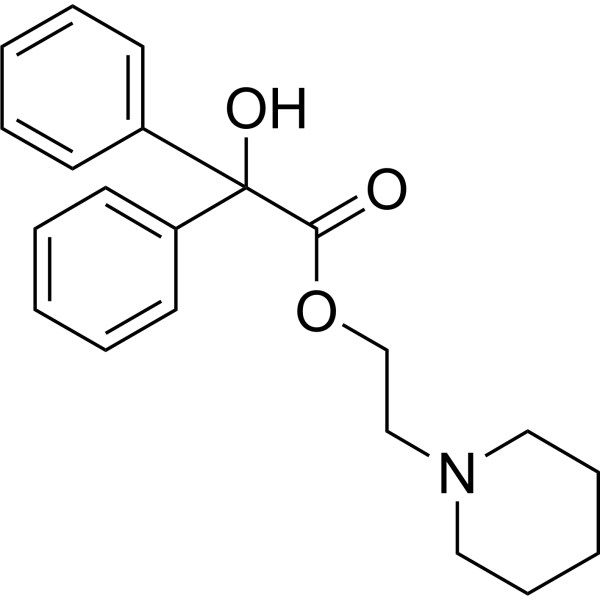
Piperilate (Pipethanate) is one of the mixtures of hetrazepine derivative PAF antagonists with anticholinergics, can be used for bronchial asthma research. Piperilate also causes hypotension and rescues mice poisoned by the organophosphates.
Nos produits utilisent uniquement pour la recherche. Nous ne vendons pas aux patients.
- CAS No.: 4546-39-8
- Formule: C21H25NO3
- Masse moléculaire:339.43
-
Stockage:
Please store the product under the recommended conditions in the Certificate of Analysis.

To place orders, for customer services and technical support, please contact: MedChemExpress USA
Tel: 609-228-6898 E-mail: [email protected] [email protected]


-
 Activité biologique
-
Chemical Information
- Pureté et documentation
- Références
-
 Help & FAQs




Activité biologique
Description
In Vivo
Piperilate (1 mg/kg; i.v.) causes hypotension in rabbit which is not blocked by dichloroisoproterenol or Atropine (HY-B1205)[2].
Piperilate (3 mg/kg; i.v.) decreases respiration and heart rate of test rabbits, blocks the Adrenaline (HY-122304)-induced constriction of an isolated rabbit auricle preparation[2].
MedChemExpress (MCE) has not independently confirmed the accuracy of these methods. They are for reference only.
-
Animal Model:Male albino mice (18-22 g)[1]
-
Dosage:11.3 mg/kg, 29.42 mg/kg
-
Administration:Intraperitoneal injection; single dose
-
Result:Showed anticholinergic activity with EC50 values of 11.33 mg/kg (antagonism of oxotremorine induced salivation) and 29.42 mg/kg (antagonism of oxotremorine induced tremor) in mice.


Chemical Information
-
CAS No. 4546-39-8
-
Masse moléculaire 339.43
-
Formule C21H25NO3
-
SMILES
O=C(OCCN1CCCCC1)C(C2=CC=CC=C2)(C3=CC=CC=C3)O
-
Synonyms
Pipethanate
-
Livraison
Room temperature in continental US; may vary elsewhere.
-
Stockage
Please store the product under the recommended conditions in the Certificate of Analysis.


Pureté et documentation
Références
[1]. Faff J, et al. Therapeutic effects of some cholinolytics in organophosphate intoxications. Arch Toxicol. 1976 Oct 28;36(2):139-46. [Content Brief]
[2]. Tanaka S, et al. [Studies on pharmacological effect of pipethanate. II. Effect of pipethanate on respiration, circulation system and smooth muscle]. Eisei Shikenjo Hokoku. 1971;89:54-8. Japanese. [Content Brief]

Calculators
Concentration (start) × Volume (start) = Concentration (final) × Volume (final)


Piperilate Related Classifications
HY-105790 Related Classifications
 Powered by Bioz