



Sciadopitysin
Based on 4 publication(s) in Google Scholar
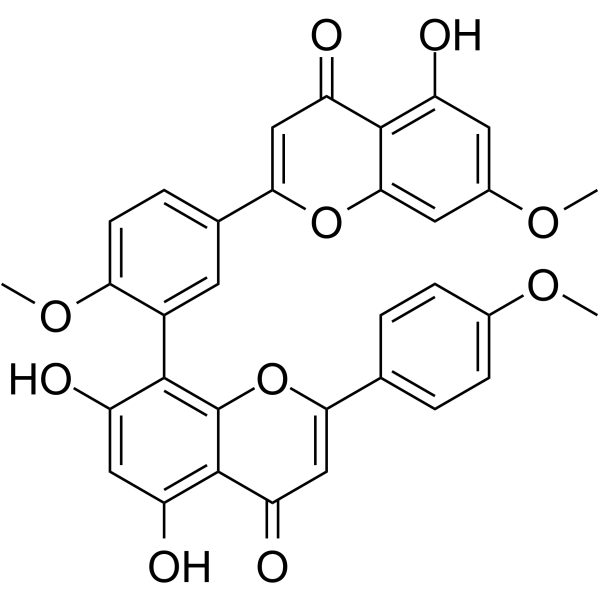
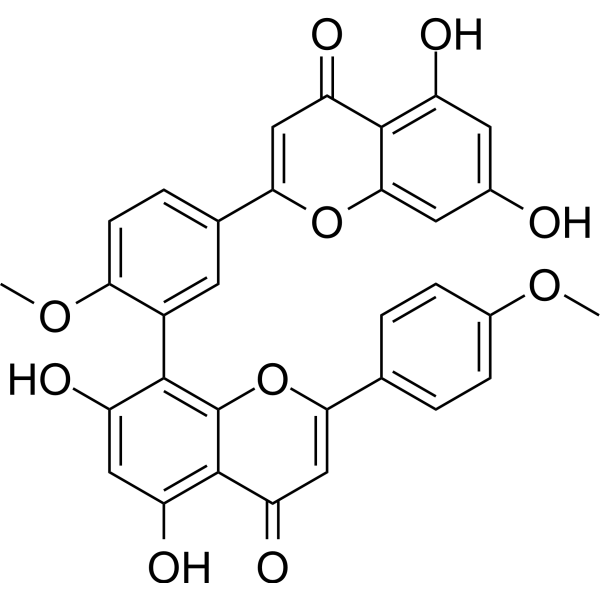
Sciadopitysin is a type of biflavonoids in leaves from ginkgo biloba. Sciadopitysi inhibits RANKL-induced osteoclastogenesis and bone loss by inhibiting NF-κB activation and reducing the expression of c-Fos and NFATc1.
Nos produits utilisent uniquement pour la recherche. Nous ne vendons pas aux patients.
- Pureté : 99.0%
- CAS No.: 521-34-6
- Formule: C33H24O10
- Masse moléculaire:580.54
-
Stockage:
4°C, protect from light
* In solvent : -80°C, 6 months; -20°C, 1 month (protect from light)

To place orders, for customer services and technical support, please contact: MedChemExpress USA
Tel: 609-228-6898 E-mail: [email protected] [email protected]


-
 Activité biologique
-
Chemical Information
-
Solvant et solubilité
- Protocole
- Pureté et documentation
- Références
-
 Help & FAQs


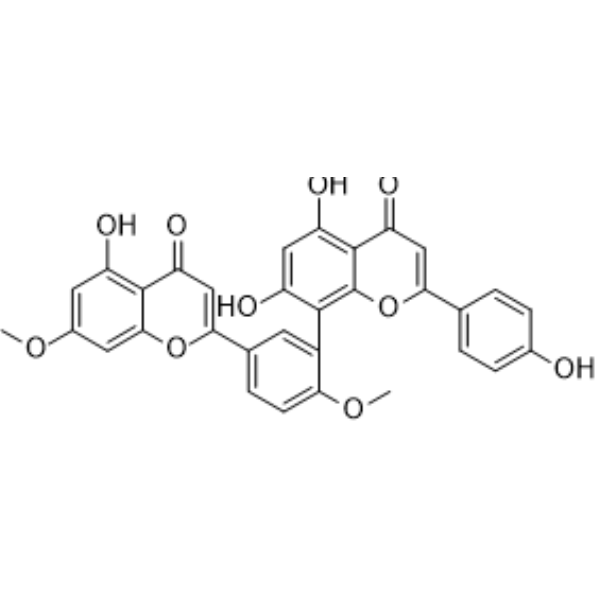
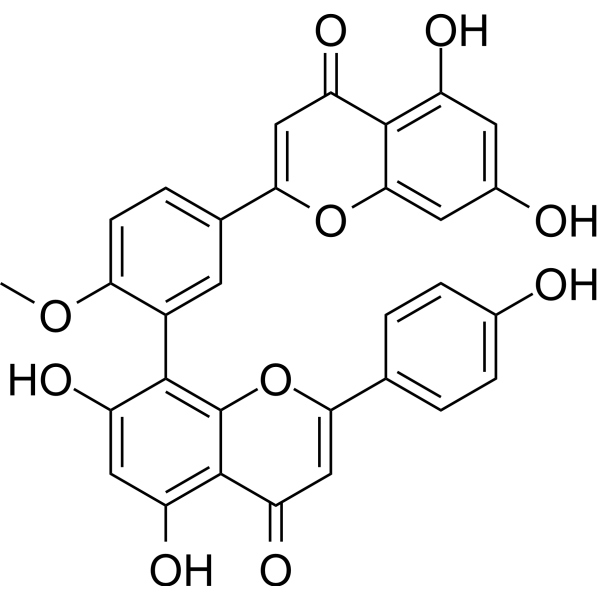
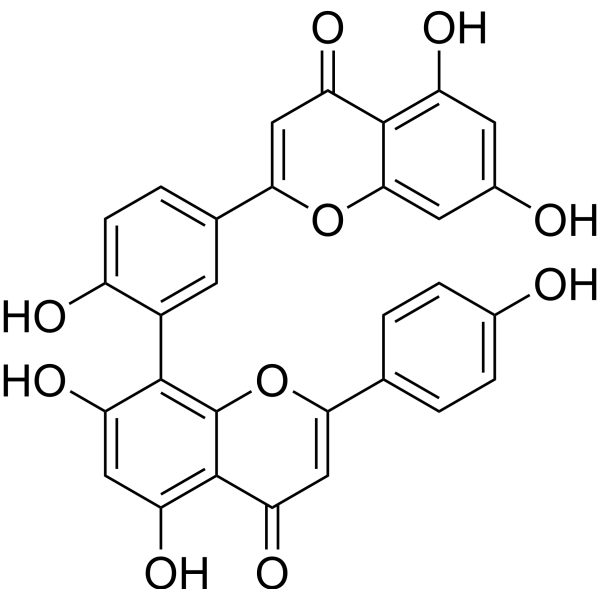
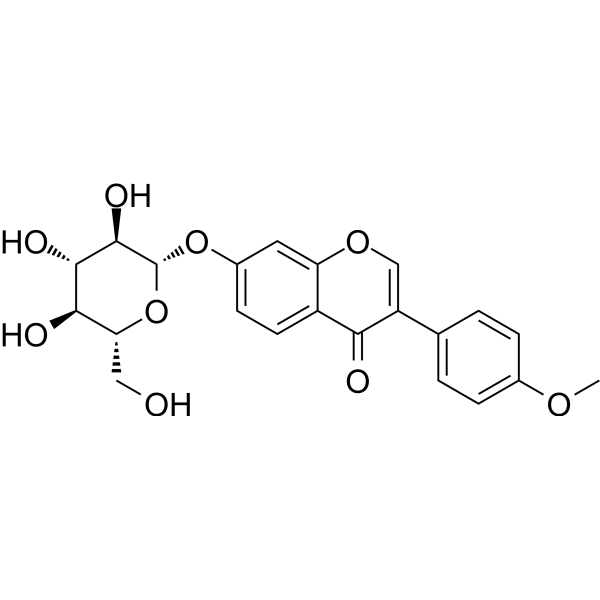
Publications Citing Use of MedChemExpress (MCE) Sciadopitysin
MoreVoir tous les produits spécifiques à Isoform TNF Receptor
More

Activité biologique
Description
IC50 & Target
[2]|
NF-κB |
Cellular Effect
|
Cell Line

|
Type | Value | Description | References |
|---|---|---|---|---|
| PC-12 | EC50 |
9.84 μM
Compound: 13
|
Neuroprotective activity against 0.1 uM amyloid beta 42-induced toxicity in rat PC12 cells assessed as cell viability after 24 hrs by MTT assay
Neuroprotective activity against 0.1 uM amyloid beta 42-induced toxicity in rat PC12 cells assessed as cell viability after 24 hrs by MTT assay
|
[PMID: 26004578] |
In Vitro
Sciadopitysin (2.5, 5, 10 μM ) strongly reduces RANKL-induced osteoclast-specific genes expression, including cathepsin K (CTSK), tartrate-resistant acid phosphatase (TRAP) and MMP-9. Furthermore, Sciadopitysin apparently attenuates RANKL-increased expressions of c-Fos and NFATc1[2].
MedChemExpress (MCE) has not independently confirmed the accuracy of these methods. They are for reference only.
In Vivo
MedChemExpress (MCE) has not independently confirmed the accuracy of these methods. They are for reference only.


Chemical Information
-
CAS No. 521-34-6
-
Appearance Solid
-
Masse moléculaire 580.54
-
Formule C33H24O10
-
Color Light yellow to yellow
-
SMILES
O=C1C=C(C2=CC=C(OC)C=C2)OC3=C(C4=CC(C5=CC(C6=C(O)C=C(OC)C=C6O5)=O)=CC=C4OC)C(O)=CC(O)=C13
-
Structure Classification
-
Initial Source
-
Livraison
Room temperature in continental US; may vary elsewhere.
-
Stockage
4°C, protect from light
* In solvent : -80°C, 6 months; -20°C, 1 month (protect from light)


Publications (4)
-
Journal Impact Factor
-
Most Recent
-
Food Chem
Effects of sun drying combined with baking processes on the flavor quality of Chongqing Tuocha raw tea. [Abstract]2025 Dec 30:497:146992. PMID: 41285060 -
Food Chem
Flavonoid-mediated metabolic underpinning quality variation in red bud-sport pear mutants. [Abstract]2025 Oct 15:489:144992. PMID: 40466530 -
J Sep Sci
Oriented Immobilization Coupled With Ligand Fishing Strategy for Rapid Discovery of Direct HMGB1 Inhibitors in Taxus wallichiana var. mairei. [Abstract]2026 Apr;49(4):e70402. PMID: 41906428 -
Arch Pharm (Weinheim)
Discovery of potent CSK inhibitors through integrated virtual screening and molecular dynamic simulation. [Abstract]2024 Sep;357(9):e2400066. PMID: 38809025


Solvant et solubilité
In Vitro:
DMSO : 20 mg/mL (34.45 mM; Need ultrasonic; Hygroscopic DMSO has a significant impact on the solubility of product, please use newly opened DMSO)
Please refer to the solubility information to select the appropriate solvent. Once prepared, please aliquot and store the solution to prevent product inactivation from repeated freeze-thaw cycles.
Storage method and period of stock solution: -80°C, 6 months; -20°C, 1 month (protect from light). When stored at -80°C, please use it within 6 months. When stored at -20°C, please use it within 1 month.
Please refer to the solubility information to select the appropriate solvent. Once prepared, please aliquot and store the solution to prevent product inactivation from repeated freeze-thaw cycles.
Storage method and period of stock solution: -80°C, 6 months; -20°C, 1 month (protect from light). When stored at -80°C, please use it within 6 months. When stored at -20°C, please use it within 1 month.
Concentration (start) × Volume (start) = Concentration (final) × Volume (final)
In Vivo:
Select the appropriate dissolution method based on your experimental animal and administration route.
- For the following dissolution methods, please ensure to first prepare a clear stock solution using an In Vitro approach and then sequentially add co-solvents:
- To ensure reliable experimental results, the clarified stock solution can be appropriately stored based on storage conditions. As for the working solution for In Vivo experiments, it is recommended to prepare freshly and use it on the same day.
- The percentages shown for the solvents indicate their volumetric ratio in the final prepared solution. If precipitation or phase separation occurs during preparation, heat and/or sonication can be used to aid dissolution.
Add each solvent one by one: 10% DMSO 40% PEG300 5% Tween-80 45% Saline
Solubility: 2 mg/mL (3.45 mM); Suspended solution; Need ultrasonic
This protocol yields a suspended solution of 2 mg/mL. Suspended solution can be used for oral and intraperitoneal injection.
Taking 1 mL working solution as an example, add 100 μL DMSO stock solution (20.0 mg/mL) to 400 μL PEG300, and mix evenly; then add 50 μL Tween-80 and mix evenly; then add 450 μL Saline to adjust the volume to 1 mL.
Preparation of Saline: Dissolve 0.9 g sodium chloride in ddH₂O and dilute to 100 mL to obtain a clear Saline solution.
In Vivo Dissolution Calculator
Please enter the basic information of animal experiments:
-
-
-
-
Recommended: Prepare an additional quantity of animals to account for potential losses during experiments.
Please enter your animal formula composition:
-
%DMSO +
Recommended: Keep the proportion of DMSO in working solution below 2% if your animal is weak.
-
%+
-
+%Tween-80 + +
-
%Saline +
The co-solvents required include: DMSO, . All of co-solvents are available by MedChemExpress (MCE). , Tween 80. All of co-solvents are available by MedChemExpress (MCE).
Working solution concentration: 0.22 mg/mL
Method for preparing stock solution: mg drug dissolved in μL DMSO. Stock solution concentration: mg/mL. * In solvent : -80°C, 6 months; -20°C, 1 month (protect from light)
1. Take μL DMSO stock solution;
2. Add μL .
μL , mix evenly;
3. Then add μL Tween 80, mix evenly;
4. Then add μL
Please ensure that the stock solution in the first step is dissolved to a clear state, and add co-solvents in sequence. You can use ultrasonic heating (ultrasonic cleaner, recommended frequency 20-40 kHz), vortexing, etc. to assist dissolution.


Pureté et documentation
-
Fiche technique (282 KB)
-
SDS (252 KB)
- English - EN (252 KB)
- Français - FR (252 KB)
- Deutsch - DE (252 KB)
- Norwegian - NO (252 KB)
- Español - ES (252 KB)
- Swedish - SV (252 KB)
- Italian - IT (252 KB)
- Korean - KR (252 KB)
- Portuguese - PT (252 KB)
-
Instruction de manipulation (2659 KB)
Références
[1]. Briançon-Scheid F, et al. HPLC Separation and Quantitative Determination of Biflavones in Leaves from Ginkgo biloba. Planta Med. 1983 Dec;49(12):204-7. [Content Brief]
[2]. Sciadopitysin suppresses RANKL-mediated osteoclastogenesis and prevents boneloss in LPS-treated mice. Int Immunopharmacol. 2017 Aug;49:109-117. [Content Brief]


Complete Stock Solution Preparation Table
Please refer to the solubility information to select the appropriate solvent. Once prepared, please aliquot and store the solution to prevent product inactivation from repeated freeze-thaw cycles.
Storage method and period of stock solution: -80°C, 6 months; -20°C, 1 month (protect from light). When stored at -80°C, please use it within 6 months. When stored at -20°C, please use it within 1 month.
| Optional Solvent | Concentration Solvent Mass | 1 mg | 5 mg | 10 mg | 25 mg |
|---|---|---|---|---|---|
| DMSO | 1 mM | 1.7225 mL | 8.6127 mL | 17.2253 mL | 43.0634 mL |
| 5 mM | 0.3445 mL | 1.7225 mL | 3.4451 mL | 8.6127 mL | |
| 10 mM | 0.1723 mL | 0.8613 mL | 1.7225 mL | 4.3063 mL | |
| 15 mM | 0.1148 mL | 0.5742 mL | 1.1484 mL | 2.8709 mL | |
| 20 mM | 0.0861 mL | 0.4306 mL | 0.8613 mL | 2.1532 mL | |
| 25 mM | 0.0689 mL | 0.3445 mL | 0.6890 mL | 1.7225 mL | |
| 30 mM | 0.0574 mL | 0.2871 mL | 0.5742 mL | 1.4354 mL |


Sciadopitysin Related Classifications
HY-N2119 Related Classifications
 Powered by Bioz