



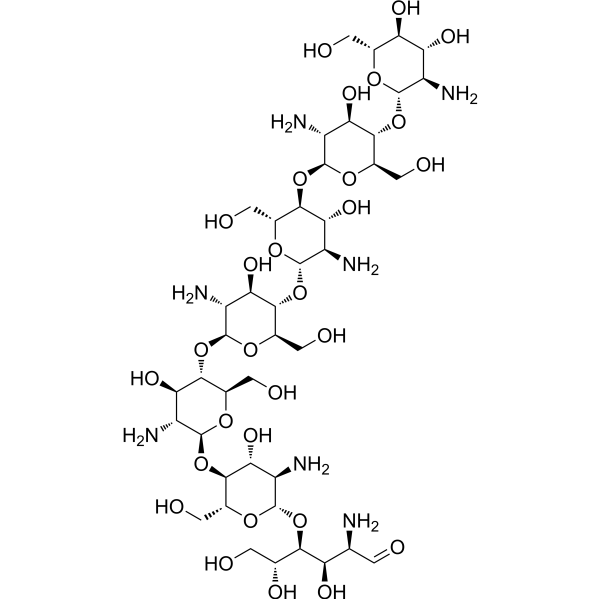
Chitoheptaose
Chitoheptaose is an orally active chitooligosaccharide (degree of polymerization = 7). Chitoheptaose can be extracted from the exoskeletons of crustaceans, such as the shells of crabs, shrimps and lobsters. Chitoheptaose reduces pro-inflammatory cytokines while increasing the levels of anti-inflammatory cytokines (decreasing the levels of pro-inflammatory cytokines IL-1β, IL-17A and IFN-γ, and increasing the level of the anti-inflammatory cytokine IL-10). Chitoheptaose possesses antioxidant, anti-inflammatory and anti-Apoptotic activities. Chitoheptaose improves cardiac parameters, alleviates myocarditis injury, and exerts cardioprotective effects in a rat model of myocarditis. Chitoheptaose can be used in studies related to myocarditis.
Nur für Forschungszwecke. Wir verkaufen nicht an Patienten.
- CAS. Nr.: 68232-35-9
- Formel: C42H79N7O29
- Molecular Weight:1146.11
-
Speicherung:
-20°C, stored under nitrogen
* In solvent : -80°C, 6 months; -20°C, 1 month (stored under nitrogen)

To place orders, for customer services and technical support, please contact: MedChemExpress USA
Tel: 609-228-6898 E-mail: [email protected] [email protected]


-
 Biologische Aktivität
-
Chemical Information
- Protokoll
- Reinheit & Dokumentation
- Verweise
-
 Help & FAQs




Biologische Aktivität
Beschreibung
IC50 & Target
[1]|
IL-1β |
IL-17A |
IL-10 |
In Vitro
Chitoheptaose (100 μM; 24 h prior to 6 h LPS stimulation at 200 ng/mL) exerts anti-inflammatory activity in LPS-stimulated RAW264.7 cells, with activity greater than chitopentaose and chitohexaose, ranking third among tested chitosan oligosaccharides with degree of polymerization >4[1].
MedChemExpress (MCE) has not independently confirmed the accuracy of these methods. They are for reference only.
-
Cell Line:RAW264.7 macrophage cells
-
Concentration:100 μM
-
Incubation Time:24 h (prior to 6 h LPS stimulation at 200 ng/mL)
-
Result:Reduced levels of proinflammatory cytokines IL-1β, IL-17A, and IFN-γ.
Increased levels of anti-inflammatory cytokine IL-10.
Showed significantly greater anti-inflammatory activity than chitopentaose and chitohexaose, but less than chitooctaose (p < 0.05).
In Vivo
MedChemExpress (MCE) has not independently confirmed the accuracy of these methods. They are for reference only.
-
Animal Model:SPF rats (8-week-old, 200-220 g, experimental autoimmune myocarditis model induced by subcutaneous injection of porcine cardiac myosin emulsified with complete Freund’s adjuvant on day 1 and day 8)[1]
-
Dosage:100 μM
-
Administration:p.o.; daily; 30 days
-
Result:Reduced left ventricular internal diameter in end diastole (LVIDd) and left ventricular internal diameter in end systole (LVIDs) significantly compared with other chitosan oligosaccharides (p < 0.05).
Increased ejection fraction (EF) and fractional shortening (FS) significantly compared with other chitosan oligosaccharides (p < 0.05).
Reduced myocardial histopathological scores and inflammatory cell infiltration more effectively than other chitosan oligosaccharides (p < 0.05).
Lowered serum levels of proinflammatory cytokines IL-1β, IL-17A, and IFN-γ, and increased anti-inflammatory cytokine IL-10 significantly compared with other chitosan oligosaccharides (p < 0.05).
Reduced cardiac tissue levels of reactive oxygen species (ROS) and reactive nitrogen species (RNS) significantly compared with other chitosan oligosaccharides (p < 0.05).
Reduced relative mRNA and protein levels of proapoptotic factors caspase 3 and BAX, and increased relative mRNA and protein levels of antiapoptotic factor BCL-2 significantly compared with other chitosan oligosaccharides (p < 0.05).
Reduced IHC scores for caspase 3 and BAX, and increased IHC scores for BCL-2 significantly compared with other chitosan oligosaccharides (p < 0.05).
Achieved a serum level of 45 μM after treatment.


Chemical Information
-
CAS. Nr. 68232-35-9
-
Appearance Solid
-
Molecular Weight 1146.11
-
Formel C42H79N7O29
-
Color White to off-white
-
SMILES
OC[C@@H](O[C@H]([C@@H]([C@H]1O)N)O[C@@H]2[C@H](O[C@H]([C@@H]([C@H]2O)N)O[C@H]([C@H](O)CO)[C@H](O)[C@@H](N)C=O)CO)[C@H]1O[C@@H]3O[C@@H]([C@H]([C@@H]([C@H]3N)O)O[C@@H]4O[C@@H]([C@H]([C@@H]([C@H]4N)O)O[C@@H]5O[C@@H]([C@H]([C@@H]([C@H]5N)O)O[C@@H]6O[C@@H]([C@H]([C@@H]([C@H]6N)O)O)CO)CO)CO)CO
-
Versand
Room temperature in continental US; may vary elsewhere.
-
Speicherung
-20°C, stored under nitrogen
* In solvent : -80°C, 6 months; -20°C, 1 month (stored under nitrogen)


Reinheit & Dokumentation
-
Data Sheet (279 KB)
-
SDS (252 KB)
- English - EN (252 KB)
- Français - FR (252 KB)
- Deutsch - DE (252 KB)
- Norwegian - NO (252 KB)
- Español - ES (252 KB)
- Swedish - SV (252 KB)
- Italian - IT (252 KB)
- Korean - KR (252 KB)
- Portuguese - PT (252 KB)
-
Handling Instructions (2659 KB)
Verweise

Calculators
Konzentration (Stammlösung) × Volumen (Stammlösung) = Konzentration (Ziellösung) × Volumen (Ziellösung)


Chitoheptaose Related Classifications
HY-W145695 Related Classifications
 Powered by Bioz
Keywords
- Chitoheptaose
- 68232-35-9
- Biochemical Assay Reagents
- Apoptosis
- Interleukin Related
- IFNAR
- antiapoptotic factor
- reactive oxygen species
- rat autoimmune myocarditis model
- chitosan oligosaccharide
- proapoptotic factor
- rat myocarditis model
- anti-inflammatory cytokine
- proinflammatory cytokine
- RAW264.7 cells
- reactive nitrogen species
- Inhibitor
- inhibitor
- inhibit