



Clobetasol 17-Propionate-d5
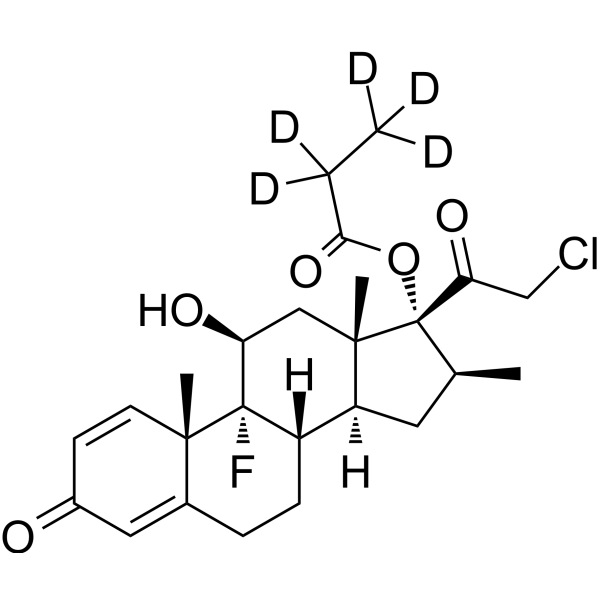
Clobetasol 17-Propionate-d5 is the deuterium labeled Clobetasol propionate (HY-13600). Clobetasol propionate is a potent and selective CYP3A5 inhibitor with an IC50 of 0.206 μM. Clobetasol propionate has no inhibiting on CYP3A4 or other major CYPs. Clobetasol propionate is a corticosteroid and has the potential for psoriasis and other dermatoses research.
For research use only. We do not sell to patients.
- CAS No.: 2280940-18-1
- Formula: C25H27D5ClFO5
- Molecular Weight:472.00
-
Storage:
Please store the product under the recommended conditions in the Certificate of Analysis.


To place orders, for customer services and technical support, please contact: MedChemExpress USA
Tel: 609-228-6898 E-mail: [email protected] [email protected]


-
 Biological Activity
-
Chemical Information
- Protocols
- Purity & Documentation
-
 Help & FAQs




Biological Activity
Description
In Vitro
Stable heavy isotopes of hydrogen, carbon, and other elements have been incorporated into drug molecules, largely as tracers for quantitation during the drug development process. Deuteration has gained attention because of its potential to affect the pharmacokinetic and metabolic profiles of drugs[1].
MedChemExpress (MCE) has not independently confirmed the accuracy of these methods. They are for reference only. Further protocols information, click here.
Application
1. This compound can be used as a tracer
2. This compound can be used as an internal standard for quantitative analysis by NMR, GC-MS, or LC-MS.


Chemical Information
-
CAS No. 2280940-18-1
-
Unlabeled CAS 25122-46-7
-
Molecular Weight 472.00
-
Formula C25H27D5ClFO5
-
SMILES
O=C1C=C[C@]2(C(CC[C@@]3([C@@]2([C@H](C[C@]4([C@]3(C[C@@H]([C@@]4(C(CCl)=O)OC(C([2H])(C([2H])([2H])[2H])[2H])=O)C)[H])C)O)F)[H])=C1)C
-
Shipping
Room temperature in continental US; may vary elsewhere.
-
Storage
Please store the product under the recommended conditions in the Certificate of Analysis.

Protocols
-
Cell Cytotoxicity Assay
Cytotoxicity assays are usually based on the assessment of cell membrane damage, which can also be indirectly detected by measuring cell viability. Detection methods include MTT assay, CKK-8 assay, LDH assay and ATP assay, etc.
-
Imiquimod-Induced Psoriasiform Dermatitis
Imiquimod (IMQ)-induced psoriasiform dermatitis is a widely used murine model in which topical application of IMQ, a Toll-like receptor 7 (TLR7) agonist, triggers innate immune activation in the skin and induces a psoriasis-like inflammatory cascade characterized by epidermal hyperplasia, immune cell infiltration, and cytokine production dominated by the IL-23/IL-17 axis. This inflammatory response is mediated through activation of dendritic cells and downstream induction of IL-23, IL-17A, IL-22, and related pro-inflammatory mediators, recapitulating key features of human plaque psoriasis and enabling mechanistic and therapeutic studies. The model is commonly induced using Aldara (5% IMQ cream) applied topically to murine skin, resulting in rapid onset of erythema, scaling, and thickening that can be quantified as disease severity indices and validated histologically.


Purity & Documentation

Calculators
Concentration (start) × Volume (start) = Concentration (final) × Volume (final)


Clobetasol 17-Propionate-d5 Related Classifications
HY-W744187 Related Classifications
 Powered by Bioz