



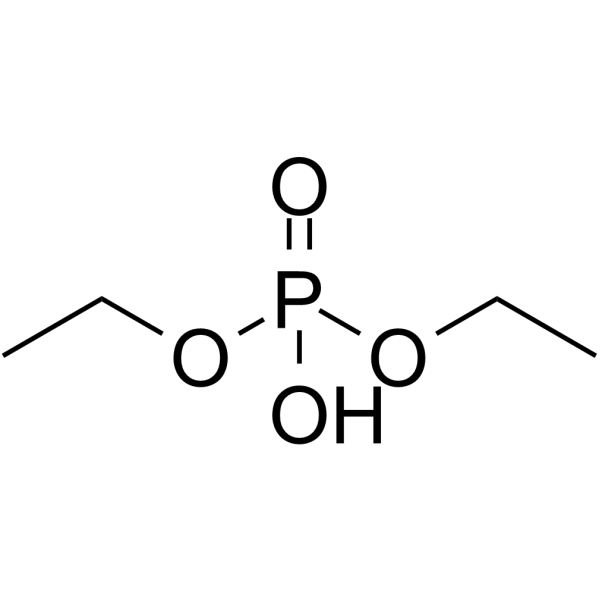
Diethyl phosphate

Based on 1 Customer Validation
Diethylphosphate (Diethyl phosphoric acid) is an orally active organophosphorus pesticides metabolite. Diethylphosphate can interfere with thyroid hormone-related mechanisms and affect intestinal microbes in rats.
For research use only. We do not sell to patients.
- Purity: 98.08%
- CAS No.: 598-02-7
- Formula: C4H11O4P
- Molecular Weight:154.10
-
Storage:Pure form -20°C, 3 years , 4°C, 2 years ; In solvent -80°C, 6 months , -20°C, 1 month

To place orders, for customer services and technical support, please contact: MedChemExpress USA
Tel: 609-228-6898 E-mail: [email protected] [email protected]


-
 Biological Activity
-
Chemical Information
-
Solvent & Solubility
- Purity & Documentation
- References
-
 Help & FAQs


-

HY-101417R
Diethyl phosphate (Standard) -
HY-108309
Medronic acid -
HY-W008151
Diphenyl Phosphate -

HY-108309R
Medronic acid (Standard) -

HY-135604
Dibutyl phosphate -

HY-107859
Tris(2-chloroethyl) phosphate -

HY-Y1322
Triphenyl phosphate -

HY-W008151R
Diphenyl Phosphate (Standard) -

HY-W016414
Triethyl phosphate -
HY-A0108A
Trimethyl phosphate -
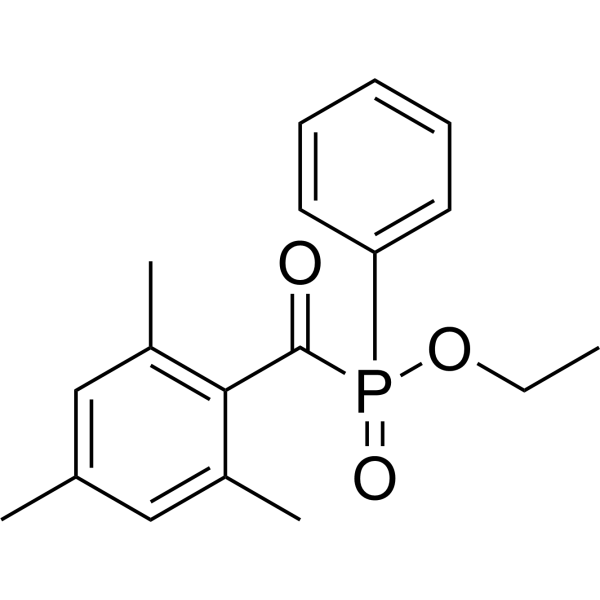
HY-W017894
TPO-L -
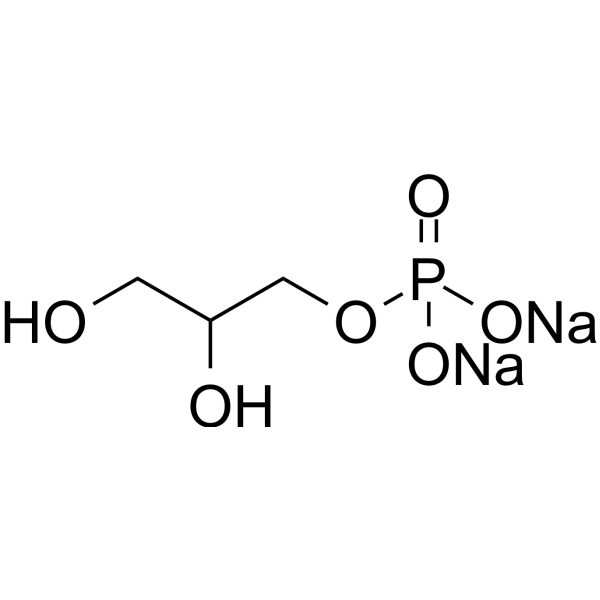
HY-108776
(Rac)-sn-Glycerol 3-phosphate sodium
All Endogenous Metabolite Isoforms
More

Biological Activity
Description
In Vitro
Diethyl phosphate can interact with thyroid hormone biosynthesis, blood transport, receptor binding and metabolism-related enzymes/proteins, interfering with the production and signal regulation of thyroid hormones in silico[1].
MedChemExpress (MCE) has not independently confirmed the accuracy of these methods. They are for reference only.
In Vivo
Diethyl phosphate (oral gavage; 0.08-0.13 mg/kg; 20 weeks) affects the intestinal microbiota, serum hormones and pro-inflammatory cytokines[2].
MedChemExpress (MCE) has not independently confirmed the accuracy of these methods. They are for reference only.
-
Animal Model:Adult male Wistar rats aged 7-8 weeks old (344.4 ± 21.0 g)[1]
-
Dosage:0.08 or 0.8 mg/kg
-
Administration:Oral gavage (i.g.); 24 weeks
-
Result:Did not affect the body weight of rats and food intake.
Significantly decreased serum levels of TC, TG and LDL-C in rats.
Resulted in a decrease in sperm concentration, while the sperm abnormality rate increased, did not affect the sperm morphology in rats.
Increased the serum levels of FSH and estradiol, while the serum levels of LH and testosterone decreased.
Could cause thyroid-related hormone disorders in the serum of rats, causing symptoms of hyperthyroidism in rats, and could also lead to abnormal expression of thyroid hormone-related genes in the rat liver.
-
Animal Model:Male Wistar rats aged 7 weeks old[2]
-
Dosage:0.08 or 0.13 mg/kg
-
Administration:Oral gavage (i.g.); 20 weeks
-
Result:Significantly enriched opportunistic pathogens, including Paraprevotella, Parabacteroides, Alloprevotella, and Helicobacter, leading to a decrease in IL-6.
Enriched the butyrate-producing genera, Alloprevotella and Intestinimonas, leading to an increase in estradiol and a resulting decrease in total triglycerides (TGs) and low-density lipoprotein cholesterol (LDL-C) in high dose group.
Induced increases in peptide tyrosine-tyrosine (PYY) and ghrelin.


Chemical Information
-
CAS No. 598-02-7
-
Appearance Liquid (Density: 1.29 g/cm3)
-
Molecular Weight 154.10
-
Formula C4H11O4P
-
Color Colorless to light yellow
-
SMILES
O=P(OCC)(O)OCC
-
Synonyms
Diethyl phosphoric acid
-
Structure Classification
-
Initial Source
-
Shipping
Room temperature in continental US; may vary elsewhere.
-
Storage
Pure form -20°C 3 years 4°C 2 years In solvent -80°C 6 months -20°C 1 month


Solvent & Solubility
In Vitro:
DMSO : 100 mg/mL (648.93 mM; Need ultrasonic; Hygroscopic DMSO has a significant impact on the solubility of product, please use newly opened DMSO)
Please refer to the solubility information to select the appropriate solvent. Once prepared, please aliquot and store the solution to prevent product inactivation from repeated freeze-thaw cycles.
Storage method and period of stock solution: -80°C, 6 months; -20°C, 1 month. When stored at -80°C, please use it within 6 months. When stored at -20°C, please use it within 1 month.
Please refer to the solubility information to select the appropriate solvent. Once prepared, please aliquot and store the solution to prevent product inactivation from repeated freeze-thaw cycles.
Storage method and period of stock solution: -80°C, 6 months; -20°C, 1 month. When stored at -80°C, please use it within 6 months. When stored at -20°C, please use it within 1 month.
Concentration (start) × Volume (start) = Concentration (final) × Volume (final)
In Vivo:
Select the appropriate dissolution method based on your experimental animal and administration route.
- For the following dissolution methods, please ensure to first prepare a clear stock solution using an In Vitro approach and then sequentially add co-solvents:
- To ensure reliable experimental results, the clarified stock solution can be appropriately stored based on storage conditions. As for the working solution for In Vivo experiments, it is recommended to prepare freshly and use it on the same day.
- The percentages shown for the solvents indicate their volumetric ratio in the final prepared solution. If precipitation or phase separation occurs during preparation, heat and/or sonication can be used to aid dissolution.
Add each solvent one by one: 10% DMSO 40% PEG300 5% Tween-80 45% Saline
Solubility: ≥ 2.5 mg/mL (16.22 mM); Clear solution
This protocol yields a clear solution of ≥ 2.5 mg/mL (saturation unknown).
Taking 1 mL working solution as an example, add 100 μL DMSO stock solution (25.0 mg/mL) to 400 μL PEG300, and mix evenly; then add 50 μL Tween-80 and mix evenly; then add 450 μL Saline to adjust the volume to 1 mL.
Preparation of Saline: Dissolve 0.9 g sodium chloride in ddH₂O and dilute to 100 mL to obtain a clear Saline solution.
Add each solvent one by one: 10% DMSO 90% (20% SBE-β-CD in Saline)
Solubility: ≥ 2.5 mg/mL (16.22 mM); Clear solution
This protocol yields a clear solution of ≥ 2.5 mg/mL (saturation unknown).
Taking 1 mL working solution as an example, add 100 μL DMSO stock solution (25.0 mg/mL) to 900 μL 20% SBE-β-CD in Saline, and mix evenly.
Preparation of 20% SBE-β-CD in Saline (4°C, storage for one week): 2 g SBE-β-CD powder is dissolved in 10 mL Saline, completely dissolve until clear.
In Vivo Dissolution Calculator
Please enter the basic information of animal experiments:
-
-
-
-
Recommended: Prepare an additional quantity of animals to account for potential losses during experiments.
Please enter your animal formula composition:
-
%DMSO +
Recommended: Keep the proportion of DMSO in working solution below 2% if your animal is weak.
-
%+
-
+%Tween-80 + +
-
%Saline +
The co-solvents required include: DMSO, . All of co-solvents are available by MedChemExpress (MCE). , Tween 80. All of co-solvents are available by MedChemExpress (MCE).
Working solution concentration: 0.22 mg/mL
Method for preparing stock solution: mg drug dissolved in μL DMSO. Stock solution concentration: mg/mL.
1. Take μL DMSO stock solution;
2. Add μL .
μL , mix evenly;
3. Then add μL Tween 80, mix evenly;
4. Then add μL
Please ensure that the stock solution in the first step is dissolved to a clear state, and add co-solvents in sequence. You can use ultrasonic heating (ultrasonic cleaner, recommended frequency 20-40 kHz), vortexing, etc. to assist dissolution.


Purity & Documentation
-
Data Sheet (273 KB)
-
SDS (477 KB)
- English - EN (477 KB)
- Français - FR (477 KB)
- Deutsch - DE (477 KB)
- Norwegian - NO (477 KB)
- Español - ES (477 KB)
- Swedish - SV (477 KB)
- Italian - IT (477 KB)
- Korean - KR (477 KB)
- Portuguese - PT (477 KB)
-
Handling Instructions (2659 KB)
References
[1]. Yang FW, et al. Assessment of the endocrine-disrupting effects of diethyl phosphate, a nonspecific metabolite of organophosphorus pesticides, by in vivo and in silico approaches. Environ Int. 2020 Feb;135:105383. [Content Brief]
[2]. Yang F, et al. Effects of Diethyl Phosphate, a Non-Specific Metabolite of Organophosphorus Pesticides, on Serum Lipid, Hormones, Inflammation, and Gut Microbiota. Molecules. 2019 May 24;24(10):2003. [Content Brief]


Complete Stock Solution Preparation Table
Please refer to the solubility information to select the appropriate solvent. Once prepared, please aliquot and store the solution to prevent product inactivation from repeated freeze-thaw cycles.
Storage method and period of stock solution: -80°C, 6 months; -20°C, 1 month. When stored at -80°C, please use it within 6 months. When stored at -20°C, please use it within 1 month.
| Optional Solvent | Concentration Solvent Mass | 1 mg | 5 mg | 10 mg | 25 mg |
|---|---|---|---|---|---|
| DMSO | 1 mM | 6.4893 mL | 32.4465 mL | 64.8929 mL | 162.2323 mL |
| 5 mM | 1.2979 mL | 6.4893 mL | 12.9786 mL | 32.4465 mL | |
| 10 mM | 0.6489 mL | 3.2446 mL | 6.4893 mL | 16.2232 mL | |
| 15 mM | 0.4326 mL | 2.1631 mL | 4.3262 mL | 10.8155 mL | |
| 20 mM | 0.3245 mL | 1.6223 mL | 3.2446 mL | 8.1116 mL | |
| 25 mM | 0.2596 mL | 1.2979 mL | 2.5957 mL | 6.4893 mL | |
| 30 mM | 0.2163 mL | 1.0815 mL | 2.1631 mL | 5.4077 mL | |
| 40 mM | 0.1622 mL | 0.8112 mL | 1.6223 mL | 4.0558 mL | |
| 50 mM | 0.1298 mL | 0.6489 mL | 1.2979 mL | 3.2446 mL | |
| 60 mM | 0.1082 mL | 0.5408 mL | 1.0815 mL | 2.7039 mL | |
| 80 mM | 0.0811 mL | 0.4056 mL | 0.8112 mL | 2.0279 mL | |
| 100 mM | 0.0649 mL | 0.3245 mL | 0.6489 mL | 1.6223 mL |


Diethyl phosphate Related Classifications
HY-101417 Related Classifications
 Powered by Bioz