



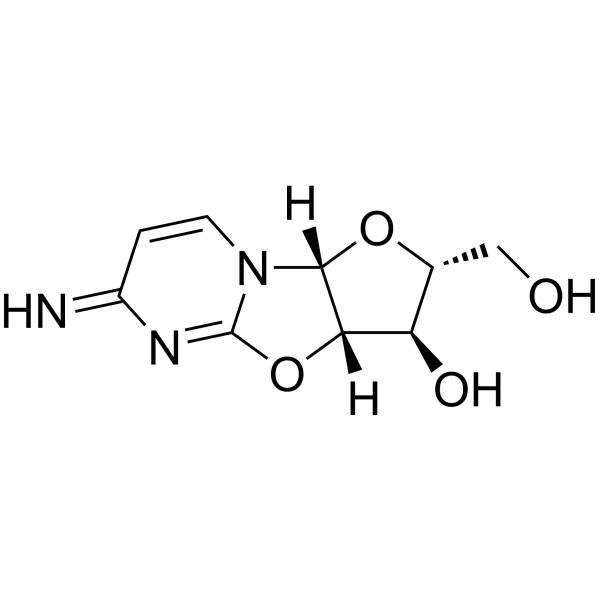
Ancitabine
Based on 1 publication(s) in Google Scholar
Ancitabine (Cyclocytidine) is a cytarabine derivative that inhibits viral replication. Ancitabine blocks vaccinia virus DNA replication, the progression of viral protein synthesis from early to late stages, and one-step growth of vaccinia virus. Ancitabine is applicable to research related to vaccinia virus infection, leukemia, human cytomegalovirus infection and colorectal cancer.
For research use only. We do not sell to patients.
- CAS No.: 31698-14-3
- Formula: C9H11N3O4
- Molecular Weight:225.20
-
Storage:
Please store the product under the recommended conditions in the Certificate of Analysis.

To place orders, for customer services and technical support, please contact: MedChemExpress USA
Tel: 609-228-6898 E-mail: [email protected] [email protected]


-
 Biological Activity
-
Chemical Information
- Protocols
- Purity & Documentation
- References
-
 Help & FAQs


Publications Citing Use of MedChemExpress (MCE) Ancitabine
MoreAll DNA/RNA Synthesis Isoforms
More

Biological Activity
Description
In Vitro
Ancitabine non-toxically inhibits vaccinia virus replication in BSC40 African green monkey kidney cells with a 48 h IC99 of 11 μM, acting by blocking viral DNA replication and preventing progression from early to late viral protein synthesis[1].
Ancitabine (5 μg/mL; 2 days) completely inhibits replication of the KOS strain of HSV-1 in HEL cells[2].
Ancitabine (5 μg/mL; 2 days) completely inhibits replication of the Savage strain of HSV-2 in HEL cells[2].
Ancitabine (0.14-10 μg/mL; 4 days) potently inhibits replication of the AD169 strain of HCMV in HEL cells, with an ED90 of 0.14 μg/mL and complete inhibition at 10 μg/mL maintained for 4 days[2].
Ancitabine (<0.010->100 μg/mL; 4 days) is non-toxic to stationary HEL cells at concentrations up to 100 μg/mL, but is highly cytotoxic to growing HEL cells with a CyD50 of <0.010 μg/mL[2].
Ancitabine (500 μM; 48 h) is converted to its triphosphate form in HCMV-infected HEL cells[2].
Ancitabine (5 μg/mL; 48 h) substantially suppresses synthesis of HCMV DNA in infected HEL cells[2].
Ancitabine (10 μM; 72 h) induces intracellular vesicle formation in human colorectal carcinoma HCT116 cells with reproducible morphological profiles[3].
MedChemExpress (MCE) has not independently confirmed the accuracy of these methods. They are for reference only.
In Vivo
MedChemExpress (MCE) has not independently confirmed the accuracy of these methods. They are for reference only.


Chemical Information
-
CAS No. 31698-14-3
-
Molecular Weight 225.20
-
Formula C9H11N3O4
-
SMILES
OC[C@@H]1[C@@H](O)[C@@](O2)([H])[C@@](N(C2=N3)C=CC3=N)([H])O1
-
Synonyms
Cyclocytidine; Cyclo-CMP
-
Shipping
Room temperature in continental US; may vary elsewhere.
-
Storage
Please store the product under the recommended conditions in the Certificate of Analysis.


Publications (1)
-
Journal Impact Factor
-
Most Recent


Purity & Documentation
References
[1]. Deng L, et al. Identification of novel antipoxviral agents: mitoxantrone inhibits vaccinia virus replication by blocking virion assembly. J Virol. 2007;81(24):13392-13402. [Content Brief]
[2]. Nakamura K, et al. Antiviral effect of antileukemic drugs N4-behenoyl-1-beta-D-arabinofuranosylcytosine (BH-AC) and 2,2'-anhydro-1-beta-D-arabinofuranosylcytosine (cyclo-C) against human cytomegalovirus. J Med Virol. 1990;31(2):141-147. [Content Brief]
[3]. Aftab O, et al. Detection of cell aggregation and altered cell viability by automated label-free video microscopy: a promising alternative to endpoint viability assays in high-throughput screening. J Biomol Screen. 2015;20(3):372-381. [Content Brief]

Calculators
Concentration (start) × Volume (start) = Concentration (final) × Volume (final)


Ancitabine Related Classifications
HY-N0093A Related Classifications
 Powered by Bioz
Keywords
- Ancitabine
- 31698-14-3
- Cyclocytidine
- Cyclo-CMP
- DNA/RNA Synthesis
- Orthopoxvirus
- CMV
- Autophagy
- cytidine deaminase
- leukemia
- cytarabine
- human colorectal carcinoma cells
- human fibroblasts
- human cytomegalovirus
- BSC40 African green monkey kidney cells
- HCT116 cells
- herpes simplex virus types 1 and 2
- vaccinia virus
- Inhibitor
- inhibitor
- inhibit