



Bz 423
Based on 1 publication(s) in Google Scholar
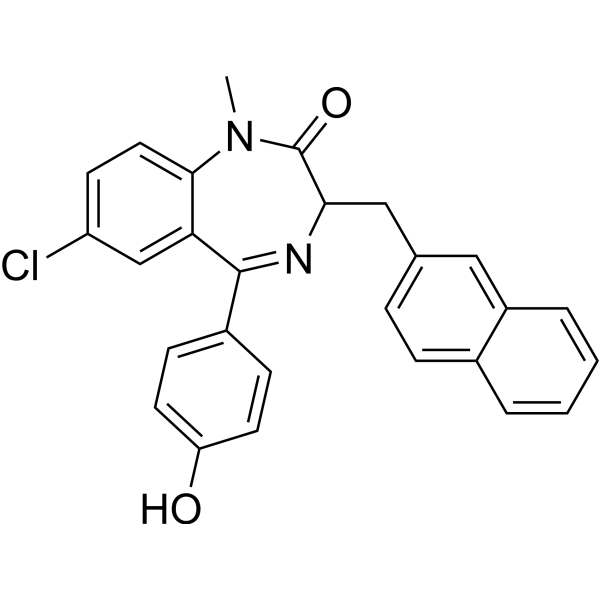
Bz 423 is a pro-apoptotic 1,4-benzodiazepine with therapeutic properties in murine models of lupus demonstrating selectivity for autoreactive lymphocytes, and activates Bax and Bak.
For research use only. We do not sell to patients.
- Purity: 99.72%
- CAS No.: 216691-95-1
- Formula: C27H21ClN2O2
- Molecular Weight:440.92
-
Storage:Powder -20°C, 3 years , 4°C, 2 years ; In solvent -80°C, 2 years , -20°C, 1 year

To place orders, for customer services and technical support, please contact: MedChemExpress USA
Tel: 609-228-6898 E-mail: [email protected] [email protected]


-
 Biological Activity
-
Chemical Information
-
Solvent & Solubility
- Protocol
- Purity & Documentation
- References
-
 Help & FAQs



Publications Citing Use of MedChemExpress (MCE) Bz 423
More

Biological Activity
Description
IC50 & Target
[1]|
Bax |
Bak |
Cellular Effect
|
Cell Line

|
Type | Value | Description | References |
|---|---|---|---|---|
| Jurkat | EC50 |
10 μM
Compound: Bz-423
|
Induction of reactive oxygen species response in Jurkat cells after 1 hr
Induction of reactive oxygen species response in Jurkat cells after 1 hr
|
[PMID: 17251020] |
| Jurkat | EC50 |
6 μM
Compound: Bz-423
|
Induction of cell death in Jurkat cells after 24 hrs
Induction of cell death in Jurkat cells after 24 hrs
|
[PMID: 17251020] |
| Keratinocyte | EC50 |
3.1 μM
Compound: Bz-423
|
Antiproliferative activity against human Keratinocyte assessed as inhibition of cell proliferation incubated for 2 days by Beckman Coulter analysis
Antiproliferative activity against human Keratinocyte assessed as inhibition of cell proliferation incubated for 2 days by Beckman Coulter analysis
|
[PMID: 32942072] |
| Ramos | EC50 |
6.3 μM
Compound: Bz-423
|
Induction of cell death in Ramos cells after 24 hrs
Induction of cell death in Ramos cells after 24 hrs
|
[PMID: 17251020] |
| Ramos | EC50 |
7.3 μM
Compound: Bz-423
|
Induction of reactive oxygen species response in Ramos cells after 1 hr
Induction of reactive oxygen species response in Ramos cells after 1 hr
|
[PMID: 17251020] |
In Vitro
Bz-423 induces a larger superoxide response in Ramos cells, and causes rapid death of Ramos B cells. Bz-423 activates Bax and Bak, but does not activate ASK1/JNK in Ramos cells. In Ramos cells Bz-423-induced superoxide leads to Bax and Bak activation via changes in Mcl-1 expression and functional activation of BH3-only proteins[1]. Bz-423 rapidly increases superoxide levels in MEFs within 1 h and the magnitude of the increase is concentration-dependent. Bz-423-induced apoptosis dependents upon superoxide[2].
MedChemExpress (MCE) has not independently confirmed the accuracy of these methods. They are for reference only.


Chemical Information
-
CAS No. 216691-95-1
-
Appearance Solid
-
Molecular Weight 440.92
-
Formula C27H21ClN2O2
-
Color Light yellow to yellow
-
SMILES
O=C1N(C)C2=CC=C(Cl)C=C2C(C3=CC=C(O)C=C3)=NC1CC4=CC=C5C=CC=CC5=C4
-
Synonyms
BZ48
-
Shipping
Room temperature in continental US; may vary elsewhere.
-
Storage
Powder -20°C 3 years 4°C 2 years In solvent -80°C 2 years -20°C 1 year


Publications (1)
-
Journal Impact Factor
-
Most Recent
-
J Cancer
Msi1 inhibits cervical cancer cell apoptosis by downregulating BAK through AKT signaling. [Abstract]2021 Mar 1;12(8):2422-2429. PMID: 33758618


Solvent & Solubility
In Vitro:
DMSO : ≥ 125 mg/mL (283.50 mM; Hygroscopic DMSO has a significant impact on the solubility of product, please use newly opened DMSO)
* "≥" means soluble, but saturation unknown.
Please refer to the solubility information to select the appropriate solvent. Once prepared, please aliquot and store the solution to prevent product inactivation from repeated freeze-thaw cycles.
Storage method and period of stock solution: -80°C, 2 years; -20°C, 1 year. When stored at -80°C, please use it within 2 years. When stored at -20°C, please use it within 1 year.
Please refer to the solubility information to select the appropriate solvent. Once prepared, please aliquot and store the solution to prevent product inactivation from repeated freeze-thaw cycles.
Storage method and period of stock solution: -80°C, 2 years; -20°C, 1 year. When stored at -80°C, please use it within 2 years. When stored at -20°C, please use it within 1 year.
Concentration (start) × Volume (start) = Concentration (final) × Volume (final)
In Vivo:
Select the appropriate dissolution method based on your experimental animal and administration route.
- For the following dissolution methods, please ensure to first prepare a clear stock solution using an In Vitro approach and then sequentially add co-solvents:
- To ensure reliable experimental results, the clarified stock solution can be appropriately stored based on storage conditions. As for the working solution for In Vivo experiments, it is recommended to prepare freshly and use it on the same day.
- The percentages shown for the solvents indicate their volumetric ratio in the final prepared solution. If precipitation or phase separation occurs during preparation, heat and/or sonication can be used to aid dissolution.
Add each solvent one by one: 10% DMSO 40% PEG300 5% Tween-80 45% Saline
Solubility: ≥ 2.08 mg/mL (4.72 mM); Clear solution
This protocol yields a clear solution of ≥ 2.08 mg/mL (saturation unknown).
Taking 1 mL working solution as an example, add 100 μL DMSO stock solution (20.8 mg/mL) to 400 μL PEG300, and mix evenly; then add 50 μL Tween-80 and mix evenly; then add 450 μL Saline to adjust the volume to 1 mL.
Preparation of Saline: Dissolve 0.9 g sodium chloride in ddH₂O and dilute to 100 mL to obtain a clear Saline solution.
In Vivo Dissolution Calculator
Please enter the basic information of animal experiments:
-
-
-
-
Recommended: Prepare an additional quantity of animals to account for potential losses during experiments.
Please enter your animal formula composition:
-
%DMSO +
Recommended: Keep the proportion of DMSO in working solution below 2% if your animal is weak.
-
%+
-
+%Tween-80 + +
-
%Saline +
The co-solvents required include: DMSO, . All of co-solvents are available by MedChemExpress (MCE). , Tween 80. All of co-solvents are available by MedChemExpress (MCE).
Working solution concentration: 0.22 mg/mL
Method for preparing stock solution: mg drug dissolved in μL DMSO. Stock solution concentration: mg/mL.
1. Take μL DMSO stock solution;
2. Add μL .
μL , mix evenly;
3. Then add μL Tween 80, mix evenly;
4. Then add μL
Please ensure that the stock solution in the first step is dissolved to a clear state, and add co-solvents in sequence. You can use ultrasonic heating (ultrasonic cleaner, recommended frequency 20-40 kHz), vortexing, etc. to assist dissolution.

Protocol
Kinase Assay[1]
To detect ASK1 activity, inactive GST-MKK6 (0.1 mg) is incubated (15 min, 25°C) with immunoprecipitated ASK1 in kinase assay buffer. Subsequently, GST-p38α (0.5 µg) is added to this reaction and incubated (15 min, 25°C) followed by detection of phospho-GST-p38 via immunoblot.
MedChemExpress (MCE) has not independently confirmed the accuracy of these methods. They are for reference only.


Purity & Documentation
-
Data Sheet (278 KB)
-
SDS (252 KB)
- English - EN (252 KB)
- Français - FR (252 KB)
- Deutsch - DE (252 KB)
- Norwegian - NO (252 KB)
- Español - ES (252 KB)
- Swedish - SV (252 KB)
- Italian - IT (252 KB)
- Korean - KR (252 KB)
- Portuguese - PT (252 KB)
-
Handling Instructions (2659 KB)
References
[1]. Blatt NB, et al. Bz-423 superoxide signals B cell apoptosis via Mcl-1, Bak, and Bax. Biochem Pharmacol. 2009 Oct 15;78(8):966-73. [Content Brief]
[2]. Blatt NB, et al. Bz-423 superoxide signals apoptosis via selective activation of JNK, Bak, and Bax. Free Radic Biol Med. 2008 Nov 1;45(9):1232-42. [Content Brief]


Complete Stock Solution Preparation Table
Please refer to the solubility information to select the appropriate solvent. Once prepared, please aliquot and store the solution to prevent product inactivation from repeated freeze-thaw cycles.
Storage method and period of stock solution: -80°C, 2 years; -20°C, 1 year. When stored at -80°C, please use it within 2 years. When stored at -20°C, please use it within 1 year.
| Optional Solvent | Concentration Solvent Mass | 1 mg | 5 mg | 10 mg | 25 mg |
|---|---|---|---|---|---|
| DMSO | 1 mM | 2.2680 mL | 11.3399 mL | 22.6799 mL | 56.6996 mL |
| 5 mM | 0.4536 mL | 2.2680 mL | 4.5360 mL | 11.3399 mL | |
| 10 mM | 0.2268 mL | 1.1340 mL | 2.2680 mL | 5.6700 mL | |
| 15 mM | 0.1512 mL | 0.7560 mL | 1.5120 mL | 3.7800 mL | |
| 20 mM | 0.1134 mL | 0.5670 mL | 1.1340 mL | 2.8350 mL | |
| 25 mM | 0.0907 mL | 0.4536 mL | 0.9072 mL | 2.2680 mL | |
| 30 mM | 0.0756 mL | 0.3780 mL | 0.7560 mL | 1.8900 mL | |
| 40 mM | 0.0567 mL | 0.2835 mL | 0.5670 mL | 1.4175 mL | |
| 50 mM | 0.0454 mL | 0.2268 mL | 0.4536 mL | 1.1340 mL | |
| 60 mM | 0.0378 mL | 0.1890 mL | 0.3780 mL | 0.9450 mL | |
| 80 mM | 0.0283 mL | 0.1417 mL | 0.2835 mL | 0.7087 mL | |
| 100 mM | 0.0227 mL | 0.1134 mL | 0.2268 mL | 0.5670 mL |


Bz 423 Related Classifications
HY-13108 Related Classifications
 Powered by Bioz