



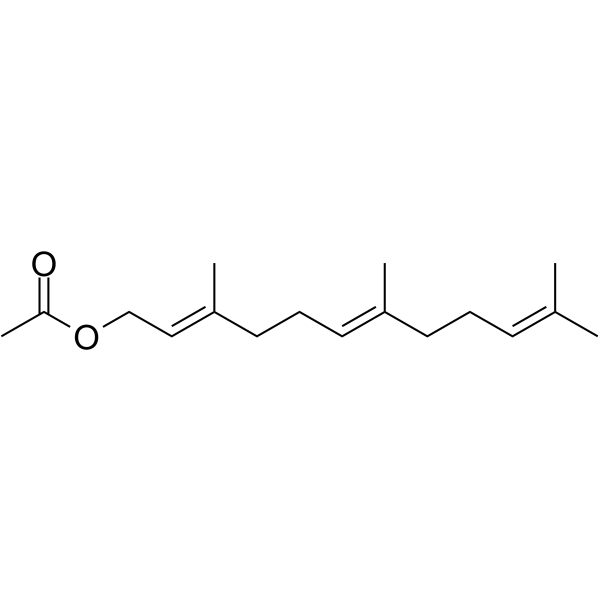
Farnesyl acetate
Farnesyl acetate is a sesquiterpene isolated from the leaves of Amomum gagnepainii. Farnesyl acetate has significant toxicity against red palm weevil larvae with a LD50 of 7867 ppm.
For research use only. We do not sell to patients.
- CAS No.: 29548-30-9
- Formula: C17H28O2
- Molecular Weight:264.40
-
Storage:Pure form -20°C, 3 years ; In solvent -80°C, 6 months , -20°C, 1 month

To place orders, for customer services and technical support, please contact: MedChemExpress USA
Tel: 609-228-6898 E-mail: [email protected] [email protected]


-
 Biological Activity
-
Chemical Information
- Protocols
- Purity & Documentation
- References
-
 Help & FAQs




Biological Activity
Description


Chemical Information
-
CAS No. 29548-30-9
-
Appearance Liquid (Density: 0.91 g/cm3)
-
Molecular Weight 264.40
-
Formula C17H28O2
-
Color Colorless to light yellow
-
SMILES
C/C(C)=C\CC/C(C)=C/CC/C(C)=C/COC(C)=O
-
Structure Classification
-
Initial Source
-
Shipping
Room temperature in continental US; may vary elsewhere.
-
Storage
Pure form -20°C 3 years In solvent -80°C 6 months -20°C 1 month

Protocols
-
Acute Systemic Toxicity Study
Acute systemic toxicity studies evaluate adverse effects occurring after a single exposure, or repeated exposure within a short acute window, and the main in vivo readouts are mortality, moribund condition, clinical signs, body-weight change, and gross pathological findings; acute oral toxicity methods were developed to replace classical LD50 testing with reduced-animal designs such as fixed-dose procedure, acute toxic class method, and up-and-down procedure. The fixed-dose procedure classifies acute toxicity by administering predefined dose levels and observing evident toxicity rather than using death as the primary endpoint, whereas the acute toxic class method uses sequential groups of three animals per step and the up-and-down procedure doses animals sequentially to estimate an LD50 with fewer animals than conventional LD50 testing.


Purity & Documentation
-
Data Sheet (262 KB)
-
SDS (597 KB)
- English - EN (597 KB)
- Français - FR (597 KB)
- Deutsch - DE (597 KB)
- Norwegian - NO (597 KB)
- Español - ES (597 KB)
- Swedish - SV (597 KB)
- Italian - IT (597 KB)
- Korean - KR (597 KB)
- Portuguese - PT (597 KB)
-
Handling Instructions (2659 KB)
References
[1]. Meigs TE, et al. Farnesyl acetate, a derivative of an isoprenoid of the mevalonate pathway, inhibits DNA replication in hamster and human cells. Exp Cell Res. 1995 Aug;219(2):461-70. [Content Brief]
[2]. Guo D, et al. Biosynthesis of advanced biofuel farnesyl acetate using engineered Escherichia coli. Bioresour Technol. 2018 Dec;269:577-580. [Content Brief]
[3]. Hussain A, et al. Lethality of Sesquiterpenes Reprogramming Red Palm Weevil Detoxification Mechanism for Natural Novel Biopesticide Development. Molecules. 2019 Apr 26;24(9). [Content Brief]

Calculators
Concentration (start) × Volume (start) = Concentration (final) × Volume (final)


Farnesyl acetate Related Classifications
HY-128430 Related Classifications
 Powered by Bioz