



Ferrozine
Based on 3 publication(s) in Google Scholar
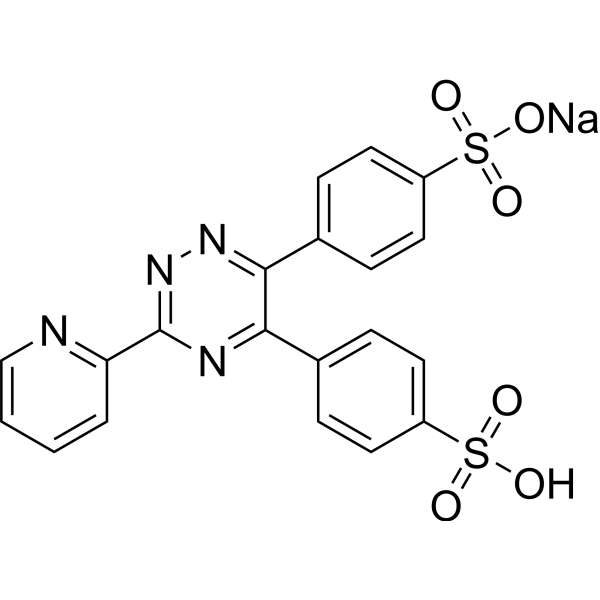
Ferrozine is a spectrophotometric reagent for iron ions, can react with divalent Fe to form a stable magenta complex species. The complex has an absorption peak at 562 nm. Ferrozine-based colorimetric assays can quantify iron in cells
Nos produits utilisent uniquement pour la recherche. Nous ne vendons pas aux patients.
- Pureté : 99.96%
- CAS No.: 69898-45-9
- Formule: C20H13N4NaO6S2
- Masse moléculaire:492.46
-
Stockage:
Please store the product under the recommended conditions in the Certificate of Analysis.

To place orders, for customer services and technical support, please contact: MedChemExpress USA
Tel: 609-228-6898 E-mail: [email protected] [email protected]


-
 Activité biologique
-
Chemical Information
-
Solvant et solubilité
- Pureté et documentation
- Références
-
 Help & FAQs


-
HY-112053
DPPHFree Radical Scavenger -
HY-10219
RapamycinmTOR Inhibitor -

HY-Y0882
Hydroxylamine hydrochlorideMAO Inhibitor -
HY-10431
SB-431542TGF-β Receptor Kinase Inhibitor -
HY-100579
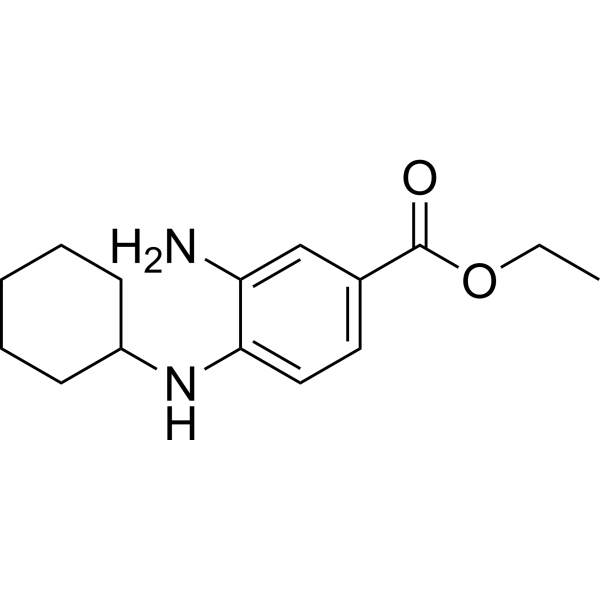
Ferrostatin-1Ferroptosis Inhibitor -
HY-15142
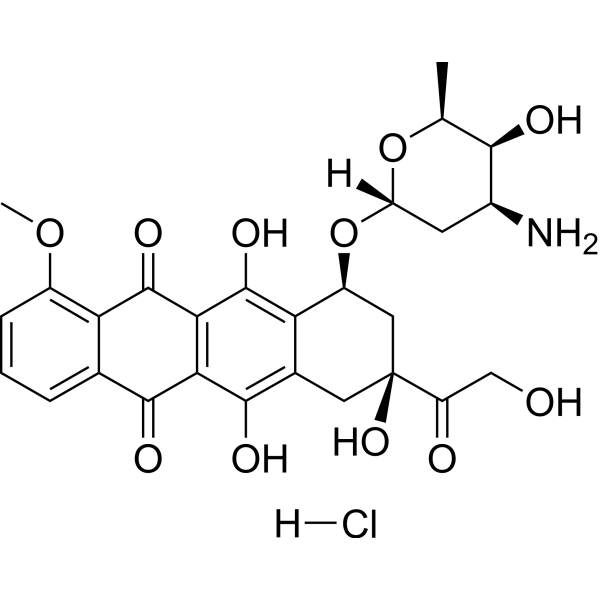
Doxorubicin hydrochlorideTopoisomerase Inhibitor -

HY-125860
Tyrosinase, MushroomMelanin-regulating Enzyme -
HY-10254
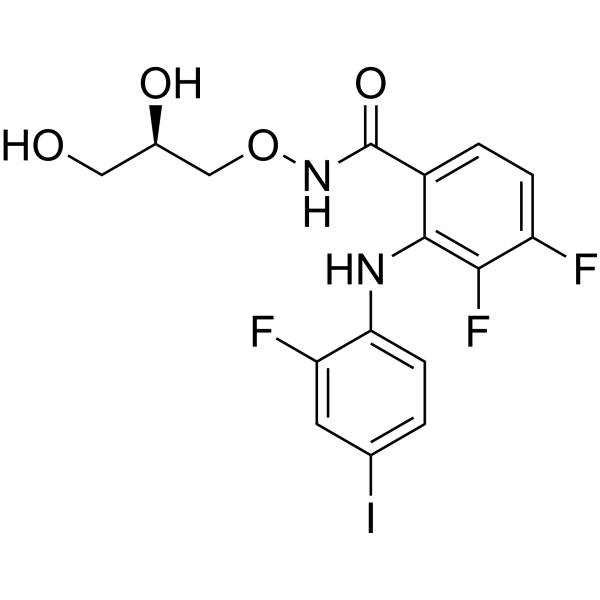
MirdametinibMEK Inhibitor -
HY-13259
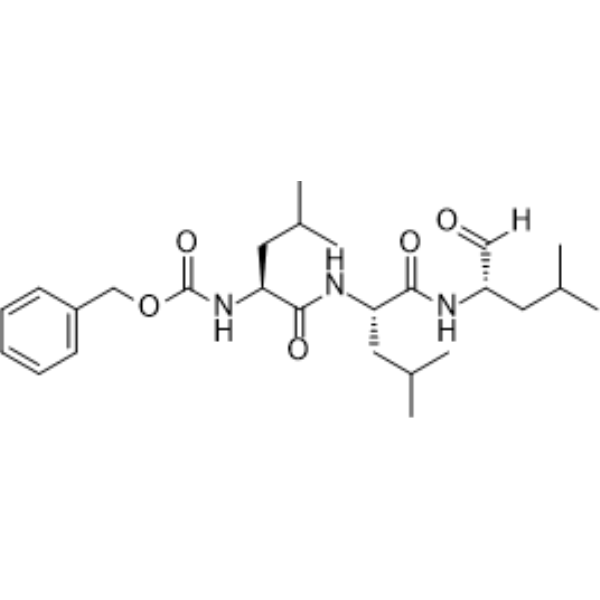
MG-132Proteasome Inhibitor -
HY-19312
3-MethyladenineAutophagy/PI3K Inhibitor -
HY-B0988
Deferoxamine mesylateIron Chelator -
HY-Y0873
PEG300Neutral Polymer
Publications Citing Use of MedChemExpress (MCE) Ferrozine
More Customer Validation & Images

-
IF
-
Bio/Physico-chemical Assay
-
Cell Imaging/Staining


Activité biologique
Description
In Vitro
Guidelines (The following is our recommended protocol. This protocol is provided for reference only and should be modified according to your specific needs).
Colorimetric ferrozine-based assay for the quantitation of iron in cultured cells[3]
1: Preparation of Reagents
·1.1: Iron Releasing Reagent: Prepare a mixture of 1.4 M HCl and 4.5% KMnO4.
·1.2: Iron Detection Reagent: Prepare a solution containing 6.5 mM Ferrozine, 6.5 mM neocuproine(HY-W004563), 2.5 M ammonium acetate, and 1 M ascorbic acid.
2: Cell Treatment: Treat cultured cells with different concentrations of Ferric Ammonium Citrate (FAC) (HY-B1645) and incubate for 24 hours. After treatment, wash the cells with PBS and collect them.
3: Cell Lysis and Iron Release
·3.1: Cell Lysis: Lyse cells using 50 mM NaOH, typically agitating at room temperature for 2 hours.
·3.2: Iron Release: Add the iron releasing reagent to the lysate and then incubate at 60°C for 2 hours.
4: Colorimetric Determination of Iron Content
·4.1: Iron Detection Reaction: Mix the lysate with the iron detection reagent and react for 30 minutes.
·4.2: Absorbance Measurement: Measure the absorbance at 550 nm using a microplate reader.
5: Data Analysis
·5.1: Standard Curve: Prepare standard solutions with known concentrations of iron, measure their absorbance at 550 nm, and establish a standard curve.
·5.2: Iron Content Calculation: Calculate the iron content of the samples by comparing their absorbance to the standard curve.
MedChemExpress (MCE) has not independently confirmed the accuracy of these methods. They are for reference only. .
Excitation (Ex)
562


Chemical Information
-
CAS No. 69898-45-9
-
Appearance Solid
-
Masse moléculaire 492.46
-
Formule C20H13N4NaO6S2
-
Color Light yellow to yellow
-
SMILES
O=S(C1=CC=C(C2=NC(C3=NC=CC=C3)=NN=C2C4=CC=C(S(=O)(O[Na])=O)C=C4)C=C1)(O)=O
-
Livraison
Room temperature in continental US; may vary elsewhere.
-
Stockage
Please store the product under the recommended conditions in the Certificate of Analysis.


Publications (3)
-
Journal Impact Factor
-
Most Recent
-
Adv Sci (Weinh)
Lysosome-Featured Cell Aggregate-Released Extracellular Vesicles Regulate Iron Homeostasis and Alleviate Post-Irradiation Endothelial Ferroptosis for Mandibular Regeneration. [Abstract]2025 Sep;12(34):e05070. PMID: 40546115
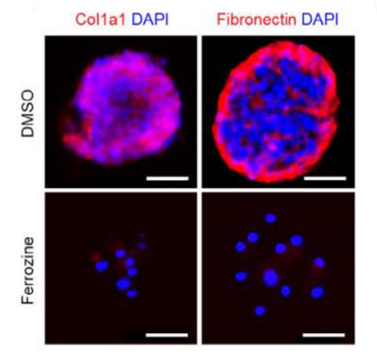
Ferrozine purchased from MedChemExpress. Usage Cited in: Adv Sci (Weinh). 2025 Sep;12(34):e05070. [Abstract]
Ferrozine (6.5 mM) reduced Col1a1 and fibronectin levels in CAs.
Ferrozine purchased from MedChemExpress. Usage Cited in: Adv Sci (Weinh). 2025 Sep;12(34):e05070. [Abstract]
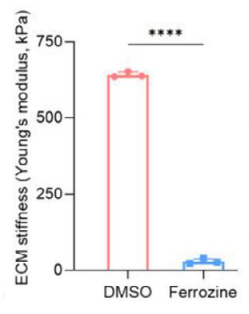
Ferrozine (6.5 mM) treatment diminished the ECM stiffness of CAs.
Ferrozine purchased from MedChemExpress. Usage Cited in: Adv Sci (Weinh). 2025 Sep;12(34):e05070. [Abstract]
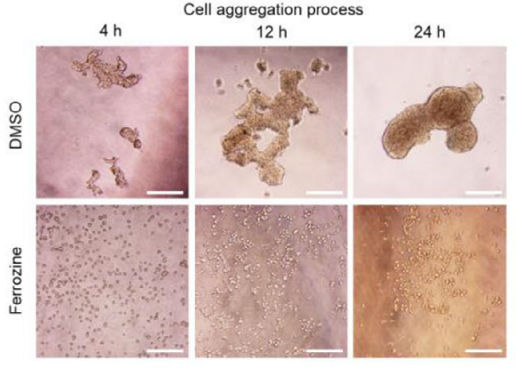
Bright-field images for the process of cell aggregation. The results showed that Ferrozine (6.5 mM) slowed the CA formation. Scale bars, 150 µm.
-
Mitochondrion
Sensitivity of primary mitochondrial disease fibroblasts to ferroptosis: The role of intracellular iron. [Abstract]2026 Mar:87:102112. PMID: 41581630 -


Solvant et solubilité
In Vitro:
DMSO : 50 mg/mL (101.53 mM; Need ultrasonic; Hygroscopic DMSO has a significant impact on the solubility of product, please use newly opened DMSO)
H2O : 50 mg/mL (101.53 mM; Need ultrasonic)
* Note: If you choose water as the stock solution, please dilute it to the working solution, then filter and sterilize it with a 0.22 μm filter before use.
* Note: If you choose water as the stock solution, please dilute it to the working solution, then filter and sterilize it with a 0.22 μm filter before use.
Concentration (start) × Volume (start) = Concentration (final) × Volume (final)


Pureté et documentation
-
Fiche technique (280 KB)
-
SDS (252 KB)
- English - EN (252 KB)
- Français - FR (252 KB)
- Deutsch - DE (252 KB)
- Norwegian - NO (252 KB)
- Español - ES (252 KB)
- Swedish - SV (252 KB)
- Italian - IT (252 KB)
- Korean - KR (252 KB)
- Portuguese - PT (252 KB)
-
Instruction de manipulation (2659 KB)
Références


Complete Stock Solution Preparation Table
| Optional Solvent | Concentration Solvent Mass | 1 mg | 5 mg | 10 mg | 25 mg |
|---|---|---|---|---|---|
| DMSO / H2O | 1 mM | 2.0306 mL | 10.1531 mL | 20.3062 mL | 50.7655 mL |
| 5 mM | 0.4061 mL | 2.0306 mL | 4.0612 mL | 10.1531 mL | |
| 10 mM | 0.2031 mL | 1.0153 mL | 2.0306 mL | 5.0766 mL | |
| 15 mM | 0.1354 mL | 0.6769 mL | 1.3537 mL | 3.3844 mL | |
| 20 mM | 0.1015 mL | 0.5077 mL | 1.0153 mL | 2.5383 mL | |
| 25 mM | 0.0812 mL | 0.4061 mL | 0.8122 mL | 2.0306 mL | |
| 30 mM | 0.0677 mL | 0.3384 mL | 0.6769 mL | 1.6922 mL | |
| 40 mM | 0.0508 mL | 0.2538 mL | 0.5077 mL | 1.2691 mL | |
| 50 mM | 0.0406 mL | 0.2031 mL | 0.4061 mL | 1.0153 mL | |
| 60 mM | 0.0338 mL | 0.1692 mL | 0.3384 mL | 0.8461 mL | |
| 80 mM | 0.0254 mL | 0.1269 mL | 0.2538 mL | 0.6346 mL | |
| 100 mM | 0.0203 mL | 0.1015 mL | 0.2031 mL | 0.5077 mL |
* Note: If you choose water as the stock solution, please dilute it to the working solution, then filter and sterilize it with a 0.22 μm filter before use.


Ferrozine Related Classifications
HY-137805 Related Classifications
 Powered by Bioz