



mHTT-IN-2

Based on 1 Customer Validation
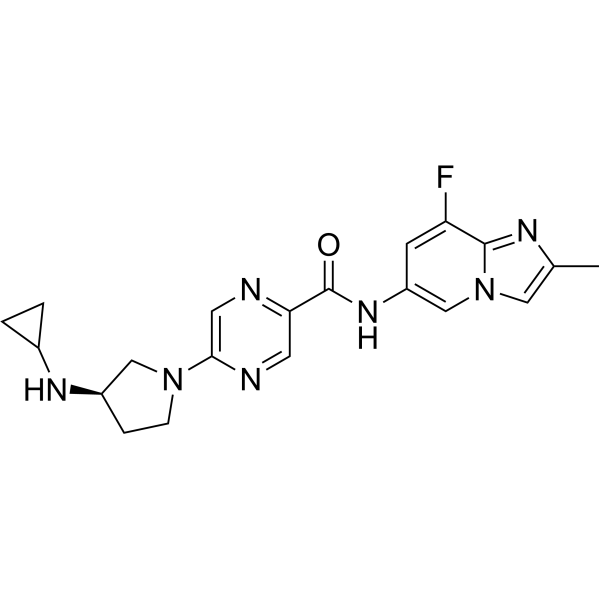
mHTT-IN-2 is an orally active RNA splicing modulator that can cross the blood-brain barrier. mHTT-IN-2 promotes the inclusion of a pseudoexon containing a premature termination codon in HTT pre-mRNA, inducing nonsense-mediated decay. mHTT-IN-2 reduces mutant huntingtin protein levels in the cortex, quadriceps, liver, plasma, and PBMCs of BACHD mice after subchronic administration. mHTT-IN-2 shows a low efflux tendency in P-glycoprotein and BCRP transporter assays. mHTT-IN-2 can be used for research on Huntington's disease.
For research use only. We do not sell to patients.
- Purity : 99.35%
- CAS No.: 2743336-70-9
- Formula: C20H22FN7O
- Molecular Weight:395.43
-
Storage:Powder -20°C, 3 years , 4°C, 2 years ; In solvent -80°C, 6 months , -20°C, 1 month

To place orders, for customer services and technical support, please contact: MedChemExpress USA
Tel: 609-228-6898 E-mail: [email protected] [email protected]


-
 Biological Activity
-
Chemical Information
-
Solvent & Solubility
- Protocols
- Purity & Documentation
- References
-
 Help & FAQs




Biological Activity
Description
IC50 & Target
EC50: 0.066 μM (mHTT protein)[1]
In Vitro
The MDCK MDR1-WT efflux ratio of mHTT-IN-2 is 2.5[1].
mHTT-IN-2 shows a 58-fold and 26-fold safety margin for TNS and AKT, respectively, relative to its mHTT-lowering effect[1].
mHTT-IN-2 has low mouse liver microsomal clearance (< 32 mL/min/kg body weight) and low mouse hepatocyte clearance (<34 mL/min/kg body weight)[1].
mHTT-IN-2 has a BCRP efflux ratio of 1.4 in the BCRP efflux assay[1].
MedChemExpress (MCE) has not independently confirmed the accuracy of these methods. They are for reference only.
In Vivo
mHTT-IN-2 (3-10 mg/kg; p.o.; once daily; 14 or 21 days) produces dose- and time-dependent reduction of mHTT in the cortex of BACHD mice, with greater reduction of mHTT in peripheral muscle and liver than in brain[1].
mHTT-IN-2 (subchronic administration) reduces central and peripheral mHTT in BACHD rats and exhibits an improved brain-to-periphery ratio compared with BACHD mice[1].
mHTT-IN-2 (compound 27) (3-10 mg/kg; p.o.; single administration) increases HTT i49 RNA levels in the brain of BACHD mice after a single oral administration[1].
mHTT-IN-2 (3-10 mg/kg; p.o.; QD; 14 or 21 days) reduces mHTT protein in BACHD mouse tissues after 14 or 21 days of oral administration, with the greatest reduction in quadriceps at 10 mg/kg[1].
mHTT-IN-2 (1-3 mg/kg; p.o.; QD; 21 days) reduces HTT e49-50 RNA and soluble expanded HTT protein in BACHD rat tissues after 21 days of oral administration[1].
MedChemExpress (MCE) has not independently confirmed the accuracy of these methods. They are for reference only.
-
Animal Model:BACHD transgenic[1]
-
Dosage:3 mg/kg; 10 mg/kg
-
Administration:p.o.; single administration
-
Result:At 12 h after dosing, canonical HTT exon49-50 RNA was reduced in BACHD mouse brain at 3 and 10 mg/kg.
The reduction was stronger at 12 h than at 24 h for both doses.
-
Animal Model:BACHD transgenic[1]
-
Dosage:3 mg/kg; 10 mg/kg
-
Administration:p.o.; once daily; 14 or 21 days
-
Result:Dose- and time-dependent mHTT lowering occurred in cortex after daily dosing, with greater reduction at day 21 than day 14.
At day 21, brain-periphery mHTT reduction ratios were 0.41 (brain-muscle), 0.55 (brain-liver), 1.0 (brain-plasma), and 0.61 (brain-PBMC) at 3 mg/kg; and 0.58, 0.78, 1.3, and 0.87 at 10 mg/kg.
Greater mHTT lowering occurred in muscle and liver than in brain at all doses and time points.
-
Animal Model:BACHD transgenic[1]
-
Dosage:10 mg/kg (6 h); 3 mg/kg and 10 mg/kg (12 h and 24 h)
-
Administration:p.o.; single administration
-
Result:HTT i49 RNA expression was increased relative to vehicle after 10 mg/kg at 6 h, after 3 and 10 mg/kg at 12 h, and after 3 and 10 mg/kg at 24 h.
-
Animal Model:BACHD transgenic[1]
-
Dosage:3 mg/kg QD; 10 mg/kg QD
-
Administration:p.o.; QD; 14 or 21 days
-
Result:mHTT protein reduction was 13% in cortex, 64% in quadriceps, 42% in liver, 36% in plasma, and 42% in PBMC after 3 mg/kg QD at 14 days.
mHTT protein reduction was 30% in cortex, 74% in quadriceps, 55% in liver, 29% in plasma, and 49% in PBMC after 3 mg/kg QD at 21 days.
mHTT protein reduction was 47% in cortex, 81% in quadriceps, 70% in liver, 37% in plasma, and 59% in PBMC after 10 mg/kg QD at 14 days.
mHTT protein reduction was 52% in cortex, 90% in quadriceps, 67% in liver, 39% in plasma, and 59% in PBMC after 10 mg/kg QD at 21 days.
HTT e49-50 expression was reduced in cortex, muscle, and liver at both 3 and 10 mg/kg at 14 and 21 days.
Soluble expanded HTT levels were also reduced relative to vehicle at both doses and time points.
-
Animal Model:BACHD transgenic[1]
-
Dosage:1 mg/kg QD; 3 mg/kg QD
-
Administration:p.o.; QD; 21 days
-
Result:After repeated oral dosing, HTT e49-50 expression was reduced in cortex, muscle, and liver at 1 and 3 mg/kg QD.
Soluble expanded HTT protein levels were reduced in cortex, muscle, liver, PBMC, and plasma at 1 and 3 mg/kg QD.
Parmacokinetics


Chemical Information
-
CAS No. 2743336-70-9
-
Appearance Solid
-
Molecular Weight 395.43
-
Formula C20H22FN7O
-
Color White to off-white
-
SMILES
FC1=CC(NC(C2=NC=C(N3C[C@@H](CC3)NC4CC4)N=C2)=O)=CN5C1=NC(C)=C5
-
Shipping
Room temperature in continental US; may vary elsewhere.
-
Storage
Powder -20°C 3 years 4°C 2 years In solvent -80°C 6 months -20°C 1 month


Solvent & Solubility
In Vitro:
DMSO : 100 mg/mL (252.89 mM; Need ultrasonic; Hygroscopic DMSO has a significant impact on the solubility of product, please use newly opened DMSO)
Please refer to the solubility information to select the appropriate solvent. Once prepared, please aliquot and store the solution to prevent product inactivation from repeated freeze-thaw cycles.
Storage method and period of stock solution: -80°C, 6 months; -20°C, 1 month. When stored at -80°C, please use it within 6 months. When stored at -20°C, please use it within 1 month.
Concentration (start) × Volume (start) = Concentration (final) × Volume (final)
In Vivo:
Select the appropriate dissolution method based on your experimental animal and administration route.
- For the following dissolution methods, please ensure to first prepare a clear stock solution using an In Vitro approach and then sequentially add co-solvents:
- To ensure reliable experimental results, the clarified stock solution can be appropriately stored based on storage conditions. As for the working solution for In Vivo experiments, it is recommended to prepare freshly and use it on the same day.
- The percentages shown for the solvents indicate their volumetric ratio in the final prepared solution. If precipitation or phase separation occurs during preparation, heat and/or sonication can be used to aid dissolution.
Add each solvent one by one: 10% DMSO 40% PEG300 5% Tween-80 45% Saline
Solubility: ≥ 2.5 mg/mL (6.32 mM); Clear solution
This protocol yields a clear solution of ≥ 2.5 mg/mL (saturation unknown).
Taking 1 mL working solution as an example, add 100 μL DMSO stock solution (25.0 mg/mL) to 400 μL PEG300, and mix evenly; then add 50 μL Tween-80 and mix evenly; then add 450 μL Saline to adjust the volume to 1 mL.
Preparation of Saline: Dissolve 0.9 g sodium chloride in ddH₂O and dilute to 100 mL to obtain a clear Saline solution.
Add each solvent one by one: 10% DMSO 90% (20% SBE-β-CD in Saline)
Solubility: ≥ 2.5 mg/mL (6.32 mM); Clear solution
This protocol yields a clear solution of ≥ 2.5 mg/mL (saturation unknown).
Taking 1 mL working solution as an example, add 100 μL DMSO stock solution (25.0 mg/mL) to 900 μL 20% SBE-β-CD in Saline, and mix evenly.
Preparation of 20% SBE-β-CD in Saline (4°C, storage for one week): 2 g SBE-β-CD powder is dissolved in 10 mL Saline, completely dissolve until clear.
In Vivo Dissolution Calculator
Please enter the basic information of animal experiments:
-
-
-
-
Recommended: Prepare an additional quantity of animals to account for potential losses during experiments.
Please enter your animal formula composition:
-
%DMSO +
Recommended: Keep the proportion of DMSO in working solution below 2% if your animal is weak.
-
%+
-
+%Tween-80 + +
-
%Saline +
The co-solvents required include: DMSO, . All of co-solvents are available by MedChemExpress (MCE). , Tween 80. All of co-solvents are available by MedChemExpress (MCE).
Working solution concentration: 0.22 mg/mL
Method for preparing stock solution: mg drug dissolved in μL DMSO. Stock solution concentration: mg/mL.
1. Take μL DMSO stock solution;
2. Add μL .
μL , mix evenly;
3. Then add μL Tween 80, mix evenly;
4. Then add μL
Please ensure that the stock solution in the first step is dissolved to a clear state, and add co-solvents in sequence. You can use ultrasonic heating (ultrasonic cleaner, recommended frequency 20-40 kHz), vortexing, etc. to assist dissolution.


Purity & Documentation


References

Complete Stock Solution Preparation Table
Please refer to the solubility information to select the appropriate solvent. Once prepared, please aliquot and store the solution to prevent product inactivation from repeated freeze-thaw cycles.
Storage method and period of stock solution: -80°C, 6 months; -20°C, 1 month. When stored at -80°C, please use it within 6 months. When stored at -20°C, please use it within 1 month.
| Optional Solvent | Concentration Solvent Mass | 1 mg | 5 mg | 10 mg | 25 mg |
|---|---|---|---|---|---|
| DMSO | 1 mM | 2.5289 mL | 12.6445 mL | 25.2889 mL | 63.2223 mL |
| 5 mM | 0.5058 mL | 2.5289 mL | 5.0578 mL | 12.6445 mL | |
| 10 mM | 0.2529 mL | 1.2644 mL | 2.5289 mL | 6.3222 mL | |
| 15 mM | 0.1686 mL | 0.8430 mL | 1.6859 mL | 4.2148 mL | |
| 20 mM | 0.1264 mL | 0.6322 mL | 1.2644 mL | 3.1611 mL | |
| 25 mM | 0.1012 mL | 0.5058 mL | 1.0116 mL | 2.5289 mL | |
| 30 mM | 0.0843 mL | 0.4215 mL | 0.8430 mL | 2.1074 mL | |
| 40 mM | 0.0632 mL | 0.3161 mL | 0.6322 mL | 1.5806 mL | |
| 50 mM | 0.0506 mL | 0.2529 mL | 0.5058 mL | 1.2644 mL | |
| 60 mM | 0.0421 mL | 0.2107 mL | 0.4215 mL | 1.0537 mL | |
| 80 mM | 0.0316 mL | 0.1581 mL | 0.3161 mL | 0.7903 mL | |
| 100 mM | 0.0253 mL | 0.1264 mL | 0.2529 mL | 0.6322 mL |


mHTT-IN-2 Related Classifications
HY-156103 Related Classifications
 Powered by Bioz