



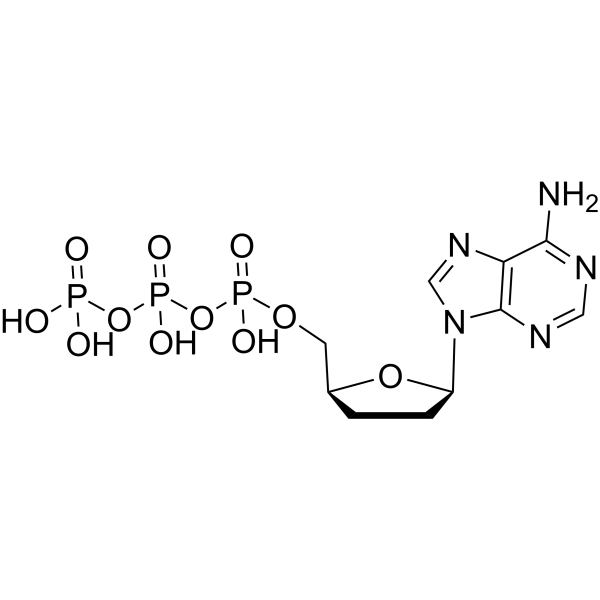
ddATP
Based on 1 publication(s) in Google Scholar
ddATP (2',3'-Dideoxyadenosine 5'-triphosphate), an active metabolite of 2',3'-dideoxyinosine, is a chain-elongating inhibitor of DNA polymerase. ddATP can be used for Sanger method for DNA sequencing and research of virus infection.
Para uso exclusivo en investigación. No vendemos a pacientes.
- No. CAS: 24027-80-3
- Fòrmula: C10H16N5O11P3
- Peso molecular:475.18
-
Almacenamiento:
Solution, -20°C, 2 years

To place orders, for customer services and technical support, please contact: MedChemExpress USA
Tel: 609-228-6898 E-mail: [email protected] [email protected]


-
 Actividad biológica
-
Chemical Information
- Protocolo
- Pureza y Documentación
- Referencias
-
 Help & FAQs


Publications Citing Use of MedChemExpress (MCE) ddATP
MoreVer todos los productos específicos de isoformas DNA/RNA Synthesis
More

Actividad biológica
Descripciòn
IC50 & Target
|
DNA Polymerase |
In Vitro
ddATP (0.05-50 μM, 30 min) inhibits adenovirus DNA synthesis in isolated nuclei from adenovirus-infected KB cells[1].
ddATP (100 μM, 5 h) reduces the number of γH2A.X foci in the DSB (DNA double-strand breaks) oocytes[3].
ddATP inhibits HIV replication by inhibiting HIV reverse transcriptase[5].
MedChemExpress (MCE) has not independently confirmed the accuracy of these methods. They are for reference only.
-
Cell Line:DSB oocytes
-
Concentration:100 μM
-
Incubation Time:5 h
-
Result:Suppressed the mtDNA replication without fully suppressed the nuclear DNA replication.


Chemical Information
-
No. CAS 24027-80-3
-
Appearance Liquid
-
Peso molecular 475.18
-
Fòrmula C10H16N5O11P3
-
Color Colorless to light yellow
-
SMILES
NC1=NC=NC2=C1N=CN2[C@H]3CC[C@H](O3)COP(O)(OP(OP(O)(O)=O)(O)=O)=O
-
Synonyms
2',3'-Dideoxyadenosine 5'-triphosphate
-
Envío
Room temperature in continental US; may vary elsewhere.
-
Almacenamiento
Solution, -20°C, 2 years


Publications (1)
-
Journal Impact Factor
-
Most Recent
-
RNA
Improved precision, sensitivity, and adaptability of Ordered Two-Template Relay cDNA library preparation for RNA sequencing. [Abstract]2025 Jan 22;31(2):224-244. PMID: 39626888


Pureza y Documentación
Referencias
[1]. van der Vliet PC, et al. Role of DNA polymerase gamma in adenovirus DNA replication. Mechanism of inhibition by 2',3'-dideoxynucleoside 5'-triphosphates. Biochemistry. 1981 Apr 28;20(9):2628-32. [Content Brief]
[2]. Xu Lan, et al. Simultaneous determination of 2 ,3 -dideoxyinosine and the active metabolite, 2 ,3 -dideoxyadenosine-5 -triphosphate in human peripheral-blood mononuclear cell by HPLC–MS/MS and the application to cell pharmacokinetics. J Chromatogr B Analyt Technol Biomed Life Sci. 2015 Oct 1;1002:337-42. [Content Brief]
[3]. Jun-Yu Ma, et al. Double-strand breaks induce short-scale DNA replication and damage amplification in the fully grown mouse oocytes. Genetics. 2021 Jun 24;218(2):iyab054. [Content Brief]
[4]. C M Perry, et al. Didanosine. An update on its antiviral activity, pharmacokinetic properties and therapeutic efficacy in the management of HIV disease. Drugs. 1996 Dec;52(6):928-62. [Content Brief]
[5]. Hao Z, et al. Factors determining the activity of 2',3'-dideoxynucleosides in suppressing human immunodeficiency virus in vitro. Mol Pharmacol. 1988 Oct;34(4):431-5. [Content Brief]

Calculators
Concentration (start) × Volume (start) = Concentration (final) × Volume (final)


ddATP Related Classifications
HY-128036 Related Classifications
 Powered by Bioz