



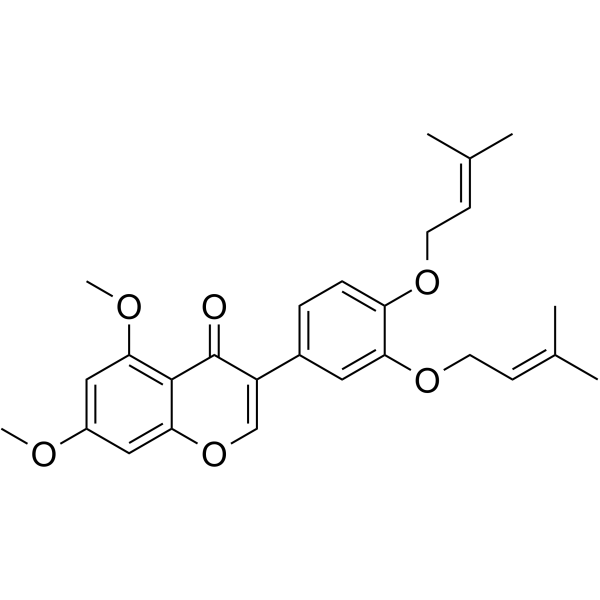
Glabrescione B

Based on 1 Customer Validation
Glabrescione B is the first compound that binds the Hedgehog (Hh) modulator Gli1. Glabrescione B impairs its activity by interfering with Gli1-DNA interaction. Glabrescione B inhibits the growth of Hedgehog-dependent tumor cells, the self-renewal ability, and clonogenicity of tumor-derived stem cells.
For research use only. We do not sell to patients.
- Purity : 98.08%
- CAS No.: 65893-94-9
- Formula: C27H30O6
- Molecular Weight:450.52
-
Storage:Powder -20°C, 3 years , 4°C, 2 years ; In solvent -80°C, 6 months , -20°C, 1 month

To place orders, for customer services and technical support, please contact: MedChemExpress USA
Tel: 609-228-6898 E-mail: [email protected] [email protected]


-
 Biological Activity
-
Chemical Information
-
Solvent & Solubility
- Protocols
- Purity & Documentation
- References
-
 Help & FAQs




Biological Activity
Description
IC50 & Target
Gli1-DNA Interaction[1]
Cellular Effect
|
Cell Line

|
Type | Value | Description | References |
|---|---|---|---|---|
| A-375 | IC50 |
0.4 μM
Compound: GlaB
|
Antiproliferative activity against human A375 cells assessed as reduction in cell viability incubated for 72 hrs by trypan blue or crystal violet staining based assay
Antiproliferative activity against human A375 cells assessed as reduction in cell viability incubated for 72 hrs by trypan blue or crystal violet staining based assay
|
[PMID: 32435392] |
| Daoy | IC50 |
0.13 μM
Compound: GlaB
|
Antiproliferative activity against human DaOY cells assessed as reduction in cell viability incubated for 72 hrs by trypan blue or crystal violet staining based assay
Antiproliferative activity against human DaOY cells assessed as reduction in cell viability incubated for 72 hrs by trypan blue or crystal violet staining based assay
|
[PMID: 32435392] |
In Vitro
Glabrescione B (5 μM; 24-72 hours) inhibits the growth of Gli-dependent basal cell carcinoma[2].
Glabrescione B (1-10 μM; 24-48 hours) decreases Gli1 mRNA expression levels[2].
MedChemExpress (MCE) has not independently confirmed the accuracy of these methods. They are for reference only. Further protocols information, click here.
-
Cell Line:ASZ001 BCC cells
-
Concentration:5 μM
-
Incubation Time:24-72 hours
-
Result:Basal cell carcinoma cell proliferation was impaired.
-
Cell Line:ASZ001 BCC cells
-
Concentration:1-10 μM
-
Incubation Time:24-48 hours
-
Result:Gli1 mRNA expression levels was decreased.
In Vivo
-
Animal Model:Female NOD/SCID mice (ASZ001 BCC allografts)[2]
-
Dosage:100 μmol/kg
-
Administration:I.p.; every second day for 18 days
-
Result:A significant reduction of tumor growth as well as Gli1 mRNA levels was observed.


Chemical Information
-
CAS No. 65893-94-9
-
Appearance Solid
-
Molecular Weight 450.52
-
Formula C27H30O6
-
Color White to off-white
-
SMILES
O=C1C(C2=CC=C(OC/C=C(C)/C)C(OC/C=C(C)/C)=C2)=COC3=CC(OC)=CC(OC)=C13
-
Shipping
Room temperature in continental US; may vary elsewhere.
-
Storage
Powder -20°C 3 years 4°C 2 years In solvent -80°C 6 months -20°C 1 month


Solvent & Solubility
In Vitro:
DMSO : 100 mg/mL (221.97 mM; Need ultrasonic; Hygroscopic DMSO has a significant impact on the solubility of product, please use newly opened DMSO)
Please refer to the solubility information to select the appropriate solvent. Once prepared, please aliquot and store the solution to prevent product inactivation from repeated freeze-thaw cycles.
Storage method and period of stock solution: -80°C, 6 months; -20°C, 1 month. When stored at -80°C, please use it within 6 months. When stored at -20°C, please use it within 1 month.
Please refer to the solubility information to select the appropriate solvent. Once prepared, please aliquot and store the solution to prevent product inactivation from repeated freeze-thaw cycles.
Storage method and period of stock solution: -80°C, 6 months; -20°C, 1 month. When stored at -80°C, please use it within 6 months. When stored at -20°C, please use it within 1 month.
Concentration (start) × Volume (start) = Concentration (final) × Volume (final)
In Vivo:
Select the appropriate dissolution method based on your experimental animal and administration route.
- For the following dissolution methods, please ensure to first prepare a clear stock solution using an In Vitro approach and then sequentially add co-solvents:
- To ensure reliable experimental results, the clarified stock solution can be appropriately stored based on storage conditions. As for the working solution for In Vivo experiments, it is recommended to prepare freshly and use it on the same day.
- The percentages shown for the solvents indicate their volumetric ratio in the final prepared solution. If precipitation or phase separation occurs during preparation, heat and/or sonication can be used to aid dissolution.
Add each solvent one by one: 10% DMSO 40% PEG300 5% Tween-80 45% Saline
Solubility: 2.5 mg/mL (5.55 mM); Suspended solution; Need ultrasonic
This protocol yields a suspended solution of 2.5 mg/mL. Suspended solution can be used for oral and intraperitoneal injection.
Taking 1 mL working solution as an example, add 100 μL DMSO stock solution (25.0 mg/mL) to 400 μL PEG300, and mix evenly; then add 50 μL Tween-80 and mix evenly; then add 450 μL Saline to adjust the volume to 1 mL.
Preparation of Saline: Dissolve 0.9 g sodium chloride in ddH₂O and dilute to 100 mL to obtain a clear Saline solution.
Add each solvent one by one: 10% DMSO 90% (20% SBE-β-CD in Saline)
Solubility: 2.5 mg/mL (5.55 mM); Suspended solution; Need ultrasonic
This protocol yields a suspended solution of 2.5 mg/mL. Suspended solution can be used for oral and intraperitoneal injection.
Taking 1 mL working solution as an example, add 100 μL DMSO stock solution (25.0 mg/mL) to 900 μL 20% SBE-β-CD in Saline, and mix evenly.
Preparation of 20% SBE-β-CD in Saline (4°C, storage for one week): 2 g SBE-β-CD powder is dissolved in 10 mL Saline, completely dissolve until clear.
In Vivo Dissolution Calculator
Please enter the basic information of animal experiments:
-
-
-
-
Recommended: Prepare an additional quantity of animals to account for potential losses during experiments.
Please enter your animal formula composition:
-
%DMSO +
Recommended: Keep the proportion of DMSO in working solution below 2% if your animal is weak.
-
%+
-
+%Tween-80 + +
-
%Saline +
The co-solvents required include: DMSO, . All of co-solvents are available by MedChemExpress (MCE). , Tween 80. All of co-solvents are available by MedChemExpress (MCE).
Working solution concentration: 0.22 mg/mL
Method for preparing stock solution: mg drug dissolved in μL DMSO. Stock solution concentration: mg/mL.
1. Take μL DMSO stock solution;
2. Add μL .
μL , mix evenly;
3. Then add μL Tween 80, mix evenly;
4. Then add μL
Please ensure that the stock solution in the first step is dissolved to a clear state, and add co-solvents in sequence. You can use ultrasonic heating (ultrasonic cleaner, recommended frequency 20-40 kHz), vortexing, etc. to assist dissolution.

Protocols
-
hPSC maintenance and expansion
This protocol maintains and expands human pluripotent stem cells under feeder-free, chemically defined conditions using E8 medium and vitronectin-coated culture surfaces; the readout is sustained adherent colony growth with undifferentiated morphology and retained pluripotency-marker expression during serial passaging. E8-based hPSC culture relies on defined soluble factors and matrix-dependent adhesion rather than feeder cells; vitronectin supports hPSC attachment through integrin-mediated interactions, and EDTA passaging dissociates colonies as small aggregates without enzymatic digestion, centrifugation, or routine ROCK-inhibitor treatment.


Purity & Documentation
-
Data Sheet (272 KB)
-
SDS (251 KB)
- English - EN (251 KB)
- Français - FR (251 KB)
- Deutsch - DE (251 KB)
- Norwegian - NO (251 KB)
- Español - ES (251 KB)
- Swedish - SV (251 KB)
- Italian - IT (251 KB)
- Korean - KR (251 KB)
- Portuguese - PT (251 KB)
-
Handling Instructions (2659 KB)
References
[1]. Ingallina C, et al. Polymeric glabrescione B nanocapsules for passive targeting of Hedgehog-dependent tumor therapy in vitro. Nanomedicine (Lond). 2017;12(7):711-728. [Content Brief]
[2]. Infante P, et al. Gli1/DNA interaction is a druggable target for Hedgehog-dependent tumors. EMBO J. 2015;34(2):200-217. [Content Brief]


Complete Stock Solution Preparation Table
Please refer to the solubility information to select the appropriate solvent. Once prepared, please aliquot and store the solution to prevent product inactivation from repeated freeze-thaw cycles.
Storage method and period of stock solution: -80°C, 6 months; -20°C, 1 month. When stored at -80°C, please use it within 6 months. When stored at -20°C, please use it within 1 month.
| Optional Solvent | Concentration Solvent Mass | 1 mg | 5 mg | 10 mg | 25 mg |
|---|---|---|---|---|---|
| DMSO | 1 mM | 2.2197 mL | 11.0983 mL | 22.1966 mL | 55.4914 mL |
| 5 mM | 0.4439 mL | 2.2197 mL | 4.4393 mL | 11.0983 mL | |
| 10 mM | 0.2220 mL | 1.1098 mL | 2.2197 mL | 5.5491 mL | |
| 15 mM | 0.1480 mL | 0.7399 mL | 1.4798 mL | 3.6994 mL | |
| 20 mM | 0.1110 mL | 0.5549 mL | 1.1098 mL | 2.7746 mL | |
| 25 mM | 0.0888 mL | 0.4439 mL | 0.8879 mL | 2.2197 mL | |
| 30 mM | 0.0740 mL | 0.3699 mL | 0.7399 mL | 1.8497 mL | |
| 40 mM | 0.0555 mL | 0.2775 mL | 0.5549 mL | 1.3873 mL | |
| 50 mM | 0.0444 mL | 0.2220 mL | 0.4439 mL | 1.1098 mL | |
| 60 mM | 0.0370 mL | 0.1850 mL | 0.3699 mL | 0.9249 mL | |
| 80 mM | 0.0277 mL | 0.1387 mL | 0.2775 mL | 0.6936 mL | |
| 100 mM | 0.0222 mL | 0.1110 mL | 0.2220 mL | 0.5549 mL |


Glabrescione B Related Classifications
HY-122590 Related Classifications
 Powered by Bioz