



10-Gingerol
Based on 4 publication(s) in Google Scholar
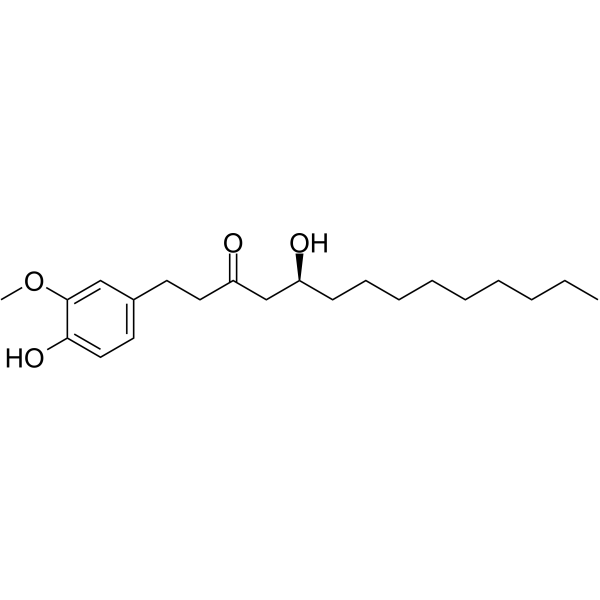
10-Gingerol is an AMPK agonist, which is found in the ginger oleoresin from fresh rhizome with anti-inflammatory, antioxidant and anti-proliferative activities. 10-Gingerol suppresses neointimal hyperplasia and inhibits vascular smooth muscle cell proliferation. 10-Gingerol exhibits substantial scavenging activities with an IC50 value of 10.47 μM against DPPH radical, an IC50 value of 1.68 μM against superoxide radical and an IC50 value of 1.35 μM against hydroxyl radical. 10-Gingerol inhibits the proliferation of MDA-MB-231 tumor cell line with an IC50 of 12.1 μM. 10-Gingerol suppresses the proliferation, migration, invasion, and induced apoptosis through targeting the PI3K/Akt signaling pathway in MDA-MB-231/IR cells. 10-Gingerol can be used in research on various common cancers such as ovarian cancer and colon cancer, as well as colitis and neurodegenerative diseases.
For research use only. We do not sell to patients.
- Purity: 99.48%
- CAS No.: 23513-15-7
- Formula: C21H34O4
- Molecular Weight:350.49
-
Storage:
-20°C, sealed storage, away from moisture and light
* In solvent : -80°C, 6 months; -20°C, 1 month (sealed storage, away from moisture and light)

To place orders, for customer services and technical support, please contact: MedChemExpress USA
Tel: 609-228-6898 E-mail: [email protected] [email protected]


-
 Biological Activity
-
Chemical Information
-
Solvent & Solubility
- Purity & Documentation
- References
-
 Help & FAQs


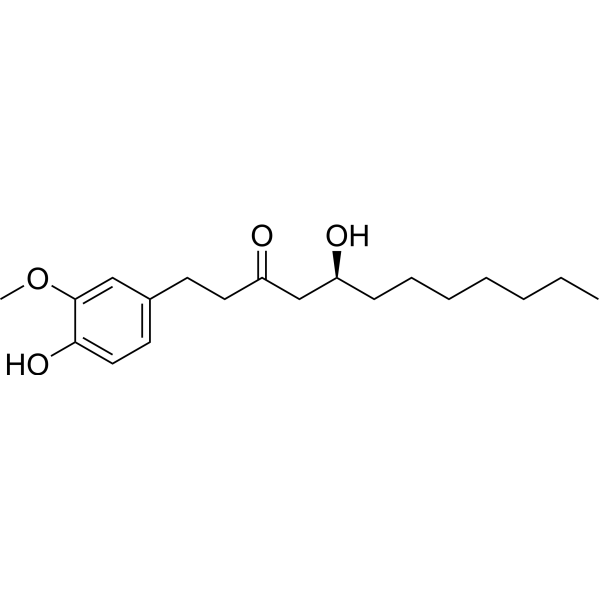
![[6]-Gingerol](https://file.medchemexpress.com/product_pic/hy-14615.gif)

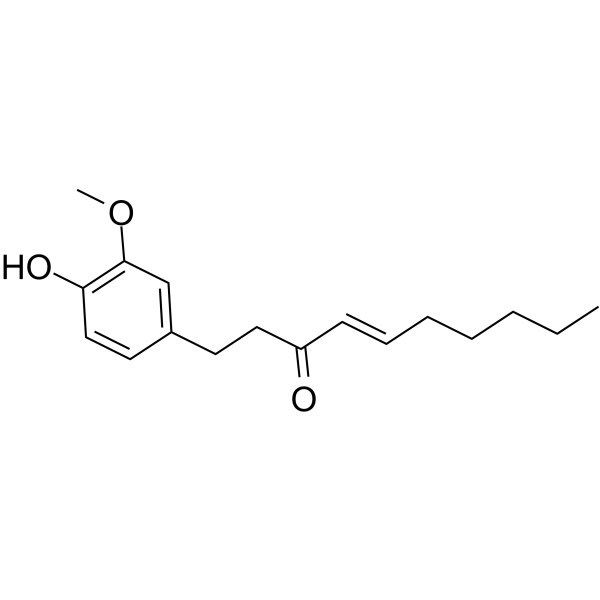
![[8]-Shogaol](https://file.medchemexpress.com/product_pic/hy-n2435.gif)
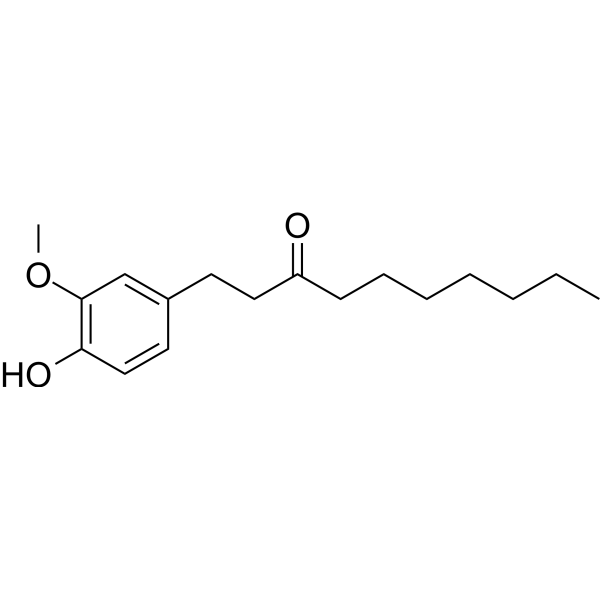
![[10]-Shogaol](https://file.medchemexpress.com/product_pic/hy-n2434.gif)
Publications Citing Use of MedChemExpress (MCE) 10-Gingerol
MoreAll AMPK Isoforms
More

Biological Activity
|
Cell Line

|
Type | Value | Description | References |
|---|---|---|---|---|
| RBL-2H3 | IC50 |
111.7 μM
Compound: 3
|
Cytotoxicity against rat RBL2H3 cells after 12 hrs by MTT assay
Cytotoxicity against rat RBL2H3 cells after 12 hrs by MTT assay
|
[PMID: 19271742] |
10-Gingerol (1-6 μM, 24 h) inhibits NO production in LPS-stimulated RAW 264.7 cells and LPS-activated PGE2 release[1].
10-Gingerol (100 μM, 24 h) is significantly effective in inhibiting MDA-MB-231 cell proliferation[2].
10-Gingerol (6.25-200 μM, 24 h and 48 h) suppresses the proliferation, migration, and invasion of MDA-MB-231/IR cells[3].
10-Gingerol (0-90 μM, 24 h) induces apoptosis and l suppresses PI3K/Akt signaling in MDA-MB-231/IR cells[3].
MedChemExpress (MCE) has not independently confirmed the accuracy of these methods. They are for reference only.
-
Cell Line:RAW 264.7 cells
-
Concentration:1-6 μM
-
Incubation Time:24 h
-
Result:Inhibited nitrite release without causing cell death in RAW 264.7 cells.
-
Cell Line:MDA-MB-231 cells
-
Concentration:100 μM
-
Incubation Time:24 h
-
Result:Was significantly effective in inhibiting MDA-MB-231 cell proliferation at 24 h of incubation in a rate of 75%.
-
Cell Line:MDA-MB-231/IR cells
-
Concentration:6.25-200 μM
-
Incubation Time:24 h and 48 h
-
Result:Causing 50% growth inhibition (IC50 ) of MDA-MB-231/IR cells at 24 and 48 h incubations were 121.2 and 101.4 µM, respectively.
-
Cell Line:MDA-MB-231/IR cells
-
Concentration:0-90 μM
-
Incubation Time:24 h
-
Result:Decreased the phosphorylation of p-Akt (Ser473), p-Akt (Thr308), p-PI3Kp85 and p4E-BP1, and activated the expression of some markers of apoptosis including Bax/Bcl-2, cleaved caspase-7, cleaved PARP, and cleaved caspase-3 in MDA-MB-231/IR cells.
MedChemExpress (MCE) has not independently confirmed the accuracy of these methods. They are for reference only.
-
Animal Model:Rats with DSS-induced acute ulcerative colitis[4]
-
Dosage:30 mg/kg
-
Administration:i.p., 7 consecutive days
-
Result:Reversed body weight loss and significantly declined DAI, reduced the serum TNF-α and IL-1β levels, ameliorated mucosa inflammation and/or defect in rats with DSS-induced acute ulcerative colitis in rats with DSS-induced acute ulcerative colitis.


Chemical Information
-
CAS No. 23513-15-7
-
Appearance Solid
-
Molecular Weight 350.49
-
Formula C21H34O4
-
Color White to light yellow
-
SMILES
CCCCCCCCC[C@H](O)CC(CCC1=CC=C(O)C(OC)=C1)=O
-
Structure Classification
-
Initial Source
-
Shipping
Room temperature in continental US; may vary elsewhere.
-
Storage
-20°C, sealed storage, away from moisture and light
* In solvent : -80°C, 6 months; -20°C, 1 month (sealed storage, away from moisture and light)


Publications (4)
-
Journal Impact Factor
-
Most Recent
-
Bioact Mater
Lipidomic analysis of plant-derived extracellular vesicles for guidance of potential anti-cancer therapy. [Abstract]2024 Dec 10:46:82-96. PMID: 39737211 -
Food Chem
2024 Sep 15:452:139425. PMID: 38744128 -
Arch Pharm Res
Cartilage extracellular matrix regeneration with 10-gingerol via KEAP1-NRF2-ARE axis for osteoarthritis therapy. [Abstract]2025 Dec;48(11-12):1460-1481. PMID: 41212495 -
Pharm Biol
Potential pharmacological quality control markers in the traditional Japanese medicine Hangeshashinto: identifying anti-inflammatory ingredients through a cell-based bioassay and multicomponent analysis. [Abstract]2025 Dec;63(1):819-836. PMID: 41240012


Solvent & Solubility
DMSO : 100 mg/mL (285.31 mM; Need ultrasonic; Hygroscopic DMSO has a significant impact on the solubility of product, please use newly opened DMSO)
Please refer to the solubility information to select the appropriate solvent. Once prepared, please aliquot and store the solution to prevent product inactivation from repeated freeze-thaw cycles.
Storage method and period of stock solution: -80°C, 6 months; -20°C, 1 month (sealed storage, away from moisture and light). When stored at -80°C, please use it within 6 months. When stored at -20°C, please use it within 1 month.
Please refer to the solubility information to select the appropriate solvent. Once prepared, please aliquot and store the solution to prevent product inactivation from repeated freeze-thaw cycles.
Storage method and period of stock solution: -80°C, 6 months; -20°C, 1 month (sealed storage, away from moisture and light). When stored at -80°C, please use it within 6 months. When stored at -20°C, please use it within 1 month.
Concentration (start) × Volume (start) = Concentration (final) × Volume (final)
Select the appropriate dissolution method based on your experimental animal and administration route.
- For the following dissolution methods, please ensure to first prepare a clear stock solution using an In Vitro approach and then sequentially add co-solvents:
- To ensure reliable experimental results, the clarified stock solution can be appropriately stored based on storage conditions. As for the working solution for In Vivo experiments, it is recommended to prepare freshly and use it on the same day.
- The percentages shown for the solvents indicate their volumetric ratio in the final prepared solution. If precipitation or phase separation occurs during preparation, heat and/or sonication can be used to aid dissolution.
Please enter the basic information of animal experiments:
-
-
-
-
Recommended: Prepare an additional quantity of animals to account for potential losses during experiments.
Please enter your animal formula composition:
-
%DMSO +
Recommended: Keep the proportion of DMSO in working solution below 2% if your animal is weak.
-
%+
-
+%Tween-80 + +
-
%Saline +
The co-solvents required include: DMSO, . All of co-solvents are available by MedChemExpress (MCE). , Tween 80. All of co-solvents are available by MedChemExpress (MCE).
Working solution concentration: 0.22 mg/mL
Method for preparing stock solution: mg drug dissolved in μL DMSO. Stock solution concentration: mg/mL. * In solvent : -80°C, 6 months; -20°C, 1 month (sealed storage, away from moisture and light)
1. Take μL DMSO stock solution;
2. Add μL .
μL , mix evenly;
3. Then add μL Tween 80, mix evenly;
4. Then add μL
Please ensure that the stock solution in the first step is dissolved to a clear state, and add co-solvents in sequence. You can use ultrasonic heating (ultrasonic cleaner, recommended frequency 20-40 kHz), vortexing, etc. to assist dissolution.


Purity & Documentation
-
Data Sheet (275 KB)
-
SDS (394 KB)
- English - EN (394 KB)
- Français - FR (394 KB)
- Deutsch - DE (394 KB)
- Norwegian - NO (394 KB)
- Español - ES (394 KB)
- Swedish - SV (394 KB)
- Italian - IT (394 KB)
- Korean - KR (394 KB)
- Portuguese - PT (394 KB)
-
Handling Instructions (2659 KB)
References
[1]. Dugasani S, et al. Comparative antioxidant and anti-inflammatory effects of [6]-gingerol, [8]-gingerol, [10]-gingerol and [6]-shogaol. J Ethnopharmacol. 2010 Feb 3;127(2):515-20. [Content Brief]
[2]. Almada da Silva J, et al. Purification and differential biological effects of ginger-derived substances on normal and tumor cell lines. J Chromatogr B Analyt Technol Biomed Life Sci. 2012 Aug 15;903:157-62. [Content Brief]
[3]. Ediriweera MK, Moon JY, Nguyen YT, Cho SK. 10-Gingerol Targets Lipid Rafts Associated PI3K/Akt Signaling in Radio-Resistant Triple Negative Breast Cancer Cells. Molecules. 2020;25(14):3164. [Content Brief]
[4]. Zhang F, et al. Therapeutic Effects of 6-Gingerol, 8-Gingerol, and 10-Gingerol on Dextran Sulfate Sodium-Induced Acute Ulcerative Colitis in Rats. Phytother Res. 2017 Sep;31(9):1427-1432. [Content Brief]
[5]. Deng B, et al. 10-Gingerol, a natural AMPK agonist, suppresses neointimal hyperplasia and inhibits vascular smooth muscle cell proliferation. Food Funct. 2022 Mar 21;13(6):3234-3246. [Content Brief]


Complete Stock Solution Preparation Table
Please refer to the solubility information to select the appropriate solvent. Once prepared, please aliquot and store the solution to prevent product inactivation from repeated freeze-thaw cycles.
Storage method and period of stock solution: -80°C, 6 months; -20°C, 1 month (sealed storage, away from moisture and light). When stored at -80°C, please use it within 6 months. When stored at -20°C, please use it within 1 month.
| Optional Solvent | Concentration Solvent Mass | 1 mg | 5 mg | 10 mg | 25 mg |
|---|---|---|---|---|---|
| DMSO | 1 mM | 2.8531 mL | 14.2657 mL | 28.5315 mL | 71.3287 mL |
| 5 mM | 0.5706 mL | 2.8531 mL | 5.7063 mL | 14.2657 mL | |
| 10 mM | 0.2853 mL | 1.4266 mL | 2.8531 mL | 7.1329 mL | |
| 15 mM | 0.1902 mL | 0.9510 mL | 1.9021 mL | 4.7552 mL | |
| 20 mM | 0.1427 mL | 0.7133 mL | 1.4266 mL | 3.5664 mL | |
| 25 mM | 0.1141 mL | 0.5706 mL | 1.1413 mL | 2.8531 mL | |
| 30 mM | 0.0951 mL | 0.4755 mL | 0.9510 mL | 2.3776 mL | |
| 40 mM | 0.0713 mL | 0.3566 mL | 0.7133 mL | 1.7832 mL | |
| 50 mM | 0.0571 mL | 0.2853 mL | 0.5706 mL | 1.4266 mL | |
| 60 mM | 0.0476 mL | 0.2378 mL | 0.4755 mL | 1.1888 mL | |
| 80 mM | 0.0357 mL | 0.1783 mL | 0.3566 mL | 0.8916 mL | |
| 100 mM | 0.0285 mL | 0.1427 mL | 0.2853 mL | 0.7133 mL |


10-Gingerol Related Classifications
HY-N0448 Related Classifications
 Powered by Bioz