



IITR01324

Based on 1 Customer Validation
IITR01324 is an antimicrobial agent. IITR01324 has antimicrobial activity against Escherichia coli (MIC = 3.58 mg/L) and other Gram-negative bacteria (Shigella flexneri: MIC = 3.58 mg/L; Cronobacter sakazakii: MIC = 28.63 mg/L). IITR01324 exerts its antimicrobial activity by destroying bacterial DNA after activation of intracellular reductases. IITR01324 can be used to study the development of new antimicrobial drugs, especially against multidrug-resistant (MDR) pathogens.
For research use only. We do not sell to patients.
- Purity : 99.12%
- CAS No.: 92-55-7
- Formula: C9H9NO7
- Molecular Weight:243.17
-
Storage:
Store at room temperature 3 years.
In solvent -80°C, 2 years , -20°C, 1 year


To place orders, for customer services and technical support, please contact: MedChemExpress USA
Tel: 609-228-6898 E-mail: [email protected] [email protected]


-
 Biological Activity
-
Chemical Information
-
Solvent & Solubility
- Protocols
- Purity & Documentation
- References
-
 Help & FAQs


-

HY-Y1826R
IITR01324 (Standard)Antimicrobial Agent -
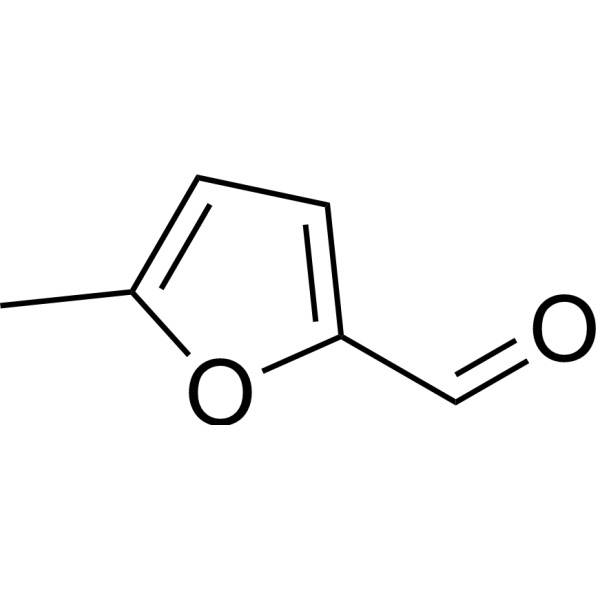
HY-Y0543
5-MethylfurfuralBiochemical Reagent -

HY-W012813
2-Acetyl-5-methylfuranAnti-tuberculous bacillus Agent -
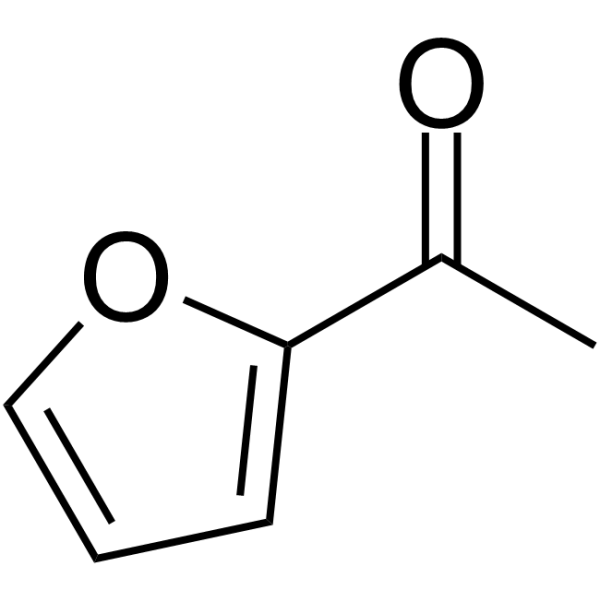
HY-W015912
2-AcetylfuranIntermediate In Foods -
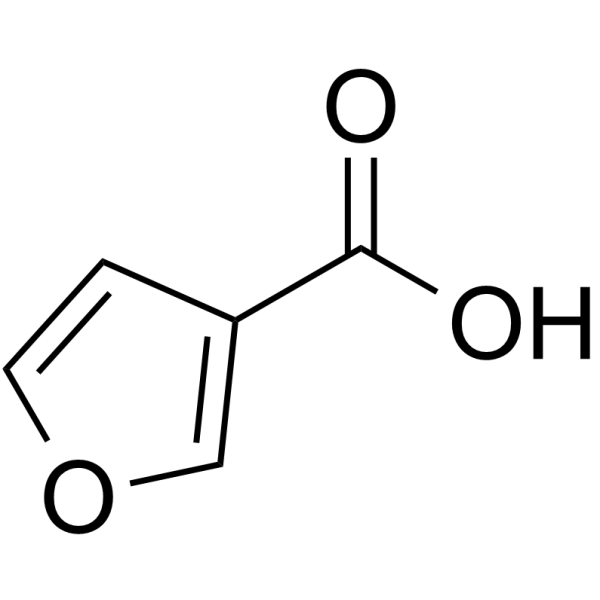
HY-21075
3-Furanoic acidEndogenous Metabolite -
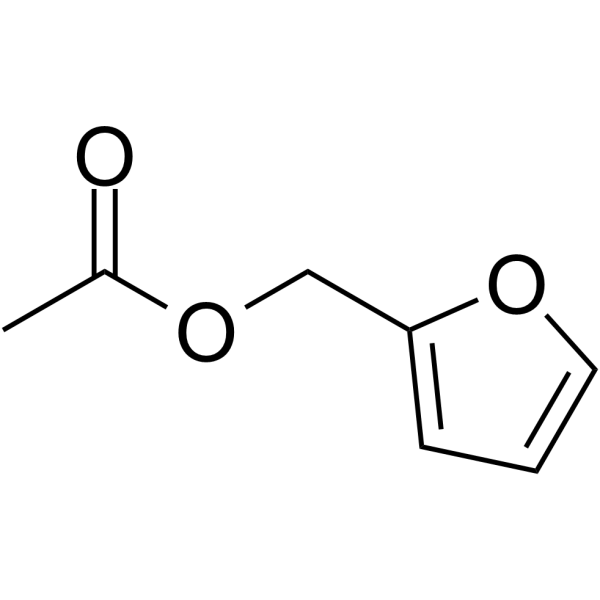
HY-W010321
Furfuryl acetate -

HY-Y0543R
5-Methylfurfural (Standard)Biochemical Reagent -
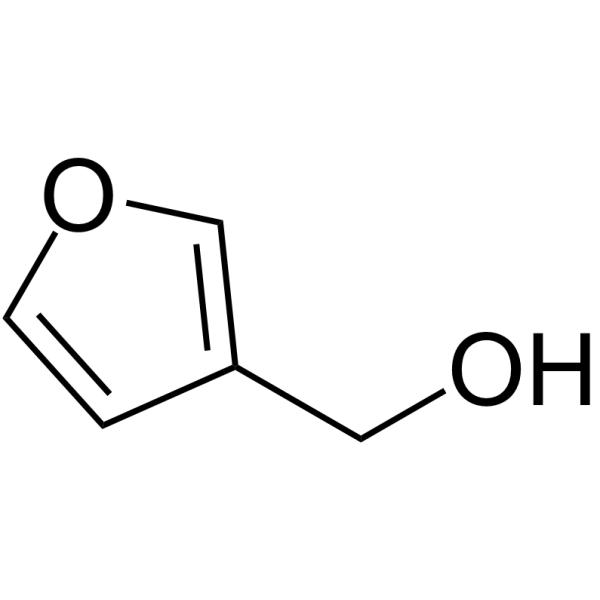
HY-W007708
3-FuranmethanolFlavor Compound -

HY-W014103R
5-(4-Nitrophenyl)furan-2-carbaldehyde (Standard) -

HY-W015912R
2-Acetylfuran (Standard) -

HY-21075R
3-Furanoic acid (Standard)Endogenous Metabolite -

HY-W010321R
Furfuryl acetate (Standard)
All Antibiotic Isoforms
More

Biological Activity
Description


Chemical Information
-
CAS No. 92-55-7
-
Appearance Solid
-
Molecular Weight 243.17
-
Formula C9H9NO7
-
Color White to off-white
-
SMILES
O=[N+](C1=CC=C(C(OC(C)=O)OC(C)=O)O1)[O-]
-
Shipping
Room temperature in continental US; may vary elsewhere.
-
Storage
Store at room temperature 3 years
In solvent -80°C 2 years -20°C 1 year


Solvent & Solubility
In Vitro:
DMSO : 50 mg/mL (205.62 mM; Need ultrasonic; Hygroscopic DMSO has a significant impact on the solubility of product, please use newly opened DMSO)
Please refer to the solubility information to select the appropriate solvent. Once prepared, please aliquot and store the solution to prevent product inactivation from repeated freeze-thaw cycles.
Storage method and period of stock solution: -80°C, 2 years; -20°C, 1 year. When stored at -80°C, please use it within 2 years. When stored at -20°C, please use it within 1 year.
Please refer to the solubility information to select the appropriate solvent. Once prepared, please aliquot and store the solution to prevent product inactivation from repeated freeze-thaw cycles.
Storage method and period of stock solution: -80°C, 2 years; -20°C, 1 year. When stored at -80°C, please use it within 2 years. When stored at -20°C, please use it within 1 year.
Concentration (start) × Volume (start) = Concentration (final) × Volume (final)
In Vivo:
Select the appropriate dissolution method based on your experimental animal and administration route.
- For the following dissolution methods, please ensure to first prepare a clear stock solution using an In Vitro approach and then sequentially add co-solvents:
- To ensure reliable experimental results, the clarified stock solution can be appropriately stored based on storage conditions. As for the working solution for In Vivo experiments, it is recommended to prepare freshly and use it on the same day.
- The percentages shown for the solvents indicate their volumetric ratio in the final prepared solution. If precipitation or phase separation occurs during preparation, heat and/or sonication can be used to aid dissolution.
Add each solvent one by one: 10% DMSO 40% PEG300 5% Tween-80 45% Saline
Solubility: ≥ 2.5 mg/mL (10.28 mM); Clear solution
This protocol yields a clear solution of ≥ 2.5 mg/mL (saturation unknown).
Taking 1 mL working solution as an example, add 100 μL DMSO stock solution (25.0 mg/mL) to 400 μL PEG300, and mix evenly; then add 50 μL Tween-80 and mix evenly; then add 450 μL Saline to adjust the volume to 1 mL.
Preparation of Saline: Dissolve 0.9 g sodium chloride in ddH₂O and dilute to 100 mL to obtain a clear Saline solution.
Add each solvent one by one: 10% DMSO 90% (20% SBE-β-CD in Saline)
Solubility: ≥ 2.5 mg/mL (10.28 mM); Clear solution
This protocol yields a clear solution of ≥ 2.5 mg/mL (saturation unknown).
Taking 1 mL working solution as an example, add 100 μL DMSO stock solution (25.0 mg/mL) to 900 μL 20% SBE-β-CD in Saline, and mix evenly.
Preparation of 20% SBE-β-CD in Saline (4°C, storage for one week): 2 g SBE-β-CD powder is dissolved in 10 mL Saline, completely dissolve until clear.
In Vivo Dissolution Calculator
Please enter the basic information of animal experiments:
-
-
-
-
Recommended: Prepare an additional quantity of animals to account for potential losses during experiments.
Please enter your animal formula composition:
-
%DMSO +
Recommended: Keep the proportion of DMSO in working solution below 2% if your animal is weak.
-
%+
-
+%Tween-80 + +
-
%Saline +
The co-solvents required include: DMSO, . All of co-solvents are available by MedChemExpress (MCE). , Tween 80. All of co-solvents are available by MedChemExpress (MCE).
Working solution concentration: 0.22 mg/mL
Method for preparing stock solution: mg drug dissolved in μL DMSO. Stock solution concentration: mg/mL.
1. Take μL DMSO stock solution;
2. Add μL .
μL , mix evenly;
3. Then add μL Tween 80, mix evenly;
4. Then add μL
Please ensure that the stock solution in the first step is dissolved to a clear state, and add co-solvents in sequence. You can use ultrasonic heating (ultrasonic cleaner, recommended frequency 20-40 kHz), vortexing, etc. to assist dissolution.


Purity & Documentation
-
Data Sheet (278 KB)
-
SDS (557 KB)
- English - EN (557 KB)
- Français - FR (557 KB)
- Deutsch - DE (557 KB)
- Norwegian - NO (557 KB)
- Español - ES (557 KB)
- Swedish - SV (557 KB)
- Italian - IT (557 KB)
- Korean - KR (557 KB)
- Portuguese - PT (557 KB)
-
Handling Instructions (2659 KB)
References


Complete Stock Solution Preparation Table
Please refer to the solubility information to select the appropriate solvent. Once prepared, please aliquot and store the solution to prevent product inactivation from repeated freeze-thaw cycles.
Storage method and period of stock solution: -80°C, 2 years; -20°C, 1 year. When stored at -80°C, please use it within 2 years. When stored at -20°C, please use it within 1 year.
| Optional Solvent | Concentration Solvent Mass | 1 mg | 5 mg | 10 mg | 25 mg |
|---|---|---|---|---|---|
| DMSO | 1 mM | 4.1123 mL | 20.5617 mL | 41.1235 mL | 102.8087 mL |
| 5 mM | 0.8225 mL | 4.1123 mL | 8.2247 mL | 20.5617 mL | |
| 10 mM | 0.4112 mL | 2.0562 mL | 4.1123 mL | 10.2809 mL | |
| 15 mM | 0.2742 mL | 1.3708 mL | 2.7416 mL | 6.8539 mL | |
| 20 mM | 0.2056 mL | 1.0281 mL | 2.0562 mL | 5.1404 mL | |
| 25 mM | 0.1645 mL | 0.8225 mL | 1.6449 mL | 4.1123 mL | |
| 30 mM | 0.1371 mL | 0.6854 mL | 1.3708 mL | 3.4270 mL | |
| 40 mM | 0.1028 mL | 0.5140 mL | 1.0281 mL | 2.5702 mL | |
| 50 mM | 0.0822 mL | 0.4112 mL | 0.8225 mL | 2.0562 mL | |
| 60 mM | 0.0685 mL | 0.3427 mL | 0.6854 mL | 1.7135 mL | |
| 80 mM | 0.0514 mL | 0.2570 mL | 0.5140 mL | 1.2851 mL | |
| 100 mM | 0.0411 mL | 0.2056 mL | 0.4112 mL | 1.0281 mL |


IITR01324 Related Classifications
HY-Y1826 Related Classifications
 Powered by Bioz