



HTS01037
Based on 1 publication(s) in Google Scholar
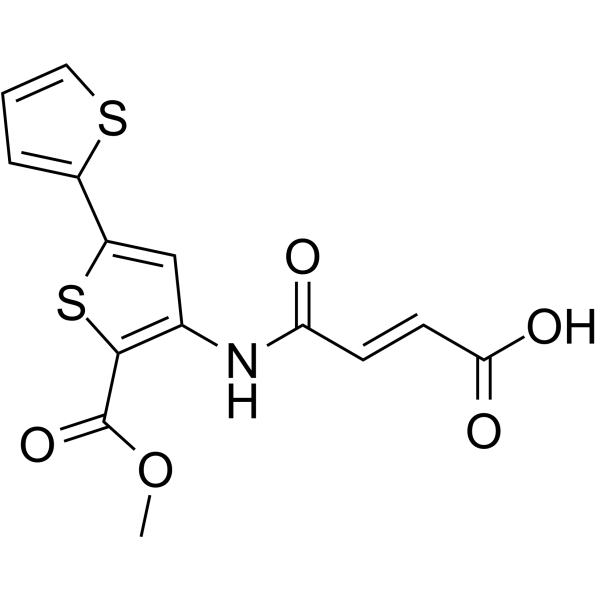
HTS01037 is an inhibitor of fatty acid binding; and a competitive antagonist of protein-protein interactions mediated by AFABP/aP2 with a Ki of 0.67 μM.
For research use only. We do not sell to patients.
- Purity : 98.24%
- CAS No.: 682741-29-3
- Formula: C14H11NO5S2
- Molecular Weight:337.37
-
Storage:Powder -20°C, 3 years , 4°C, 2 years ; In solvent -80°C, 2 years , -20°C, 1 year

To place orders, for customer services and technical support, please contact: MedChemExpress USA
Tel: 609-228-6898 E-mail: [email protected] [email protected]


-
 Biological Activity
-
Chemical Information
-
Solvent & Solubility
- Purity & Documentation
- References
-
 Help & FAQs


-
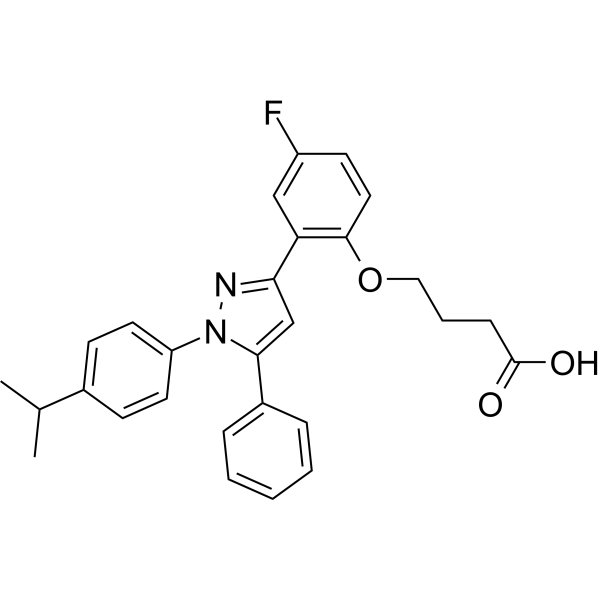
HY-145990
FABPs ligand 6FABP5/FABP7 Inhibitor -
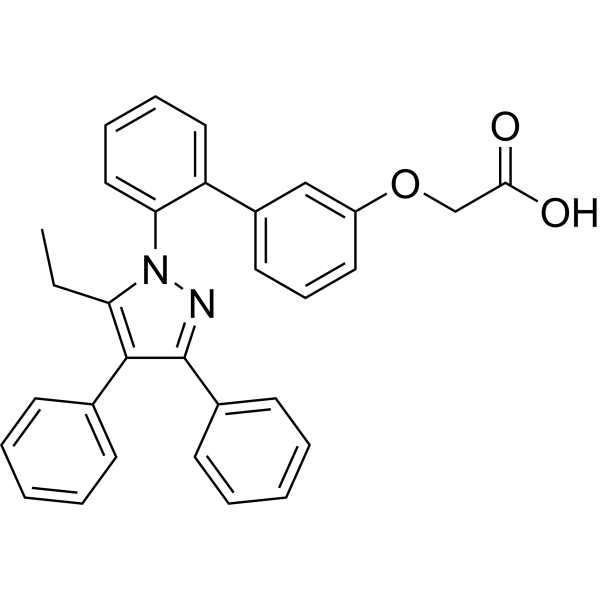
HY-101903
BMS-309403FABP4 Inhibitor -
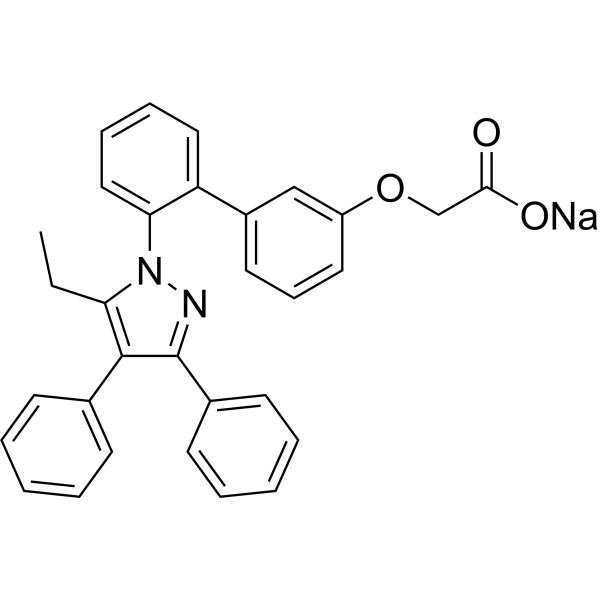
HY-101903A
BMS-309403 sodiumFABP4 Inhibitor -

HY-101503R
HTS01037 (Standard)AFABP Antagonist -

HY-101903R
BMS-309403 (Standard)FABP4 Inhibitor -

HY-101903AR
BMS-309403 sodium (Standard)FABP4 Inhibitor -
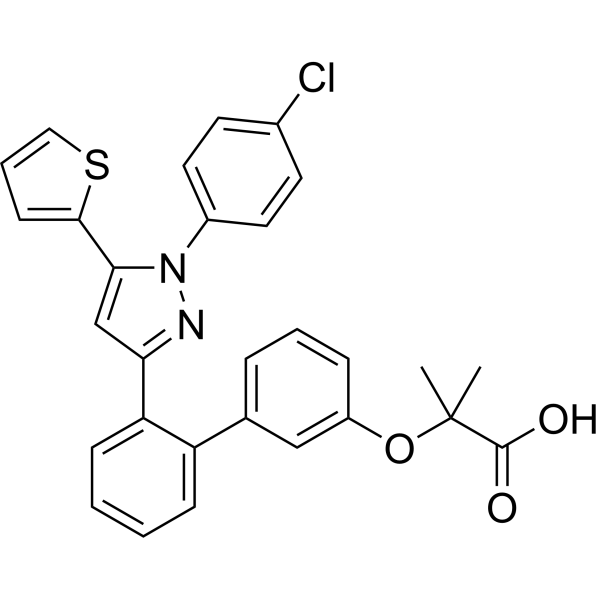
HY-117562
a-FABP-IN-1a-FABP Inhibitor
Publications Citing Use of MedChemExpress (MCE) HTS01037
More

Biological Activity
Description
IC50 & Target
IC50: 0.67 μM (AFABP/aP2)[1]
In Vitro
HTS01037 functions as a high affinity ligand of AFABP/aP2 with an apparent Ki of 0.67 μM. HTS01037 is somewhat selective for AFABP/aP2, but at higher concentrations is a pan-specific FABP inhibitor. HTS01037 inhibits lipolysis in 3T3-L1 adipocytes and reduces LPS-stimulated inflammation in cultured macrophages. HTS01037 acts as an antagonist of the protein-protein interaction between AFABP/aP2 and hormone sensitive lipase but does not activate PPARγ in macrophage or CV-1 cells[1]. Treatment of microglial cells with HTS01037 increases expression of Ucp2 and arginase in the presence or absence of palmitic acid. Moreover, cells exposed to HTS01037 exhibits attenuated expression of inducible nitric oxide synthase (iNOS) compared to palmitic acid alone indicating reduced NFκB signaling[2]. Treatment of macrophages with HTS01037results in a marked decrease in both basal and fatty acid-stimulated LTC4 secretion but no change in 5-HETE production or 5-lipoxygenase expression[3].
MedChemExpress (MCE) has not independently confirmed the accuracy of these methods. They are for reference only.


Chemical Information
-
CAS No. 682741-29-3
-
Appearance Solid
-
Molecular Weight 337.37
-
Formula C14H11NO5S2
-
Color Light yellow to yellow
-
SMILES
O=C(C1=C(NC(/C=C/C(O)=O)=O)C=C(C2=CC=CS2)S1)OC
-
Shipping
Room temperature in continental US; may vary elsewhere.
-
Storage
Powder -20°C 3 years 4°C 2 years In solvent -80°C 2 years -20°C 1 year


Publications (1)
-
Journal Impact Factor
-
Most Recent
-
J Lipid Res
The oxidized phospholipid PGPC impairs endothelial function by promoting endothelial cell ferroptosis via FABP3. [Abstract]2024 Feb;65(2):100499. PMID: 38218337


Solvent & Solubility
In Vitro:
DMSO : 100 mg/mL (296.41 mM; Need ultrasonic; Hygroscopic DMSO has a significant impact on the solubility of product, please use newly opened DMSO)
Please refer to the solubility information to select the appropriate solvent. Once prepared, please aliquot and store the solution to prevent product inactivation from repeated freeze-thaw cycles.
Storage method and period of stock solution: -80°C, 2 years; -20°C, 1 year. When stored at -80°C, please use it within 2 years. When stored at -20°C, please use it within 1 year.
Please refer to the solubility information to select the appropriate solvent. Once prepared, please aliquot and store the solution to prevent product inactivation from repeated freeze-thaw cycles.
Storage method and period of stock solution: -80°C, 2 years; -20°C, 1 year. When stored at -80°C, please use it within 2 years. When stored at -20°C, please use it within 1 year.
Concentration (start) × Volume (start) = Concentration (final) × Volume (final)
In Vivo:
Select the appropriate dissolution method based on your experimental animal and administration route.
- For the following dissolution methods, please ensure to first prepare a clear stock solution using an In Vitro approach and then sequentially add co-solvents:
- To ensure reliable experimental results, the clarified stock solution can be appropriately stored based on storage conditions. As for the working solution for In Vivo experiments, it is recommended to prepare freshly and use it on the same day.
- The percentages shown for the solvents indicate their volumetric ratio in the final prepared solution. If precipitation or phase separation occurs during preparation, heat and/or sonication can be used to aid dissolution.
Add each solvent one by one: 10% DMSO 40% PEG300 5% Tween-80 45% Saline
Solubility: 2.5 mg/mL (7.41 mM); Suspended solution; Need ultrasonic
This protocol yields a suspended solution of 2.5 mg/mL. Suspended solution can be used for oral and intraperitoneal injection.
Taking 1 mL working solution as an example, add 100 μL DMSO stock solution (25.0 mg/mL) to 400 μL PEG300, and mix evenly; then add 50 μL Tween-80 and mix evenly; then add 450 μL Saline to adjust the volume to 1 mL.
Preparation of Saline: Dissolve 0.9 g sodium chloride in ddH₂O and dilute to 100 mL to obtain a clear Saline solution.
Add each solvent one by one: 10% DMSO 90% (20% SBE-β-CD in Saline)
Solubility: 2.5 mg/mL (7.41 mM); Suspended solution; Need ultrasonic
This protocol yields a suspended solution of 2.5 mg/mL. Suspended solution can be used for oral and intraperitoneal injection.
Taking 1 mL working solution as an example, add 100 μL DMSO stock solution (25.0 mg/mL) to 900 μL 20% SBE-β-CD in Saline, and mix evenly.
Preparation of 20% SBE-β-CD in Saline (4°C, storage for one week): 2 g SBE-β-CD powder is dissolved in 10 mL Saline, completely dissolve until clear.
In Vivo Dissolution Calculator
Please enter the basic information of animal experiments:
-
-
-
-
Recommended: Prepare an additional quantity of animals to account for potential losses during experiments.
Please enter your animal formula composition:
-
%DMSO +
Recommended: Keep the proportion of DMSO in working solution below 2% if your animal is weak.
-
%+
-
+%Tween-80 + +
-
%Saline +
The co-solvents required include: DMSO, . All of co-solvents are available by MedChemExpress (MCE). , Tween 80. All of co-solvents are available by MedChemExpress (MCE).
Working solution concentration: 0.22 mg/mL
Method for preparing stock solution: mg drug dissolved in μL DMSO. Stock solution concentration: mg/mL.
1. Take μL DMSO stock solution;
2. Add μL .
μL , mix evenly;
3. Then add μL Tween 80, mix evenly;
4. Then add μL
Please ensure that the stock solution in the first step is dissolved to a clear state, and add co-solvents in sequence. You can use ultrasonic heating (ultrasonic cleaner, recommended frequency 20-40 kHz), vortexing, etc. to assist dissolution.


Purity & Documentation
-
Data Sheet (279 KB)
-
SDS (251 KB)
- English - EN (251 KB)
- Français - FR (251 KB)
- Deutsch - DE (251 KB)
- Norwegian - NO (251 KB)
- Español - ES (251 KB)
- Swedish - SV (251 KB)
- Italian - IT (251 KB)
- Korean - KR (251 KB)
- Portuguese - PT (251 KB)
-
Handling Instructions (2659 KB)
References
[1]. Hertzel AV, et al. Identification and characterization of a small molecule inhibitor of Fatty Acid binding proteins. J Med Chem. 2009 Oct 8;52(19):6024-31. [Content Brief]
[2]. Duffy CM, et al. Identification of a fatty acid binding protein4-UCP2 axis regulating microglial mediated neuroinflammation. Mol Cell Neurosci. 2017 Apr;80:52-57. [Content Brief]
[3]. Long EK, et al. Fatty acids induce leukotriene C4 synthesis in macrophages in a fatty acid binding protein-dependent manner. Biochim Biophys Acta. 2013 Jul;1831(7):1199-207. [Content Brief]


Complete Stock Solution Preparation Table
Please refer to the solubility information to select the appropriate solvent. Once prepared, please aliquot and store the solution to prevent product inactivation from repeated freeze-thaw cycles.
Storage method and period of stock solution: -80°C, 2 years; -20°C, 1 year. When stored at -80°C, please use it within 2 years. When stored at -20°C, please use it within 1 year.
| Optional Solvent | Concentration Solvent Mass | 1 mg | 5 mg | 10 mg | 25 mg |
|---|---|---|---|---|---|
| DMSO | 1 mM | 2.9641 mL | 14.8205 mL | 29.6410 mL | 74.1026 mL |
| 5 mM | 0.5928 mL | 2.9641 mL | 5.9282 mL | 14.8205 mL | |
| 10 mM | 0.2964 mL | 1.4821 mL | 2.9641 mL | 7.4103 mL | |
| 15 mM | 0.1976 mL | 0.9880 mL | 1.9761 mL | 4.9402 mL | |
| 20 mM | 0.1482 mL | 0.7410 mL | 1.4821 mL | 3.7051 mL | |
| 25 mM | 0.1186 mL | 0.5928 mL | 1.1856 mL | 2.9641 mL | |
| 30 mM | 0.0988 mL | 0.4940 mL | 0.9880 mL | 2.4701 mL | |
| 40 mM | 0.0741 mL | 0.3705 mL | 0.7410 mL | 1.8526 mL | |
| 50 mM | 0.0593 mL | 0.2964 mL | 0.5928 mL | 1.4821 mL | |
| 60 mM | 0.0494 mL | 0.2470 mL | 0.4940 mL | 1.2350 mL | |
| 80 mM | 0.0371 mL | 0.1853 mL | 0.3705 mL | 0.9263 mL | |
| 100 mM | 0.0296 mL | 0.1482 mL | 0.2964 mL | 0.7410 mL |


HTS01037 Related Classifications
HY-101503 Related Classifications
 Powered by Bioz