



PAK3
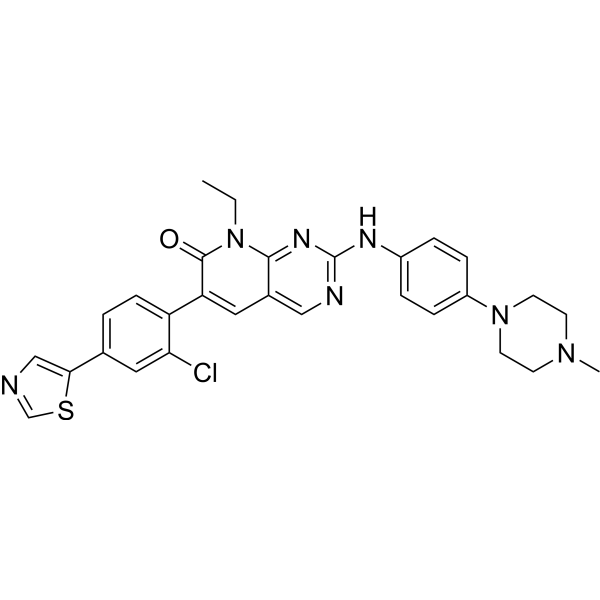
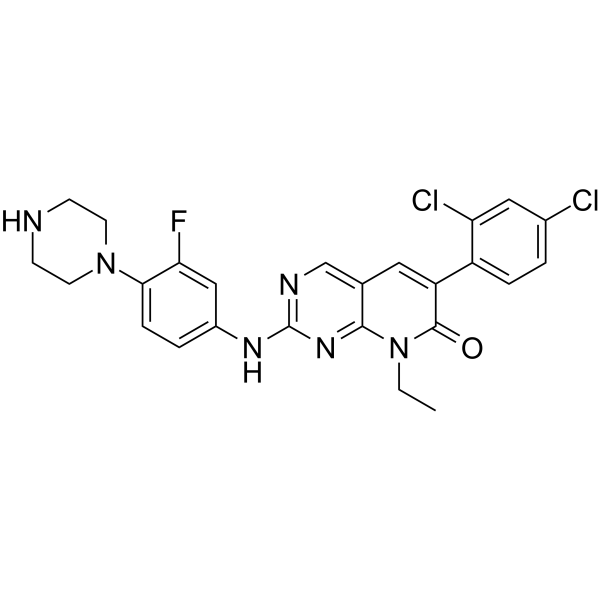
PAK3 (p21-activated kinase 3) is a Group I serine/threonine kinase that functions downstream of the small GTPases RAC1 and CDC42, linking extracellular signals to cytoskeletal remodeling and neuronal signaling networks[1][2]. Mechanistically, PAK3 regulates dendritic development, dendritic spine morphogenesis, synapse formation, and synaptic plasticity, thereby contributing to the establishment and maintenance of neuronal connectivity[1][2][3]. Through its role in actin-dependent structural remodeling, PAK3 participates in neuroplastic processes that are essential for learning, memory, and higher cognitive functions[1][3]. In disease contexts, genetic alterations of PAK3 are strongly associated with X-linked intellectual disability and broader neurodevelopmental disorders, highlighting the importance of tightly controlled PAK3 signaling during brain development and function[2][4]. Experimental studies further demonstrate that impaired PAK3 activity can disrupt hippocampal plasticity and cognitive performance, supporting its utility as a mechanistic model for investigating neurodevelopmental pathogenesis[5]. Compared with the closely related Group I isoforms PAK1 and PAK2, PAK3 exhibits prominent neuronal expression and has been particularly linked to synapse-associated functions, although all three kinases share substantial sequence homology and overlapping regulatory mechanisms[2]. For experimental applications, PAK3 is commonly studied through genetic perturbation models and by using Group I PAK inhibitors, including pan-PAK compounds such as FRAX597, which enable investigation of PAK-dependent signaling pathways and cytoskeletal regulation in cellular and disease-relevant systems[6].
References:
- [1]. Kreis P, et al. PAK signalling in neuronal physiology. Cell Signal. 2009 Mar;21(3):384-93. [Content Brief]
- [2]. Meng J, et al. Abnormal long-lasting synaptic plasticity and cognition in mice lacking the mental retardation gene Pak3. J Neurosci. 2005 Jul 13;25(28):6641-50. [Content Brief]
- [3]. Licciulli S, et al. FRAX597, a small molecule inhibitor of the p21-activated kinases, inhibits tumorigenesis of neurofibromatosis type 2 (NF2)-associated Schwannomas. J Biol Chem. 2013 Oct 4;288(40):29105-14. [Content Brief]
All Product Categories
-
PAK3 Related Products (10)
Related Products (10)

-
Recombinant Proteins (3)
-
PF-3758309
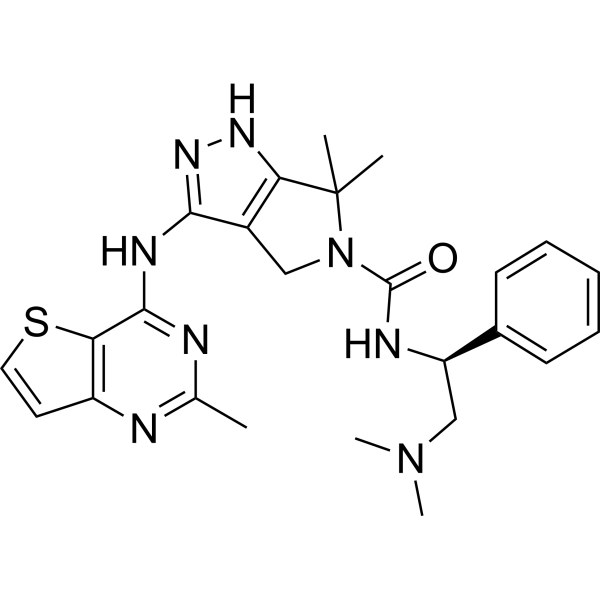 0 ImagesSynonyms: PF-03758309PF-3758309 (PF-03758309) is a potent, orally available, and reversible ATP-competitive inhibitor of PAK4 (Kd= 2.7 nM; Ki=18.7 nM). PF-3758309 has the expected cellular functions of a PAK4 inhibitor: inhibition of anchorage-independent growth, induction of apoptosis, cytoskeletal remodeling, and inhibition of proliferation.
-
LDN-0028574
 0 ImagesCat. No.: HY-123739CAS No.: 337500-87-5LDN-0028574 is a PAK3 inhibitor. LDN-0028574 can be used in the research of p53-deficient cancers.
-
PF-3758309 hydrochloride
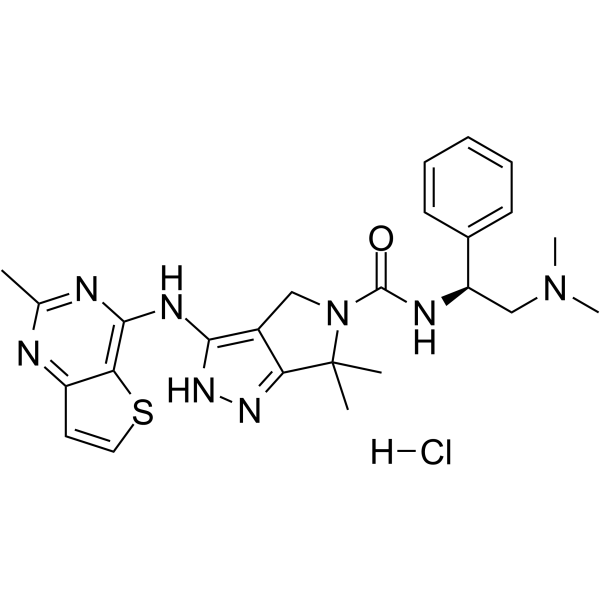 0 ImagesCat. No.: HY-13007ACAS No.: 1279034-84-2Synonyms: PF-03758309 hydrochloridePF-3758309 (PF-03758309) hydrochloride is a potent, orally available, and reversible ATP-competitive inhibitor of PAK4 (Kd= 2.7 nM; Ki=18.7 nM). PF-3758309 hydrochloride has the expected cellular functions of a PAK4 inhibitor: inhibition of anchorage-independent growth, induction of apoptosis, cytoskeletal remodeling, and inhibition of proliferation.
-
RN193
 0 ImagesCat. No.: HY-184447CAS No.: 3091508-49-2RN193 is a type II kinase inhibitor with a human PAK1 IC50 of 4.28 μM. RN193 functionally inhibits kinase activity of PAK1, PAK2, and PAK3, and engages with their kinase domains in live cells. RN193 induces thermal shifts in CLK1, GSK3B, ULK1, MELK, MAPK13, BRAF, and STK10, indicating binding and stabilization of these proteins. RN193 induces formation of PAK3:PAK2 heterodimers and displaces PAK2 homodimers in live cells. RN193 acts as a tool compound for studying group I PAK conformational states.
-
PF-3758309 dihydrochloride
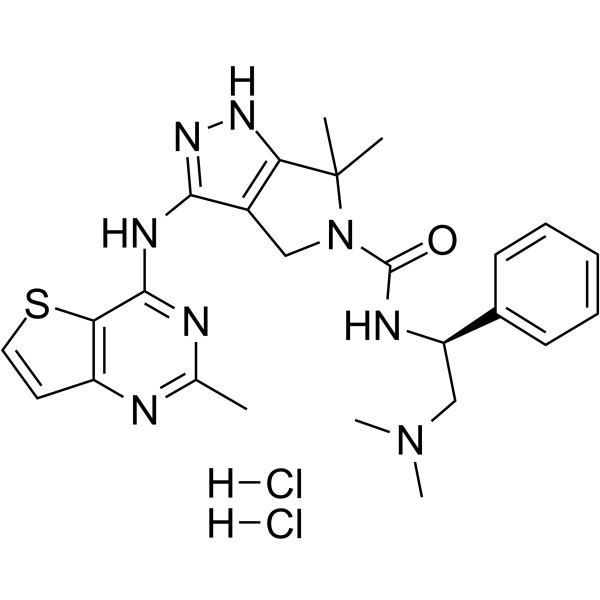 0 ImagesCat. No.: HY-13007BSynonyms: PF-03758309 dihydrochloridePF-3758309 (PF-03758309) dihydrochloride is a potent, orally available, and reversible ATP-competitive inhibitor of PAK4 (Kd= 2.7 nM; Ki=18.7 nM). PF-3758309 dihydrochloride has the expected cellular functions of a PAK4 inhibitor: inhibition of anchorage-independent growth, induction of apoptosis, cytoskeletal remodeling, and inhibition of proliferation.
-
PI3Kα-IN-27
 0 ImagesCat. No.: HY-178812CAS No.: 2098649-83-1PI3Kα-IN-27 (Compound 50b) is an orally active PI3K-α inhibitor, with an IC50 of 40 nM. PI3Kα-IN-27 effectively inhibits PAK3, p110α, phospho-mTOR and phospho-ERK1/2. PI3Kα-IN-27 induces early Apoptosis. PI3Kα-IN-27 shows anticancer activity against pancreatic cancer, lung cancer, breast cancer.
-
ZMF-10
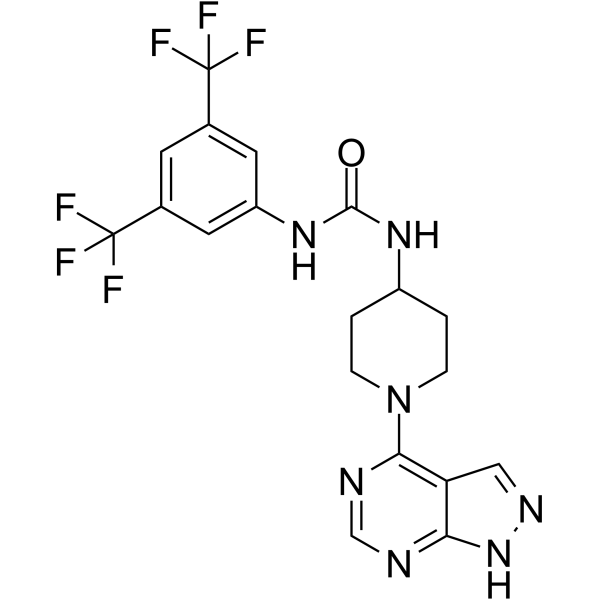 0 ImagesCat. No.: HY-146786CAS No.: 2415295-37-1
-
LDN-0044878
 0 ImagesCat. No.: HY-118606CAS No.: 296246-47-4LDN-0044878 is a PAK3 inhibitor. LDN-0044878 inhibits the proliferation or induces the death of p53-deficient cells. LDN-0044878 exhibits moderate trypanocidal activity against Trypanosoma brucei, but does not directly inhibit the core target Rhodesain. LDN-0044878 can be used in studies related to cervical adenocarcinoma and Trypanosoma brucei infection.




