



NU223612

Based on 1 Customer Validation
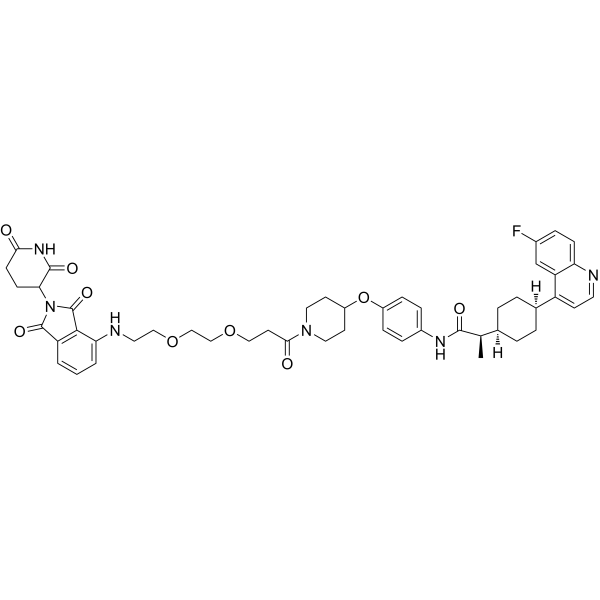
NU223612 is a cereblon (CRBN)-recruiting IDO1 PROTAC degrader, with a DC50 value of 0.329-0.5438 μM against human IDO1, and it is capable of penetrating the blood-brain barrier. NU223612 directly binds to IDO1, mediates the degradation of both wild-type and catalytically inactive mutant IDO1 proteins, and does not degrade TDO2. NU223612 inhibits IDO1-mediated enzymatic activity. NU223612 directly binds to CRBN and promotes the formation of a cooperative ternary complex with IDO1. NU223612 induces ubiquitin-dependent proteasomal degradation of the IDO1 protein. NU223612 suppresses IDO1-mediated non-enzymatic phosphorylation of NF-κB p65 and the DNA-binding activity of downstream transcription factors. NU223612 can be used in studies of glioblastoma (malignant glioma).
(Pink: IDO1 ligand (HY-184993); Blue: Ligands for E3 Ligase ligand (HY-41547); Black: linker).
For research use only. We do not sell to patients.
- Purity : 99.41%
- CAS No.: 2759420-43-2
- Formula: C49H55FN6O9
- Molecular Weight:890.99
-
Storage:Powder -20°C, 3 years , 4°C, 2 years ; In solvent -80°C, 6 months , -20°C, 1 month

To place orders, for customer services and technical support, please contact: MedChemExpress USA
Tel: 609-228-6898 E-mail: [email protected] [email protected]


-
 Biological Activity
-
Chemical Information
-
Solvent & Solubility
- Protocols
- Purity & Documentation
- References
-
 Help & FAQs


All PROTACs Isoforms
More

Biological Activity
Description
IC50 & Target
[1]|
Cereblon |
IDO1 0.329-0.54 μM (DC50) |
In Vitro
NU223612 (0.01-30 μM; 24 h) potently degrades IDO1 protein with a DC50 of 0.5438 μM in interferon-gamma stimulated GBM43 human glioblastoma cells[1].
NU223612 (1-10 μM; 1-96 h) mediates sustained, long-lasting IDO1 protein degradation in GBM43 cells, and the degradation effect in U87 cells does not require continuous compound presence in culture media in U87 and GBM43 human glioblastoma cells[1].
NU223612 (80 μM stock) directly binds both its target IDO1 protein and the cereblon E3 ubiquitin ligase protein with nanomolar affinity[1].
NU223612 (1.4 μM; 15 min pre-incubation) drives the formation of a highly stable, positively cooperative ternary complex between the IDO1 protein and the CRBN E3 ligase protein[1].
NU223612 (0.1-30 μM; 24 h) is a broadly active, IDO1-selective degrader that acts across multiple IDO1-expressing human and murine cell types, targets IDO1 in both major subcellular compartments, and degrades both wild-type and catalytically inactive IDO1 protein[1].
NU223612 (1-10 μM; 24 h) directly promotes the monoubiquitination of IDO1 protein, a required upstream step of targeted proteasomal degradation[1].
NU223612 (1-10 μM; 24 h) degrades IDO1 protein exclusively via the canonical cereblon-dependent, ubiquitin-mediated proteasomal degradation pathway[1].
MedChemExpress (MCE) has not independently confirmed the accuracy of these methods. They are for reference only.
-
Cell Line:Interferon-gamma stimulated U87 human glioblastoma cells
-
Concentration:0.01-30 μM (24 h incubation); 10 μM (24 h initial library screening)
-
Incubation Time:24 h
-
Result:Degrades IDO1 protein in a dose-dependent manner, achieving 94% IDO1 degradation at 10 μM, and exhibits measurable IDO1 protein degradation activity at 100 nM.
The half-maximal IDO1 degradation concentration (DC50) in U87 cells is 0.3290 μM.
-
Cell Line:Interferon-gamma stimulated GBM43 human glioblastoma cells
-
Concentration:0.01-30 μM
-
Incubation Time:24 h
-
Result:Degrades IDO1 protein in a dose-dependent manner, with a measured half-maximal IDO1 degradation concentration (DC50) of 0.5438 μM.
-
Cell Line:U87 and GBM43 human glioblastoma cells
-
Concentration:10 μM (1-96 h time-course); 1-10 μM (24-72 h continuous treatment in U87 cells)
-
Incubation Time:1-96 h (time-course); 24-72 h (continuous treatment)
-
Result:Initiates IDO1 protein degradation at 16 h post-treatment in U87 cells.
The degradation effect in GBM43 cells persists for at least 96 h.
Continuous treatment with 1 or 10 μM maintains suppressed IDO1 protein levels for up to 72 h in U87 cells.
Even after complete withdrawal from culture media following 24 h of treatment, the IDO1 degradation effect remains intact for at least an additional 48 h.
-
Cell Line:Multiple human cancer cell lines, murine GL261 IDO1-expressing glioma cells, and human PBMCs
-
Concentration:0.1-30 μM
-
Incubation Time:24 h
-
Result:Dose-dependently degrades IDO1 protein in every tested human cancer cell line, human DIPG cell line, GL261 murine glioma cell line, and human PBMC sample.
Equally degrades IDO1 protein in both the cytoplasmic and nuclear subcellular compartments of treated GBM cells, and degrades both wild-type IDO1 and catalytically inactive enzyme-dead mutant IDO1 protein.
Does not reduce TDO2 protein levels, confirming it is specifically selective for IDO1.
-
Cell Line:FLAG-tagged IDO1 expressing U87 cells
-
Concentration:1-10 μM (NU223612); 10 μM (cereblon E3 ligase modulator compound 1); 0.5 μM (MLN4924); 5 μM (MG132); 10 μM (NU223618); 250 nM (BGB-7204)
-
Incubation Time:24 h
-
Result:Co-treatment with excess cereblon E3 ligase modulator compound 1 (to compete for CRBN binding), the E1 ligase inhibitor MLN4924, or the proteasome inhibitor MG132 completely ablates NU223612-mediated IDO1 degradation.
A competitive IDO1 inhibitor co-treatment blocks NU223612 activity, while a non-competitive IDO1 inhibitor co-treatment does not prevent NU223612-mediated IDO1 degradation.
Parmacokinetics
In Vivo
MedChemExpress (MCE) has not independently confirmed the accuracy of these methods. They are for reference only.
-
Animal Model:C57BL/6 mice (8 week old male wild-type)[1]
-
Dosage:10 mg/kg; 25 mg/kg (single dose, IDO1 degradation); 25 mg/kg (Survival); 50 mg/kg; 100 mg/kg
-
Administration:i.p. (single dose); i.p.; 5 days/week; 3 weeks
-
Result:Decreased IDO1 protein by >70% within 2 hours post single 25 mg/kg i.p. administration, with reduced IDO1 protein levels remaining low for at least 24 hours.
Extended the overall survival of mice with established intracranial GL261-luciferase glioma at 25 mg/kg once daily 5 days per week administration initiated 14 days post tumor cell injection.
Showed no significant body weight change across 10, 25, or 50 mg/kg treatment groups over 3 weeks of administration.


Chemical Information
-
CAS No. 2759420-43-2
-
Appearance Solid
-
Molecular Weight 890.99
-
Formula C49H55FN6O9
-
Color White to yellow
-
SMILES
O=C([C@H](C)[C@@]1([H])CC[C@](C2=CC=NC3=CC=C(F)C=C23)([H])CC1)NC4=CC=C(OC5CCN(C(CCOCCOCCNC6=CC=CC(C(N7C(CC8)C(NC8=O)=O)=O)=C6C7=O)=O)CC5)C=C4
-
Shipping
Room temperature in continental US; may vary elsewhere.
-
Storage
Powder -20°C 3 years 4°C 2 years In solvent -80°C 6 months -20°C 1 month


Solvent & Solubility
In Vitro:
DMSO : 100 mg/mL (112.23 mM; Need ultrasonic; Hygroscopic DMSO has a significant impact on the solubility of product, please use newly opened DMSO)
Please refer to the solubility information to select the appropriate solvent. Once prepared, please aliquot and store the solution to prevent product inactivation from repeated freeze-thaw cycles.
Storage method and period of stock solution: -80°C, 6 months; -20°C, 1 month. When stored at -80°C, please use it within 6 months. When stored at -20°C, please use it within 1 month.
Please refer to the solubility information to select the appropriate solvent. Once prepared, please aliquot and store the solution to prevent product inactivation from repeated freeze-thaw cycles.
Storage method and period of stock solution: -80°C, 6 months; -20°C, 1 month. When stored at -80°C, please use it within 6 months. When stored at -20°C, please use it within 1 month.
Concentration (start) × Volume (start) = Concentration (final) × Volume (final)
In Vivo:
Select the appropriate dissolution method based on your experimental animal and administration route.
- For the following dissolution methods, please ensure to first prepare a clear stock solution using an In Vitro approach and then sequentially add co-solvents:
- To ensure reliable experimental results, the clarified stock solution can be appropriately stored based on storage conditions. As for the working solution for In Vivo experiments, it is recommended to prepare freshly and use it on the same day.
- The percentages shown for the solvents indicate their volumetric ratio in the final prepared solution. If precipitation or phase separation occurs during preparation, heat and/or sonication can be used to aid dissolution.
In Vivo Dissolution Calculator
Please enter the basic information of animal experiments:
-
-
-
-
Recommended: Prepare an additional quantity of animals to account for potential losses during experiments.
Please enter your animal formula composition:
-
%DMSO +
Recommended: Keep the proportion of DMSO in working solution below 2% if your animal is weak.
-
%+
-
+%Tween-80 + +
-
%Saline +
The co-solvents required include: DMSO, . All of co-solvents are available by MedChemExpress (MCE). , Tween 80. All of co-solvents are available by MedChemExpress (MCE).
Working solution concentration: 0.22 mg/mL
Method for preparing stock solution: mg drug dissolved in μL DMSO. Stock solution concentration: mg/mL.
1. Take μL DMSO stock solution;
2. Add μL .
μL , mix evenly;
3. Then add μL Tween 80, mix evenly;
4. Then add μL
Please ensure that the stock solution in the first step is dissolved to a clear state, and add co-solvents in sequence. You can use ultrasonic heating (ultrasonic cleaner, recommended frequency 20-40 kHz), vortexing, etc. to assist dissolution.


Purity & Documentation
-
Data Sheet (285 KB)
-
SDS (254 KB)
- English - EN (254 KB)
- Français - FR (254 KB)
- Deutsch - DE (254 KB)
- Norwegian - NO (254 KB)
- Español - ES (254 KB)
- Swedish - SV (254 KB)
- Italian - IT (254 KB)
- Korean - KR (254 KB)
- Portuguese - PT (254 KB)
-
Handling Instructions (2659 KB)
References


Complete Stock Solution Preparation Table
Please refer to the solubility information to select the appropriate solvent. Once prepared, please aliquot and store the solution to prevent product inactivation from repeated freeze-thaw cycles.
Storage method and period of stock solution: -80°C, 6 months; -20°C, 1 month. When stored at -80°C, please use it within 6 months. When stored at -20°C, please use it within 1 month.
| Optional Solvent | Concentration Solvent Mass | 1 mg | 5 mg | 10 mg | 25 mg |
|---|---|---|---|---|---|
| DMSO | 1 mM | 1.1223 mL | 5.6117 mL | 11.2235 mL | 28.0587 mL |
| 5 mM | 0.2245 mL | 1.1223 mL | 2.2447 mL | 5.6117 mL | |
| 10 mM | 0.1122 mL | 0.5612 mL | 1.1223 mL | 2.8059 mL | |
| 15 mM | 0.0748 mL | 0.3741 mL | 0.7482 mL | 1.8706 mL | |
| 20 mM | 0.0561 mL | 0.2806 mL | 0.5612 mL | 1.4029 mL | |
| 25 mM | 0.0449 mL | 0.2245 mL | 0.4489 mL | 1.1223 mL | |
| 30 mM | 0.0374 mL | 0.1871 mL | 0.3741 mL | 0.9353 mL | |
| 40 mM | 0.0281 mL | 0.1403 mL | 0.2806 mL | 0.7015 mL | |
| 50 mM | 0.0224 mL | 0.1122 mL | 0.2245 mL | 0.5612 mL | |
| 60 mM | 0.0187 mL | 0.0935 mL | 0.1871 mL | 0.4676 mL | |
| 80 mM | 0.0140 mL | 0.0701 mL | 0.1403 mL | 0.3507 mL | |
| 100 mM | 0.0112 mL | 0.0561 mL | 0.1122 mL | 0.2806 mL |


NU223612 Related Classifications
HY-151886 Related Classifications
 Powered by Bioz