



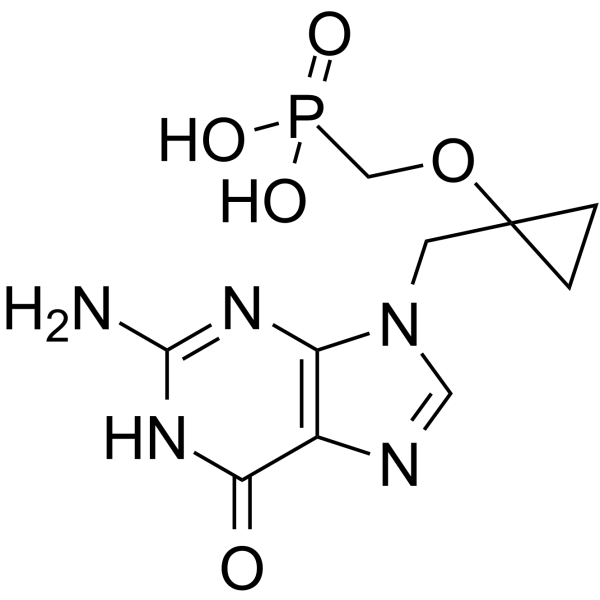
LB80317
LB80317 is an active metabolite of LB80380 and suppresses the DNA synthesis of HBV with an EC50 of 0.5 μM. LB80317 has antiviral effect and has the potential for chronic hepatitis B treatment.
商品は「研究用試薬」です。人や動物の医療用・臨床診断用・食品用の製品ではありません。
研究用途以外に使用した場合、当社は一切の責任を負いかねます。
- CAS 番号: 441785-24-6
- 分子式: C10H14N5O5P
- 分子量:315.22
-
保管条件:
Please store the product under the recommended conditions in the Certificate of Analysis.

To place orders, for customer services and technical support, please contact: MedChemExpress USA
Tel: 609-228-6898 E-mail: [email protected] [email protected]


-
 生物活性
生物活性
-
化学情報
- プロトコル
- 純度とドキュメンテーション
- 参考文献
-
 Help & FAQs



DNA/RNA Synthesis アイソフォーム固有の製品をすべて表示
More

生物活性
製品説明
IC50 & Target
EC50: 0.5 μM (DNA synthesis of HBV)[2]
Cellular Effect
|
Cell Line

|
Type | Value | Description | References |
|---|---|---|---|---|
| HepG2 | EC50 |
0.5 μM
Compound: 1
|
Compound tested for anti-HBV (hepatitis B virus) activity in HepG2 2.2.15 cell line
Compound tested for anti-HBV (hepatitis B virus) activity in HepG2 2.2.15 cell line
|
[PMID: 15139764] |
| HepG2 | CC50 |
>1000 μM
Compound: 1
|
Cytotoxic activity in HepG2 2.2.15 cell line
Cytotoxic activity in HepG2 2.2.15 cell line
|
[PMID: 15139764] |
体外実験
After phosphorylation to di- and triphosphate forms, LB80317 is incorporated into the viral DNA inside the nucleocapsid, which inhibits further DNA synthesis. In in vitro studies using cell line models, the drug concentrations causing 50% reduction in HBV DNA produced (EC50) is 0.5 μM for LB80317[2].
MedChemExpress (MCE) has not independently confirmed the accuracy of these methods. They are for reference only. Further protocols information, click here.
体内実験
MedChemExpress (MCE) has not independently confirmed the accuracy of these methods. They are for reference only.


化学情報
-
CAS 番号 441785-24-6
-
分子量 315.22
-
分子式 C10H14N5O5P
-
SMILES
OP(O)(COC1(CN2C=NC3=C2N=C(N)NC3=O)CC1)=O
-
輸送条件
Room temperature in continental US; may vary elsewhere.
-
保管条件
Please store the product under the recommended conditions in the Certificate of Analysis.

プロトコル
-
EdU Incorporation Assay (Click Chemistry-Based DNA Synthesis Measurement)
The EdU incorporation assay measures DNA synthesis by adding the thymidine analog 5-ethynyl-2′-deoxyuridine to cells or tissues, where it is incorporated into newly synthesized DNA during S phase. Incorporated EdU is detected by copper-catalyzed azide-alkyne cycloaddition, in which a fluorescent azide covalently reacts with the ethynyl group on EdU, allowing S-phase cells to be detected by fluorescence microscopy, flow cytometry, or high-content imaging. EdU detection does not require DNA denaturation or anti-BrdU antibody access, which preserves sample structure and improves compatibility with immunostaining and multiparameter cytometry compared with BrdU-based detection. EdU can be cytotoxic in a cell-type- and exposure-dependent manner, so pulse duration, concentration, and continuous-labeling designs should be validated for each cell type.
-
Research Protocol for Infectious Diseases
Infectious-disease experiments test how pathogens interact with host barriers, innate immune receptors, inflammatory signaling, pathogen replication, and tissue injury; pattern-recognition receptors such as TLRs, RIG-I-like receptors, NOD-like receptors, and inflammasomes detect microbial molecules and activate NF-κB, interferon, and cytokine responses. The central hypothesis is that infection severity reflects the balance between pathogen burden and host response: protective inflammation restricts pathogen growth, whereas excessive or mislocalized inflammation contributes to tissue damage and disease phenotype. Unresolved questions include which host pathways are protective versus pathogenic, why some infection models fail to translate to human disease, and which combined readouts best predict clinically relevant infection outcomes.
-
BrdU Incorporation Assay
Bromodeoxyuridine (BrdU) incorporation assay is based on the principle that BrdU, a thymidine analog, is incorporated into newly synthesized DNA during the S phase of the cell cycle, thereby serving as a marker of DNA replication and cellular proliferation. Incorporated BrdU can be detected using anti-BrdU antibodies following DNA denaturation, enabling visualization or quantification of proliferating cells through immunochemical detection methods such as immunofluorescence or immunohistochemistry.


純度とドキュメンテーション
参考文献
[1]. Man-Fung Yuen, et al. Pharmacokinetics of LB80331 and LB80317 Following Oral Administration of LB80380, a New Antiviral Agent for Chronic Hepatitis B (CHB), in Healthy Adult Subjects, CHB Patients, and Mice. Antimicrob Agents Chemother. 2009 May;53(5):177 [Content Brief]
[2]. Lung-Yi Mak, et al. Pharmacokinetic Evaluation of Besifovir for the Treatment of HBV Infection. Expert Opin Drug Metab Toxicol. 2018 Jan;14(1):101-106. [Content Brief]

Calculators
濃度 (開始) × 体積 (開始) = 濃度 (終了) × 体積 (終了)


LB80317 関連分類
HY-106235 関連分類
 Powered by Bioz