



Propamocarb
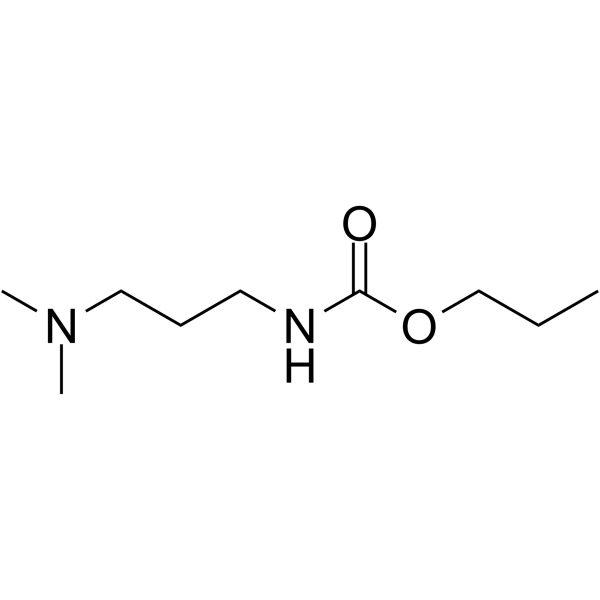
Propamocarb is an orally active phenylalanine ammonia-lyase (PAL) inducer and oomycete membrane biosynthesis inhibitor that can be present in synthetic formulations. Propamocarb is used in research on blight, gut microbiota dysbiosis and metabolic disorders, cardiovascular diseases, and potato late blight.
商品は「研究用試薬」です。人や動物の医療用・臨床診断用・食品用の製品ではありません。
研究用途以外に使用した場合、当社は一切の責任を負いかねます。
- CAS 番号: 24579-73-5
- 分子式: C9H20N2O2
- 分子量:188.27
-
保管条件:
Please store the product under the recommended conditions in the Certificate of Analysis.

To place orders, for customer services and technical support, please contact: MedChemExpress USA
Tel: 609-228-6898 E-mail: [email protected] [email protected]


-
 生物活性
生物活性
-
化学情報
- プロトコル
- 純度とドキュメンテーション
- 参考文献
-
 Help & FAQs




生物活性
製品説明
体外実験
Propamocarb significantly increases the activities of PAL (to 101.8 nmol·h-1·mg-1 protein) and POD (to 106.1 U·g-1 FW) in cucumber fruit peel[1].
Propamocarb significantly increases acetylbromide-extractable Lignin (HY-111830) content in cucumber fruit peel, reaching 80.76 mg/g dry weight, which is a 41.1% increase compared to the control[1].
Propamocarb (1.8-10 mg/mL; 5-7 days) provided minimal inhibition of mycelial growth for the 71 P. nicotianae isolates tested, with the most sensitive isolate showing 34.8% relative growth at 10 mg/mL[2].
Propamocarb (1-100 mg/mL; 5-7 days) is a poor inhibitor of P. nicotianae mycelial growth, with EC50 values ranging from 2.2 to 90.1 mg/mL across the nine isolates and a mean of 20.6 mg/mL[2].
Propamocarb (5-50,000 µg/mL; 10 h) potently suppressed sporangium production in P. nicotianae isolates, with EC50 values ranging from 133.8 to 481.3 µg/mL and complete inhibition at 50,000 µg/mL[2].
Propamocarb (5-50,000 µg/mL; 10 min-1 h) inhibited zoospore motility in P. nicotianae isolates, with EC50 values ranging from 88.1 to 249.8 µg/mL and complete cessation of motility within 10 min at 5,000 µg/mL or above[2].
Propamocarb (5-50,000 µg/mL; 2 days) inhibited zoospore germination in P. nicotianae isolates, with EC50 values ranging from 1.9 to 184.6 µg/mL across the nine isolates[2].
Propamocarb (0.1-50 µg/mL; 7 days) slightly affected cell viability and moderately reduced mitochondrial function, glucose consumption, and intracellular ATP in primary rat cortical neurons, with these effects being strongly mitigated or completely prevented by pyruvate and acetylcysteine supplementation; the compound showed no direct effect on GSH levels within 1 h[5].
Propamocarb controls late blight in detached potato leaves incited by P. infestans with EC90 values ranging from 72 to 122 ppm, with no significant difference between Metalaxyl (HY-B0843)-sensitive and metalaxyl-resistant isolates[6].
MedChemExpress (MCE) has not independently confirmed the accuracy of these methods. They are for reference only.
体内実験
MedChemExpress (MCE) has not independently confirmed the accuracy of these methods. They are for reference only.
-
Animal Model:ICR mice (Male, 5 weeks old)[3]
-
Dosage:3, 30, and 300 mg/L (0.5, 5, and 50 mg/kg bw/day)
-
Administration:p.o.; ad libitum; 28 days
-
Result:Decreased hepatic TG levels to 75.8% in the 30 mg/L group and 69.7% in the 300 mg/L group.
Significantly decreased mRNA levels of Fatp2 in all treatment groups, Fabp2 in the 30 mg/L group, Acox in all groups, and Scd1 in all groups.
Significantly up-regulated colonic LPL transcription in the 30 and 300 mg/L groups and increased colonic LPL protein in the 3 and 300 mg/L groups.
Decreased colonic GPR41 transcription in all treated groups.
Altered 20 fecal metabolites in the 300 mg/L group, including increased propionate, isobutyrate, total bile acids, taurine, choline, ethanolamine, and trimethylamine, and decreased succinate, trehalose, β-galactose, glycerol, and lactate.
-
Animal Model:C57BL/6J mice (Male, 5-week-old)[4]
-
Dosage:1 mg/L; 3 mg/L; 10 mg/L
-
Administration:p.o.; in drinking water; continuously for 10 weeks
-
Result:Increased total hepatic bile acids (BAs) by 29.8% (10.9 mmol/g vs. 8.4 mmol/g) at 10 mg/L.
Down-regulated mRNA levels of Cyp7a1, Cyp8b1, Cyp27a1, and BA transporters Abcb11, Ntcp, Mrp2, and Mrp3 in the liver.
Decreased FXR expression considerably at 10 mg/L.
Decreased Lbabp mRNA level significantly in the ileum at 3 and 10 mg/L.
Increased serum levels of TCA (64.70 vs. 46.30 nmol/L), UDCA (25.81 vs. 12.80 nmol/L), TβMCA (86.4 vs. 42.79 nmol/L), TωMCA (140.60 vs. 92.33 nmol/L), βMCA (298.48 vs. 159.77 nmol/L), and ωMCA (212.62 vs. 148.17 nmol/L) at 10 mg/L.
Decreased expression of genes related to fatty acid translation, β-oxidation, and TG synthesis significantly at 10 mg/L.
Increased hepatic FMO3 protein levels significantly at 1, 3, and 10 mg/L.
Increased cardiac NO levels significantly at 10 mg/L.
Decreased cardiac NOS activities significantly at 3 and 10 mg/L.
Increased transcriptional levels of NF-κB in the heart significantly at 3 and 10 mg/L.
Increased fecal trimethylamine (TMA) significantly at 10 mg/L.


化学情報
-
CAS 番号 24579-73-5
-
分子量 188.27
-
分子式 C9H20N2O2
-
SMILES
O=C(OCCC)NCCCN(C)C
-
輸送条件
Room temperature in continental US; may vary elsewhere.
-
保管条件
Please store the product under the recommended conditions in the Certificate of Analysis.


純度とドキュメンテーション
参考文献
[2]. Hu J, et al. Effects of Propamocarb Hydrochloride on Mycelial Growth, Sporulation, and Infection by Phytophthora nicotianae Isolates from Virginia Nurseries. Plant disease. 2007 Apr;91(4):414-420. [Content Brief]
[3]. Wu S, et al. Exposure to the fungicide propamocarb causes gut microbiota dysbiosis and metabolic disorder in mice. Environmental pollution (Barking, Essex : 1987). 2018 Jun;237:775-783. [Content Brief]
[4]. Wu S, et al. Chronic exposure to fungicide propamocarb induces bile acid metabolic disorder and increases trimethylamine in C57BL/6J mice. Sci Total Environ. 2018 Nov 15;642:341-348. [Content Brief]
[5]. Schmuck G, et al. Effects of the carbamates fenoxycarb, propamocarb and propoxur on energy supply, glucose utilization and SH-groups in neurons. Archives of toxicology. 2004 Jun;78(6):330-7. [Content Brief]

Calculators
濃度 (開始) × 体積 (開始) = 濃度 (終了) × 体積 (終了)


Propamocarb 関連分類
HY-B2026 関連分類
 Powered by Bioz
Keywords
- Propamocarb
- 24579-73-5
- Fungal
- Biochemical Assay Reagents
- oomycete membrane biosynthesis inhibitor
- gut microbiota dysbiosis
- cardiovascular disease
- cucumber fruit peel
- late blight of potato
- Phytophthora nicotianae
- phenylpropanoid pathway
- phenylalanine ammonia-lyase (PAL) inducer
- lignin synthesis
- Phytophthora infestans
- Inhibitor
- inhibitor
- inhibit