



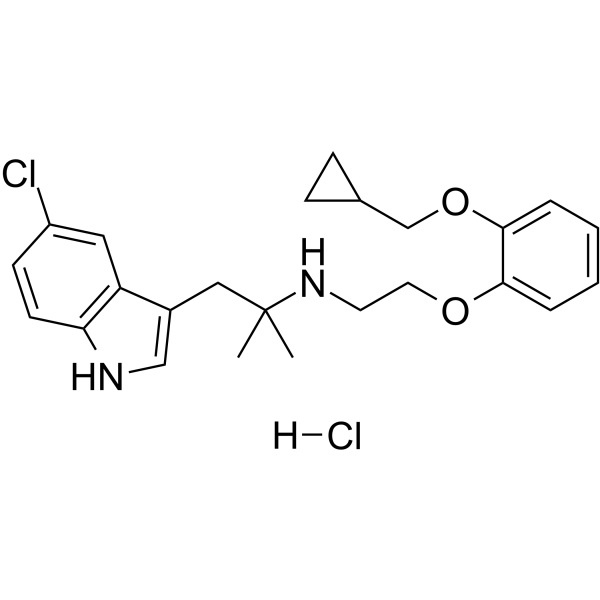
RS 17053 hydrochloride
Based on 1 publication(s) in Google Scholar
RS 17053 hydrochloride is a selective α1A-adrenoceptor antagonist. RS 17053 hydrochloride binds to MrcA/MecA A-class penicillin-binding proteins, inhibits peptidoglycan biosynthesis, and binds to α1A and α1B/α1D-adrenoceptors. RS 17053 hydrochloride disrupts bacterial membranes, causing depolarization, ATP depletion, protein leakage, ROS accumulation, and upregulation of stress response genes. RS 17053 hydrochloride exerts bactericidal activity against Gram-positive/Gram-negative pathogens. RS 17053 hydrochloride can be used for research on bacterial infections and benign prostatic hyperplasia.
연구목적의 판매만을 진행합니다. 환자를 대상으로 한 판매는 하지 않습니다.
- Purity : 99.29%
- CAS No.: 169505-93-5
- 화학식: C24H30Cl2N2O2
- 분자량:449.41
-
보관:
4°C, sealed storage, away from moisture
* In solvent : -80°C, 6 months; -20°C, 1 month (sealed storage, away from moisture)

To place orders, for customer services and technical support, please contact: MedChemExpress USA
Tel: 609-228-6898 E-mail: [email protected] [email protected]


-
 Biological Activity
-
Chemical Information
-
용액&용해도
- Protocol
- 순도&문서
- References
-
 Help & FAQs



Publications Citing Use of MedChemExpress (MCE) RS 17053 hydrochloride
MoreAll Adrenergic Receptor Isoforms
More

Biological Activity
제품 설명
|
α1A-adrenergic receptor |
α1B-adrenergic receptor |
α1D-adrenergic receptor |
penicillin-binding proteins |
In Vitro
RS 17053 hydrochloride exhibits activity against Brucella spp. in the disk diffusion method[1].
RS 17053 hydrochloride has rapid bactericidal activity against Brucella spp.[1].
RS 17053 hydrochloride causes cell wall rupture and lysis in Brucella melitensis TZ[1].
RS 17053 hydrochloride exhibits bactericidal activity against S. typhimurium SL1344 and MRSA ATCC 43300[1].
RS 17053 hydrochloride damages the cell wall membrane of MRSA and causes lysis[1].
RS 17053 hydrochloride disrupts the membrane integrity of S. typhimurium SL1344 and MRSA ATCC 43300[1].
RS 17053 hydrochloride inhibits nascent peptidoglycan synthesis in S. typhimurium SL1344 and MRSA ATCC 43300[1].
RS 17053 hydrochloride reduces S. typhimurium peptidoglycan levels by 98% and MRSA by 96%[1].
RS 17053 hydrochloride inhibits Staphylococcus aureus MW2 with an MIC of 8 µg/mL and exhibits activity against multiple drug-resistant Gram-positive isolates[4].
RS 17053 hydrochloride increases the NADH/NAD+ ratio in Staphylococcus aureus ATCC 29213[4].
RS 17053 hydrochloride depolarizes and permeabilizes the membrane of Staphylococcus aureus MW2 at active concentrations[4].
RS 17053 hydrochloride distinguishes two [3H]-Prazosin (HY-B0193) binding components in wild-type mouse brain cortex slices, with pKi values of 8.8 and 7.7, respectively[2].
RS 17053 hydrochloride antagonizes norepinephrine-induced contraction in wild-type mouse prostate with a pKB of 6.9[2].
RS 17053 hydrochloride binds to human cloned α1a, α1b, and α1d adrenergic receptors with pKi values of 8.90, 7.10, and 7.20, respectively[3].
RS-17053 (0.1-1000 µM) hydrochloride antagonizes Phenylephrine (HY-B0769)-induced contraction of isolated rabbit prostate strips, with a pKB of 6.32[3].
RS 17053 hydrochloride antagonizes norepinephrine-induced contraction of isolated rabbit prostate strips, with a pKB of 6.7[5].
MedChemExpress (MCE) has not independently confirmed the accuracy of these methods. They are for reference only.
-
Cell Line:RAW264.7 murine macrophages and THP-1 human monocytes
-
Concentration:10, 100, and 200 μM
-
Incubation Time:24 h
-
Result:Did not induce cytotoxicity at 10 μM.
Significantly inhibited cell viability at high concentrations (100 μM and 200 μM).
In Vivo
RS 17053 (10 mg/kg/day; i.m.; once daily; starting 3 hours after infection for 5 consecutive days) hydrochloride improves the survival rate of S. typhimurium-infected BALB/c mice and reduces the liver bacterial burden by 4.5 log10 CFU[1].
RS 17053 (10 mg/kg/day; i.m.; once daily; starting 3 hours post-infection for 5 consecutive days) hydrochloride improves the survival rate of infected BALB/c mice and reduces the splenic MRSA burden by 3.8 log10 CFU[1].
MedChemExpress (MCE) has not independently confirmed the accuracy of these methods. They are for reference only.
-
Animal Model:BALB/c (female, 6-8 weeks old, 18 g)[1]
-
Dosage:10 mg/kg/day
-
Administration:i.m.; once daily; 5 consecutive days starting 3 hours after infection
-
Result:Reduced splenic bacterial burden by >2 log10 CFU/mL compared with infected untreated mice.
Significantly restored the body weight of infected mice and alleviated the symptom of splenomegaly.
-
Animal Model:BALB/c (female, 6-8 weeks old, 18 g)[1]
-
Dosage:10 mg/kg/day
-
Administration:i.m.; once daily; 5 consecutive days starting 3 hours after infection
-
Result:Produced a mean reduction of 4.5 log10 CFU/liver compared with PBS.
The hazard ratio for death was 0.12 (95% CI 0.03-0.41).
-
Animal Model:BALB/c (female, 6-8 weeks old, 18 g)[1]
-
Dosage:10 mg/kg/day
-
Administration:i.m.; once daily; 5 consecutive days starting 3 hours after infection
-
Result:Produced a mean reduction of 3.8 log10 CFU/spleen compared with PBS.
The hazard ratio for death was 0.09 (95% CI 0.02-0.38).


Chemical Information
-
CAS No. 169505-93-5
-
Appearance Solid
-
분자량 449.41
-
화학식 C24H30Cl2N2O2
-
Color White to off-white
-
SMILES
ClC1=CC2=C(NC=C2CC(C)(C)NCCOC3=CC=CC=C3OCC4CC4)C=C1.Cl
-
선적
Room temperature in continental US; may vary elsewhere.
-
보관
4°C, sealed storage, away from moisture
* In solvent : -80°C, 6 months; -20°C, 1 month (sealed storage, away from moisture)


Publications (1)
-
Journal Impact Factor
-
Most Recent


용액&용해도
In Vitro:
DMSO : 100 mg/mL (222.51 mM; Need ultrasonic; Hygroscopic DMSO has a significant impact on the solubility of product, please use newly opened DMSO)
Please refer to the solubility information to select the appropriate solvent. Once prepared, please aliquot and store the solution to prevent product inactivation from repeated freeze-thaw cycles.
Storage method and period of stock solution: -80°C, 6 months; -20°C, 1 month (sealed storage, away from moisture). When stored at -80°C, please use it within 6 months. When stored at -20°C, please use it within 1 month.
Concentration (start) × Volume (start) = Concentration (final) × Volume (final)
In Vivo:
Select the appropriate dissolution method based on your experimental animal and administration route.
- For the following dissolution methods, please ensure to first prepare a clear stock solution using an In Vitro approach and then sequentially add co-solvents:
- To ensure reliable experimental results, the clarified stock solution can be appropriately stored based on storage conditions. As for the working solution for In Vivo experiments, it is recommended to prepare freshly and use it on the same day.
- The percentages shown for the solvents indicate their volumetric ratio in the final prepared solution. If precipitation or phase separation occurs during preparation, heat and/or sonication can be used to aid dissolution.
Add each solvent one by one: 10% DMSO 40% PEG300 5% Tween-80 45% Saline
Solubility: ≥ 2.08 mg/mL (4.63 mM); Clear solution
This protocol yields a clear solution of ≥ 2.08 mg/mL (saturation unknown).
Taking 1 mL working solution as an example, add 100 μL DMSO stock solution (20.8 mg/mL) to 400 μL PEG300, and mix evenly; then add 50 μL Tween-80 and mix evenly; then add 450 μL Saline to adjust the volume to 1 mL.
Preparation of Saline: Dissolve 0.9 g sodium chloride in ddH₂O and dilute to 100 mL to obtain a clear Saline solution.
Add each solvent one by one: 10% DMSO 90% (20% SBE-β-CD in Saline)
Solubility: ≥ 2.08 mg/mL (4.63 mM); Clear solution
This protocol yields a clear solution of ≥ 2.08 mg/mL (saturation unknown).
Taking 1 mL working solution as an example, add 100 μL DMSO stock solution (20.8 mg/mL) to 900 μL 20% SBE-β-CD in Saline, and mix evenly.
Preparation of 20% SBE-β-CD in Saline (4°C, storage for one week): 2 g SBE-β-CD powder is dissolved in 10 mL Saline, completely dissolve until clear.
In Vivo Dissolution Calculator
Please enter the basic information of animal experiments:
-
-
-
-
Recommended: Prepare an additional quantity of animals to account for potential losses during experiments.
Please enter your animal formula composition:
-
%DMSO +
Recommended: Keep the proportion of DMSO in working solution below 2% if your animal is weak.
-
%+
-
+%Tween-80 + +
-
%Saline +
The co-solvents required include: DMSO, . All of co-solvents are available by MedChemExpress (MCE). , Tween 80. All of co-solvents are available by MedChemExpress (MCE).
Working solution concentration: 0.22 mg/mL
Method for preparing stock solution: mg drug dissolved in μL DMSO. Stock solution concentration: mg/mL. * In solvent : -80°C, 6 months; -20°C, 1 month (sealed storage, away from moisture)
1. Take μL DMSO stock solution;
2. Add μL .
μL , mix evenly;
3. Then add μL Tween 80, mix evenly;
4. Then add μL
Please ensure that the stock solution in the first step is dissolved to a clear state, and add co-solvents in sequence. You can use ultrasonic heating (ultrasonic cleaner, recommended frequency 20-40 kHz), vortexing, etc. to assist dissolution.


순도&문서
-
Data Sheet (289 KB)
-
SDS (252 KB)
- English - EN (252 KB)
- Français - FR (252 KB)
- Deutsch - DE (252 KB)
- Norwegian - NO (252 KB)
- Español - ES (252 KB)
- Swedish - SV (252 KB)
- Italian - IT (252 KB)
- Korean - KR (252 KB)
- Portuguese - PT (252 KB)
-
Handling Instructions (2659 KB)
References


Complete Stock Solution Preparation Table
Please refer to the solubility information to select the appropriate solvent. Once prepared, please aliquot and store the solution to prevent product inactivation from repeated freeze-thaw cycles.
Storage method and period of stock solution: -80°C, 6 months; -20°C, 1 month (sealed storage, away from moisture). When stored at -80°C, please use it within 6 months. When stored at -20°C, please use it within 1 month.
| Optional Solvent | Concentration Solvent Mass | 1 mg | 5 mg | 10 mg | 25 mg |
|---|---|---|---|---|---|
| DMSO | 1 mM | 2.2251 mL | 11.1257 mL | 22.2514 mL | 55.6285 mL |
| 5 mM | 0.4450 mL | 2.2251 mL | 4.4503 mL | 11.1257 mL | |
| 10 mM | 0.2225 mL | 1.1126 mL | 2.2251 mL | 5.5628 mL | |
| 15 mM | 0.1483 mL | 0.7417 mL | 1.4834 mL | 3.7086 mL | |
| 20 mM | 0.1113 mL | 0.5563 mL | 1.1126 mL | 2.7814 mL | |
| 25 mM | 0.0890 mL | 0.4450 mL | 0.8901 mL | 2.2251 mL | |
| 30 mM | 0.0742 mL | 0.3709 mL | 0.7417 mL | 1.8543 mL | |
| 40 mM | 0.0556 mL | 0.2781 mL | 0.5563 mL | 1.3907 mL | |
| 50 mM | 0.0445 mL | 0.2225 mL | 0.4450 mL | 1.1126 mL | |
| 60 mM | 0.0371 mL | 0.1854 mL | 0.3709 mL | 0.9271 mL | |
| 80 mM | 0.0278 mL | 0.1391 mL | 0.2781 mL | 0.6954 mL | |
| 100 mM | 0.0223 mL | 0.1113 mL | 0.2225 mL | 0.5563 mL |


RS 17053 hydrochloride Related Classifications
HY-101336 Related Classifications
 Powered by Bioz
Keywords
- RS 17053
- 169505-93-5
- RS17053
- RS-17053
- Adrenergic Receptor
- Penicillin-binding protein (PBP)
- Reactive Oxygen Species (ROS)
- Bacterial
- Beta Receptor
- Brucella
- Gram-positive bacteria
- MRSA
- Salmonella typhimurium
- benign prostatic hyperplasia
- membrane depolarization
- penicillin-binding proteins
- peptidoglycan biosynthesis
- α1A-adrenoceptor
- α1L-adrenoceptor
- Inhibitor
- inhibitor
- inhibit