



Paradol (Standard)
Based on 1 publication(s) in Google Scholar
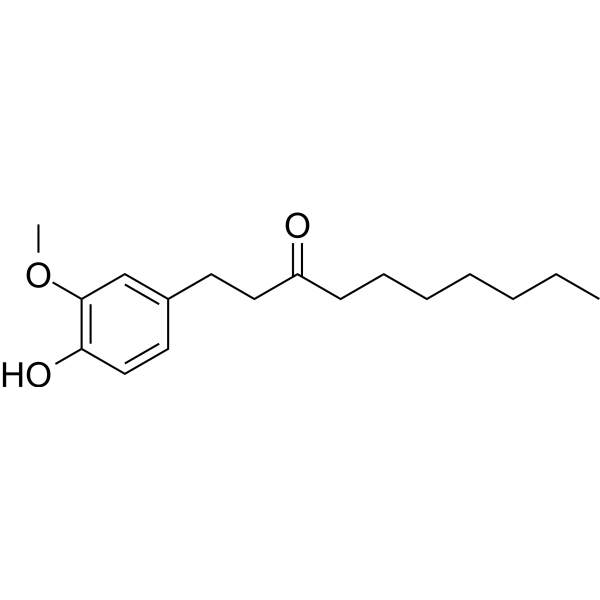
Paradol (Standard) is the analytical standard of Paradol. This product is intended for research and analytical applications. Paradol is a pungent phenolic substance found in ginger and other Zingiberaceae plants. Paradol is an effective inhibitor of tumor promotion in mouse skin carcinogenesis, binds to cyclooxygenase (COX)-2 active site.
연구목적의 판매만을 진행합니다. 환자를 대상으로 한 판매는 하지 않습니다.
- CAS No.: 27113-22-0
- 화학식: C17H26O3
- 분자량:278.39
-
보관:
Please store the product under the recommended conditions in the Certificate of Analysis.


To place orders, for customer services and technical support, please contact: MedChemExpress USA
Tel: 609-228-6898 E-mail: [email protected] [email protected]


-
 Product Information
-
Chemical Information
- 순도&문서
-
 Help & FAQs


Publications Citing Use of MedChemExpress (MCE) Paradol (Standard)
More

Product Information
Information
신청
The compound is the grade of analytical standard, which is the reference standard supplied assay. It is commonly used in qualitative, quantitative and methodological research experiments in HPLC, GC and MS.


Chemical Information
-
CAS No. 27113-22-0
-
Appearance Solid
-
분자량 278.39
-
화학식 C17H26O3
-
Color White to off-white
-
SMILES
COC1=C(O)C=CC(CCC(CCCCCCC)=O)=C1
-
Synonyms
[6]-Gingerone (Standard); [6]-Paradol (Standard)
-
Structure Classification
-
Initial Source
-
선적
Room temperature in continental US; may vary elsewhere.
-
보관
Please store the product under the recommended conditions in the Certificate of Analysis.


Publications (1)
-
Journal Impact Factor
-
Most Recent


순도&문서
References
[1]. van Breemen RB, et al. Cyclooxygenase-2 inhibitors in ginger (Zingiber officinale). Fitoterapia. 2011 Jan;82(1):38-43. [Content Brief]
[2]. Keum YS, et al. Induction of apoptosis and caspase-3 activation by chemopreventive [6]-paradol and structurally related compounds in KB cells. Cancer Lett. 2002 Mar 8;177(1):41-7. [Content Brief]
[3]. Gaire BP, et al. Neuroprotective effect of 6-paradol in focal cerebral ischemia involves the attenuation of neuroinflammatory responses in activated microglia. PLoS One. 2015 Mar 19;10(3):e0120203. [Content Brief]
[4]. Setoguchi S, et al. Pharmacokinetics of Paradol Analogues Orally Administered to Rats. J Agric Food Chem. 2016 Mar 9;64(9):1932-7. [Content Brief]

Calculators
Concentration (start) × Volume (start) = Concentration (final) × Volume (final)


Paradol (Standard) Related Classifications
HY-14617R Related Classifications
 Powered by Bioz