



MN714

Based on 1 Customer Validation
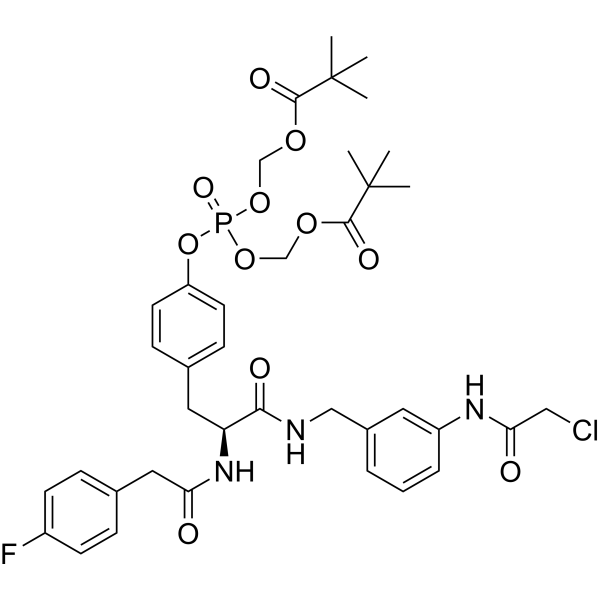
MN714 is a prodrug of MN551 (HY-156395) with enhanced cell permeability. MN714 specifically and covalently binds to SOCS2 within living cells, with an EC50 of 3.77 μM at 2 h and 2.52 μM at 8 h. MN714 serves as a chemical probe for investigating the biological mechanisms of the SOCS2 and CRL5 complex, and also functions as an E3 ligase linker for PROTAC development.
Nos produits utilisent uniquement pour la recherche. Nous ne vendons pas aux patients.
- Pureté : 99.12%
- Formule: C38H46ClFN3O11P
- Masse moléculaire:806.21
-
Stockage:
4°C, sealed storage, away from moisture
* In solvent : -80°C, 6 months; -20°C, 1 month (sealed storage, away from moisture)

To place orders, for customer services and technical support, please contact: MedChemExpress USA
Tel: 609-228-6898 E-mail: [email protected] [email protected]


-
 Activité biologique
-
Chemical Information
-
Solvant et solubilité
- Protocole
- Pureté et documentation
- Références
-
 Help & FAQs




Activité biologique
Description
In Vitro
MN714 binds to HiBiT-tagged intracellular SOCS2 in live HeLa cells in a dose- and time-dependent manner, with an EC50 of 3.77 μM after 2 h and 2.52 μM after 8 h; treatment with 50 μM for 20 h induces a thermal stability shift of approximately 5 °C[1].
MN714 (500 μM; 0-4 h) is efficiently intracellularly deprotected in K562 cells to release MN551, with an estimated deprotection half-life of 1-1.5 h[2].
MN714 (10 μM; 6 h) blocks the interaction between endogenous SOCS2 and its natural substrate GHR in K562 cells[2].
MedChemExpress (MCE) has not independently confirmed the accuracy of these methods. They are for reference only. Further protocols information, click here.
-
Cell Line:K562 cells
-
Concentration:10 μM
-
Incubation Time:6 h
-
Result:Caused near-complete abrogation of SOCS2 pulldown by biotinylated GHR_pY595 peptide, compared to DMSO-treated control cells where SOCS2 was readily pulled down.


Chemical Information
-
Appearance Solid
-
Masse moléculaire 806.21
-
Formule C38H46ClFN3O11P
-
Color White to off-white
-
SMILES
FC1=CC=C(CC(N[C@@H](CC2=CC=C(OP(OCOC(C(C)(C)C)=O)(OCOC(C(C)(C)C)=O)=O)C=C2)C(NCC3=CC=CC(NC(CCl)=O)=C3)=O)=O)C=C1
-
Livraison
Room temperature in continental US; may vary elsewhere.
-
Stockage
4°C, sealed storage, away from moisture
* In solvent : -80°C, 6 months; -20°C, 1 month (sealed storage, away from moisture)


Solvant et solubilité
In Vitro:
DMSO : 100 mg/mL (124.04 mM; Need ultrasonic; Hygroscopic DMSO has a significant impact on the solubility of product, please use newly opened DMSO)
Please refer to the solubility information to select the appropriate solvent. Once prepared, please aliquot and store the solution to prevent product inactivation from repeated freeze-thaw cycles.
Storage method and period of stock solution: -80°C, 6 months; -20°C, 1 month (sealed storage, away from moisture). When stored at -80°C, please use it within 6 months. When stored at -20°C, please use it within 1 month.
Please refer to the solubility information to select the appropriate solvent. Once prepared, please aliquot and store the solution to prevent product inactivation from repeated freeze-thaw cycles.
Storage method and period of stock solution: -80°C, 6 months; -20°C, 1 month (sealed storage, away from moisture). When stored at -80°C, please use it within 6 months. When stored at -20°C, please use it within 1 month.
Concentration (start) × Volume (start) = Concentration (final) × Volume (final)
In Vivo:
Select the appropriate dissolution method based on your experimental animal and administration route.
- For the following dissolution methods, please ensure to first prepare a clear stock solution using an In Vitro approach and then sequentially add co-solvents:
- To ensure reliable experimental results, the clarified stock solution can be appropriately stored based on storage conditions. As for the working solution for In Vivo experiments, it is recommended to prepare freshly and use it on the same day.
- The percentages shown for the solvents indicate their volumetric ratio in the final prepared solution. If precipitation or phase separation occurs during preparation, heat and/or sonication can be used to aid dissolution.
Add each solvent one by one: 10% DMSO 40% PEG300 5% Tween-80 45% Saline
Solubility: ≥ 2.5 mg/mL (3.10 mM); Clear solution
This protocol yields a clear solution of ≥ 2.5 mg/mL (saturation unknown).
Taking 1 mL working solution as an example, add 100 μL DMSO stock solution (25.0 mg/mL) to 400 μL PEG300, and mix evenly; then add 50 μL Tween-80 and mix evenly; then add 450 μL Saline to adjust the volume to 1 mL.
Preparation of Saline: Dissolve 0.9 g sodium chloride in ddH₂O and dilute to 100 mL to obtain a clear Saline solution.
In Vivo Dissolution Calculator
Please enter the basic information of animal experiments:
-
-
-
-
Recommended: Prepare an additional quantity of animals to account for potential losses during experiments.
Please enter your animal formula composition:
-
%DMSO +
Recommended: Keep the proportion of DMSO in working solution below 2% if your animal is weak.
-
%+
-
+%Tween-80 + +
-
%Saline +
The co-solvents required include: DMSO, . All of co-solvents are available by MedChemExpress (MCE). , Tween 80. All of co-solvents are available by MedChemExpress (MCE).
Working solution concentration: 0.22 mg/mL
Method for preparing stock solution: mg drug dissolved in μL DMSO. Stock solution concentration: mg/mL. * In solvent : -80°C, 6 months; -20°C, 1 month (sealed storage, away from moisture)
1. Take μL DMSO stock solution;
2. Add μL .
μL , mix evenly;
3. Then add μL Tween 80, mix evenly;
4. Then add μL
Please ensure that the stock solution in the first step is dissolved to a clear state, and add co-solvents in sequence. You can use ultrasonic heating (ultrasonic cleaner, recommended frequency 20-40 kHz), vortexing, etc. to assist dissolution.

Protocole
-
Transepithelial/transendothelial electrical resistance assay
TEER measures electrical resistance across epithelial or endothelial monolayers cultured on permeable supports, and the readout reflects ionic conductance through the cell barrier, especially the paracellular pathway regulated by junctional integrity. TEER can be measured without destroying the monolayer and is commonly used before or during transport, permeability, barrier-disruption, and barrier-maturation experiments. TEER values are influenced by biological maturation and technical conditions; reported factors include temperature, medium formulation, passage number, electrode geometry, membrane properties, and junctional length during early monolayer maturation. Therefore, TEER should be interpreted with blank-insert subtraction, area normalization, repeated readings, and, when possible, orthogonal barrier readouts such as FITC-dextran flux or tight-junction staining.


Pureté et documentation
-
Fiche technique (276 KB)
-
SDS (252 KB)
- English - EN (252 KB)
- Français - FR (252 KB)
- Deutsch - DE (252 KB)
- Norwegian - NO (252 KB)
- Español - ES (252 KB)
- Swedish - SV (252 KB)
- Italian - IT (252 KB)
- Korean - KR (252 KB)
- Portuguese - PT (252 KB)
-
Instruction de manipulation (2659 KB)
Références


Complete Stock Solution Preparation Table
Please refer to the solubility information to select the appropriate solvent. Once prepared, please aliquot and store the solution to prevent product inactivation from repeated freeze-thaw cycles.
Storage method and period of stock solution: -80°C, 6 months; -20°C, 1 month (sealed storage, away from moisture). When stored at -80°C, please use it within 6 months. When stored at -20°C, please use it within 1 month.
| Optional Solvent | Concentration Solvent Mass | 1 mg | 5 mg | 10 mg | 25 mg |
|---|---|---|---|---|---|
| DMSO | 1 mM | 1.2404 mL | 6.2019 mL | 12.4037 mL | 31.0093 mL |
| 5 mM | 0.2481 mL | 1.2404 mL | 2.4807 mL | 6.2019 mL | |
| 10 mM | 0.1240 mL | 0.6202 mL | 1.2404 mL | 3.1009 mL | |
| 15 mM | 0.0827 mL | 0.4135 mL | 0.8269 mL | 2.0673 mL | |
| 20 mM | 0.0620 mL | 0.3101 mL | 0.6202 mL | 1.5505 mL | |
| 25 mM | 0.0496 mL | 0.2481 mL | 0.4961 mL | 1.2404 mL | |
| 30 mM | 0.0413 mL | 0.2067 mL | 0.4135 mL | 1.0336 mL | |
| 40 mM | 0.0310 mL | 0.1550 mL | 0.3101 mL | 0.7752 mL | |
| 50 mM | 0.0248 mL | 0.1240 mL | 0.2481 mL | 0.6202 mL | |
| 60 mM | 0.0207 mL | 0.1034 mL | 0.2067 mL | 0.5168 mL | |
| 80 mM | 0.0155 mL | 0.0775 mL | 0.1550 mL | 0.3876 mL | |
| 100 mM | 0.0124 mL | 0.0620 mL | 0.1240 mL | 0.3101 mL |


MN714 Related Classifications
HY-156373 Related Classifications
 Powered by Bioz