



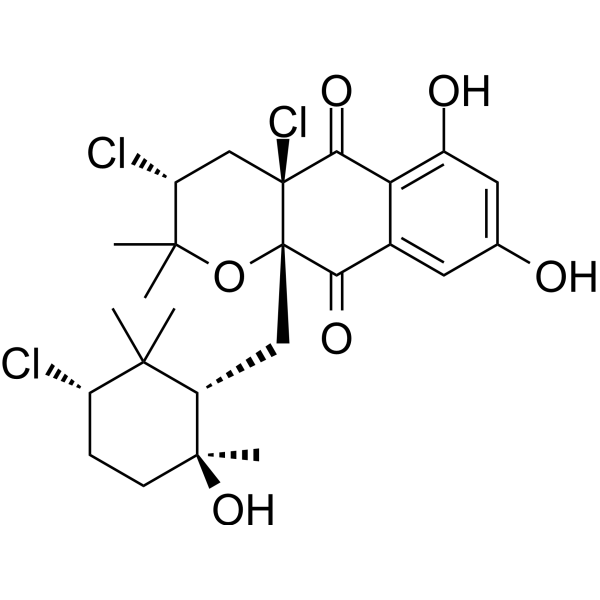
Napyradiomycin B4
Napyradiomycin B4 is a Napyradiomycin derivative, which inhibits the RANKL-induced MEK-ERK signaling pathway. Napyradiomycin B4 attenuates osteoclastogenesis and prevents alveolar bone destruction in experimental periodontitis.
For research use only. We do not sell to patients.
- CAS No.: 111216-63-8
- Formula: C25H31Cl3O6
- Molecular Weight:533.87
-
Storage:
Please store the product under the recommended conditions in the Certificate of Analysis.

To place orders, for customer services and technical support, please contact: MedChemExpress USA
Tel: 609-228-6898 E-mail: [email protected] [email protected]


-
 Biological Activity
-
Chemical Information
- Protocols
- Purity & Documentation
- References
-
 Help & FAQs


All MEK Isoforms
More

Biological Activity
Description
Cellular Effect
|
Cell Line

|
Type | Value | Description | References |
|---|---|---|---|---|
| HCT-116 | IC50 |
10 μM
Compound: napyradiomycin B4
|
Antiproliferative activity against human HCT116 cells assessed as cell viability after 72 hrs by MTS assay
Antiproliferative activity against human HCT116 cells assessed as cell viability after 72 hrs by MTS assay
|
[PMID: 24328269] |
In Vitro
Napyradiomycin B4 (5 μM, 4 days) inhibits RANKL-induced osteoclast differentation[1].
Napyradiomycin B4 (5 μM, 4 days) promotes the expressions of Nrf2 related genes and inhibits the expressions of osteoclast related genes[1].
MedChemExpress (MCE) has not independently confirmed the accuracy of these methods. They are for reference only.
-
Cell Line:BMMs
-
Concentration:1-5 μM
-
Incubation Time:4 days
-
Result:Revealed no evidence of F-actin ring.
-
Cell Line:BMMs
-
Concentration:1-5 μM
-
Incubation Time:4 days
-
Result:Reduced mRNA expressions of Nfatc1, Acp5, Dcstamp, Ctsk, and Mmp9.
Promoted mRNA expressions of Nrf2, Nqo1 and HO1.
In Vivo
MedChemExpress (MCE) has not independently confirmed the accuracy of these methods. They are for reference only.
-
Animal Model:Ligature-induced periodontitis in C57BL/J6 mice model[1]
-
Dosage:2-12 mg/kg
-
Administration:i.p. for 6 days
-
Result:Prevented the alveolar bone resorption and bone loss with high dose, inhibited osteoclast formation.


Chemical Information
-
CAS No. 111216-63-8
-
Molecular Weight 533.87
-
Formula C25H31Cl3O6
-
SMILES
Cl[C@](C(C1=C(O)C=C(O)C=C1C2=O)=O)(C[C@H](C(C)(O3)C)Cl)[C@]23C[C@H]4C(C)([C@H](CC[C@@]4(O)C)Cl)C
-
Initial Source
marine-derived Streptomyces species
-
Shipping
Room temperature in continental US; may vary elsewhere.
-
Storage
Please store the product under the recommended conditions in the Certificate of Analysis.


Purity & Documentation
References

Calculators
Concentration (start) × Volume (start) = Concentration (final) × Volume (final)


Napyradiomycin B4 Related Classifications
HY-N12740 Related Classifications
 Powered by Bioz