



NNK (Standard)

Based on 1 Customer Validation
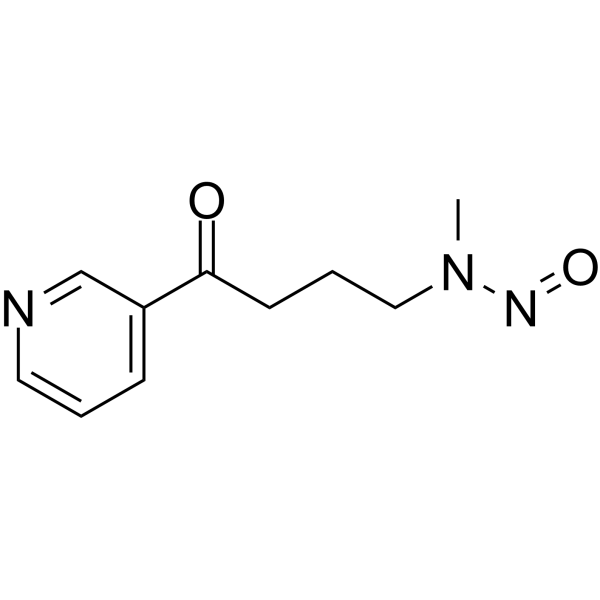
NNK (Standard) is the analytical standard of NNK. This product is intended for research and analytical applications. NNK is a nicotine-nitrosated derivative. NNK simultaneously stimulates Bcl2 phosphorylation exclusively at Ser70 and c-Myc at Thr58 and Ser62 through activation of both ERK1/2 and PKCα. NNK induces survival and proliferation of human lung cancer cells. NNK can be used for lung cancer mice model structure.
For research use only. We do not sell to patients.
- Purity : 99.94%
- CAS No.: 64091-91-4
- Formula: C₁₀H₁₃N₃O₂
- Molecular Weight:207.23
-
Storage:
Please store the product under the recommended conditions in the Certificate of Analysis.


To place orders, for customer services and technical support, please contact: MedChemExpress USA
Tel: 609-228-6898 E-mail: [email protected] [email protected]


-
 Product Information
-
Chemical Information
- Purity & Documentation
-
 Help & FAQs


-
HY-126477
NNKNicotine-nitrosated Derivative -
HY-131503
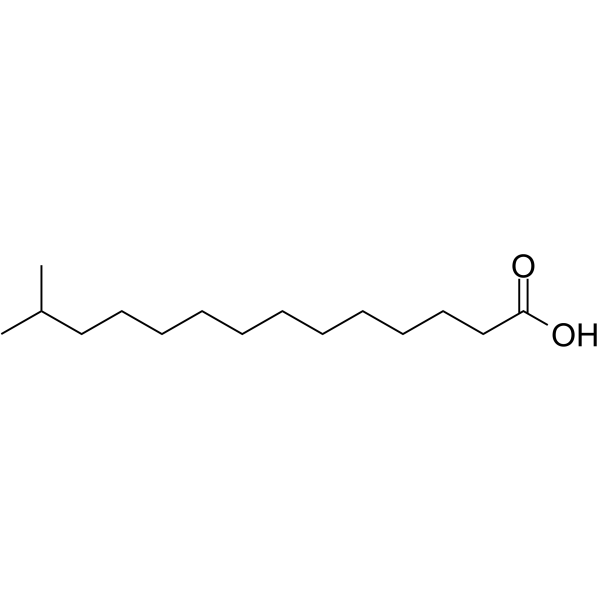
13-Methyltetradecanoic acidAnticancer Agent -
HY-B0617A
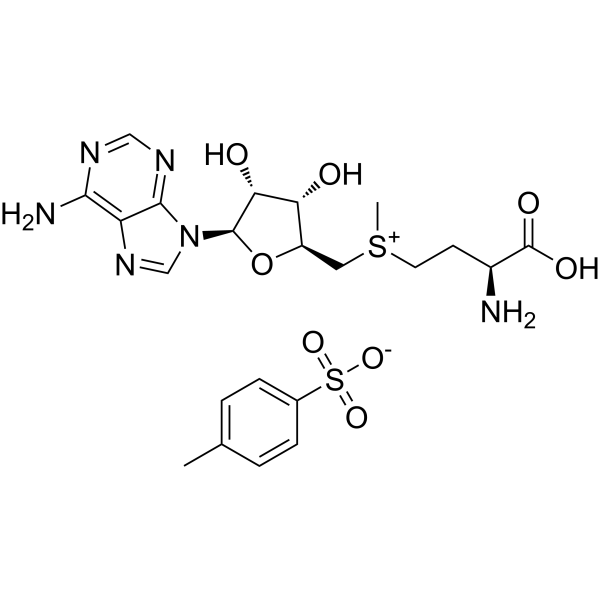
S-Adenosyl-L-methionine tosylateMethyl Group Donor -

HY-B0617AR
S-Adenosyl-L-methionine tosylate (Standard)Standard of S-Adenosyl-L-methionine tosylate -
HY-14614A
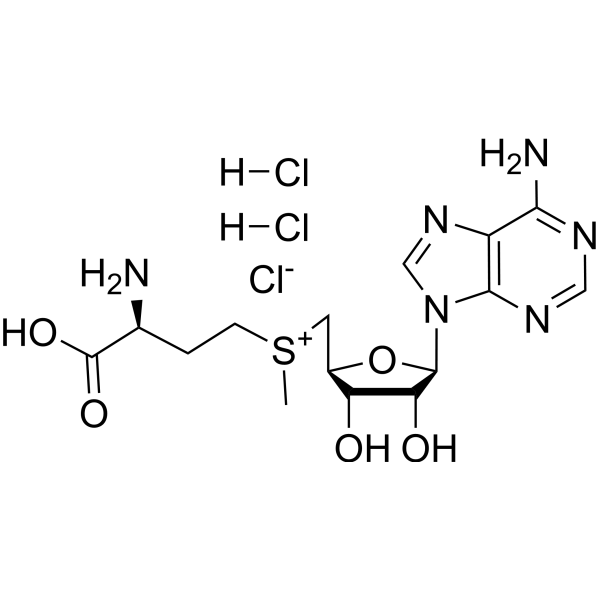
S-Adenosyl-L-methionine chloride dihydrochlorideMethyl Donor -

HY-W116576
3-MethoxycatecholAntihypertensive Agent -

HY-W116576R
3-Methoxycatechol (Standard)Reference Standard -

HY-119558
Bromacil -

HY-118614
β-NicotyrineNicotine Metabolite -
![2-Ammo-3-memyl-imidazo-[4,5-f]-quinoIine](https://file.medchemexpress.com/product_pic/hy-w281364.gif)
HY-W281364
2-Ammo-3-memyl-imidazo-[4,5-f]-quinoIineMutagenic Compound -

HY-119558R
Bromacil (Standard) -

HY-118614R
β-Nicotyrine (Standard)Nicotine Metabolite


Product Information
Information
Application
The compound is the grade of analytical standard, which is the reference standard supplied assay. It is commonly used in qualitative, quantitative and methodological research experiments in HPLC, GC and MS.


Chemical Information
-
CAS No. 64091-91-4
-
Appearance Solid
-
Molecular Weight 207.23
-
Formula C₁₀H₁₃N₃O₂
-
Color White to light yellow
-
SMILES
O=C(C1=CC=CN=C1)CCCN(C)N=O
-
Structure Classification
-
Initial Source
-
Shipping
Room temperature in continental US; may vary elsewhere.
-
Storage
Please store the product under the recommended conditions in the Certificate of Analysis.


Purity & Documentation
-
SDS (584 KB)
- English - EN (584 KB)
- Français - FR (584 KB)
- Deutsch - DE (584 KB)
- Norwegian - NO (584 KB)
- Español - ES (584 KB)
- Swedish - SV (584 KB)
- Italian - IT (584 KB)
- Korean - KR (584 KB)
- Portuguese - PT (584 KB)
-
Handling Instructions (2659 KB)
References
[1]. Jin Z, et al. Tobacco-specific nitrosamine 4-(methylnitrosamino)-1-(3-pyridyl)-1-butanone promotes functional cooperation of Bcl2 and c-Myc through phosphorylation in regulating cell survival and proliferation. J Biol Chem. 2004;279(38):40209-40219. [Content Brief]
[2]. Castonguay A, et al. Lung tumorigenicity of NNK given orally to A/J mice: its application to chemopreventive efficacy studies. Exp Lung Res. 1991;17(2):485-499. [Content Brief]

Calculators
Concentration (start) × Volume (start) = Concentration (final) × Volume (final)


NNK (Standard) Related Classifications
HY-126477R Related Classifications
 Powered by Bioz