



PhpC

Based on 1 Customer Validation
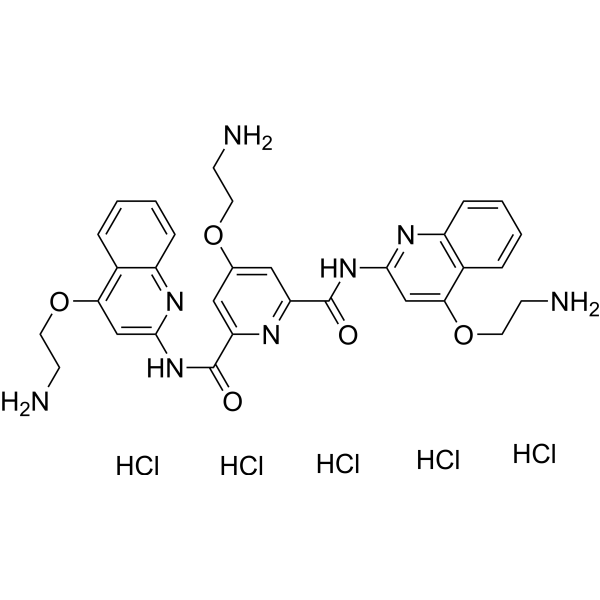
PhpC is a G-quadruplex (G4)-DNA/RNA disruptor. PhpC disrupts DNA and RNA G4 structures and promotes G4 helicase activity. PhpC effectively enhancing the activity of Taq polymerase. PhpC modulates G-quadruplexs (G4s) both in vitro and in cells.
For research use only. We do not sell to patients.
- Purity : 98.90%
- Formula: C18H20N4O4
- Molecular Weight:356.38
-
Storage:
4°C, sealed storage, away from moisture and light
* In solvent : -80°C, 6 months; -20°C, 1 month (sealed storage, away from moisture and light)


To place orders, for customer services and technical support, please contact: MedChemExpress USA
Tel: 609-228-6898 E-mail: [email protected] [email protected]


-
 Biological Activity
-
Chemical Information
-
Solvent & Solubility
- Purity & Documentation
- References
-
 Help & FAQs


All DNA/RNA Synthesis Isoforms
More

Biological Activity
Description
In Vitro
PhpC enhances the reverse transcription of RNA containing rMYC G4 while exerting a significant inhibitory effect on the reverse transcription of rhTELO, r5YEY, and rTBA[3].
PhpC promotes the in vitro translation of G4-containing RNA[3].
PhpC inhibits the cell viability of HEK293FT cells, with an IC50 value of 25.7 μM[3].
PhpC (5-20 μM; 24 h) induces an increase in the DNA damage marker γH2AX, indicating that it can induce DNA damage[3].
PhpC (25-100 μM; 24 h) leads to a gradual increase in the transcript level of mature miR-3196 in A549 cells[4].
PhpC can recognize and bind to the regions forming G4s (rG4)-3196 sequence, disrupting its native G4 conformation and leading to a structural transition[4].
In HeLa cells, the immunofluorescence (IF) analyses demonstrats that 100 µM PhpC reduces G4 levels significantly while it has no effect on the metabolic activity[5].
PhpC (90 µM, 48 h) significantly decreases the abundance of NRAS G4 in MCF7 cells[6].
PhpC (90 μM; 72 h) shows no significant effects against LINC01589 and MELTF-AS1, while PhpC triggers a significant decrease against UXT-AS1 and NRAS in HT-29 cells[7].
PhpC modulates the G4 landscapes in a focused manner, altering only the translational activity in astrocytes with the upregulation of 295 proteins mostly involved in RNA transactions[8].
MedChemExpress (MCE) has not independently confirmed the accuracy of these methods. They are for reference only.
-
Cell Line:A549 cells
-
Concentration:25 μM, 50 μM, 100 μM
-
Incubation Time:24 h
-
Result:Effectively enhanced the levels of miR-3196 in cells.
Clinical Trial
| NCT Number | Sponsor | Condition | Start Date |
Phase

|
|---|---|---|---|---|
| NCT01329991 | Plexxikon| | 2011-05 | PHASE1 |


Chemical Information
-
Appearance Solid
-
Molecular Weight 356.38
-
Formula C18H20N4O4
-
Color Light yellow to yellow
-
SMILES
NCCOC1=CC=CC(C2=CC3=CN(C(N=C3N2)=O)CC(OCC)=O)=C1
-
Shipping
Room temperature in continental US; may vary elsewhere.
-
Storage
4°C, sealed storage, away from moisture and light
* In solvent : -80°C, 6 months; -20°C, 1 month (sealed storage, away from moisture and light)


Solvent & Solubility
In Vitro:
DMSO : 100 mg/mL (280.60 mM; Need ultrasonic; Hygroscopic DMSO has a significant impact on the solubility of product, please use newly opened DMSO)
Please refer to the solubility information to select the appropriate solvent. Once prepared, please aliquot and store the solution to prevent product inactivation from repeated freeze-thaw cycles.
Storage method and period of stock solution: -80°C, 6 months; -20°C, 1 month (sealed storage, away from moisture and light). When stored at -80°C, please use it within 6 months. When stored at -20°C, please use it within 1 month.
Please refer to the solubility information to select the appropriate solvent. Once prepared, please aliquot and store the solution to prevent product inactivation from repeated freeze-thaw cycles.
Storage method and period of stock solution: -80°C, 6 months; -20°C, 1 month (sealed storage, away from moisture and light). When stored at -80°C, please use it within 6 months. When stored at -20°C, please use it within 1 month.
Concentration (start) × Volume (start) = Concentration (final) × Volume (final)
In Vivo:
Select the appropriate dissolution method based on your experimental animal and administration route.
- For the following dissolution methods, please ensure to first prepare a clear stock solution using an In Vitro approach and then sequentially add co-solvents:
- To ensure reliable experimental results, the clarified stock solution can be appropriately stored based on storage conditions. As for the working solution for In Vivo experiments, it is recommended to prepare freshly and use it on the same day.
- The percentages shown for the solvents indicate their volumetric ratio in the final prepared solution. If precipitation or phase separation occurs during preparation, heat and/or sonication can be used to aid dissolution.
Add each solvent one by one: 10% DMSO 40% PEG300 5% Tween-80 45% Saline
Solubility: 2.5 mg/mL (7.01 mM); Suspended solution; Need ultrasonic
This protocol yields a suspended solution of 2.5 mg/mL. Suspended solution can be used for oral and intraperitoneal injection.
Taking 1 mL working solution as an example, add 100 μL DMSO stock solution (25.0 mg/mL) to 400 μL PEG300, and mix evenly; then add 50 μL Tween-80 and mix evenly; then add 450 μL Saline to adjust the volume to 1 mL.
Preparation of Saline: Dissolve 0.9 g sodium chloride in ddH₂O and dilute to 100 mL to obtain a clear Saline solution.
Add each solvent one by one: 10% DMSO 90% (20% SBE-β-CD in Saline)
Solubility: 2.5 mg/mL (7.01 mM); Suspended solution; Need ultrasonic
This protocol yields a suspended solution of 2.5 mg/mL. Suspended solution can be used for oral and intraperitoneal injection.
Taking 1 mL working solution as an example, add 100 μL DMSO stock solution (25.0 mg/mL) to 900 μL 20% SBE-β-CD in Saline, and mix evenly.
Preparation of 20% SBE-β-CD in Saline (4°C, storage for one week): 2 g SBE-β-CD powder is dissolved in 10 mL Saline, completely dissolve until clear.
In Vivo Dissolution Calculator
Please enter the basic information of animal experiments:
-
-
-
-
Recommended: Prepare an additional quantity of animals to account for potential losses during experiments.
Please enter your animal formula composition:
-
%DMSO +
Recommended: Keep the proportion of DMSO in working solution below 2% if your animal is weak.
-
%+
-
+%Tween-80 + +
-
%Saline +
The co-solvents required include: DMSO, . All of co-solvents are available by MedChemExpress (MCE). , Tween 80. All of co-solvents are available by MedChemExpress (MCE).
Working solution concentration: 0.22 mg/mL
Method for preparing stock solution: mg drug dissolved in μL DMSO. Stock solution concentration: mg/mL. * In solvent : -80°C, 6 months; -20°C, 1 month (sealed storage, away from moisture and light)
1. Take μL DMSO stock solution;
2. Add μL .
μL , mix evenly;
3. Then add μL Tween 80, mix evenly;
4. Then add μL
Please ensure that the stock solution in the first step is dissolved to a clear state, and add co-solvents in sequence. You can use ultrasonic heating (ultrasonic cleaner, recommended frequency 20-40 kHz), vortexing, etc. to assist dissolution.


Purity & Documentation
-
Data Sheet (272 KB)
-
SDS (251 KB)
- English - EN (251 KB)
- Français - FR (251 KB)
- Deutsch - DE (251 KB)
- Norwegian - NO (251 KB)
- Español - ES (251 KB)
- Swedish - SV (251 KB)
- Italian - IT (251 KB)
- Korean - KR (251 KB)
- Portuguese - PT (251 KB)
-
Handling Instructions (2659 KB)
References
[1]. Mitteaux, J. et al. Identifying G-Quadruplex-DNA-Disrupting Small Molecules. J. Am. Chem. Soc. 143, 12567-12577 (2021). [Content Brief]
[2]. Liu X, et al. Unveiling a Potent Small Molecule Disruptor for RNA G-Quadruplexes Tougher Than DNA G-Quadruplex Disruption. ACS Chem Biol. 2024 Sep 20;19(9):2032-2040. [Content Brief]
[3]. Teng X, et al. Discovery of A G-Quadruplex Unwinder That Unleashes the Translation of G-Quadruplex-Containing mRNA without Inducing DNA Damage. Angew Chem Int Ed Engl. 2024 Sep 16;63(38):e202407353. [Content Brief]
[4]. Alexandre D, et al. Cellular modulation of a G-quadruplex structure found in the lung cancer-related microRNA-3196. Int J Biol Macromol. 2025 Jul;318(Pt 4):145263. [Content Brief]
[5]. De Magis, A. et al. UV-induced G4 DNA structures recruit ZRF1 which prevents UV-induced senescence. Nat. Commun. 14, 6705 (2023). [Content Brief]
[6]. Mitteaux J, et al. PhpC modulates G-quadruplex-RNA landscapes in human cells. Chem Commun (Camb). 2024 Jan 4;60(4):424-427. [Content Brief]
[7]. Sharma S, et al. Pharmacomodulation of G-quadruplexes in long non-coding RNAs dysregulated in colorectal cancer. BMC Biol. 2025 Aug 8;23(1):249. [Content Brief]
[8]. M J VK, et al. Small molecule-based regulation of gene expression in human astrocytes switching on and off the G-quadruplex control systems. J Biol Chem. 2025 Jan;301(1):108040. [Content Brief]


Complete Stock Solution Preparation Table
Please refer to the solubility information to select the appropriate solvent. Once prepared, please aliquot and store the solution to prevent product inactivation from repeated freeze-thaw cycles.
Storage method and period of stock solution: -80°C, 6 months; -20°C, 1 month (sealed storage, away from moisture and light). When stored at -80°C, please use it within 6 months. When stored at -20°C, please use it within 1 month.
| Optional Solvent | Concentration Solvent Mass | 1 mg | 5 mg | 10 mg | 25 mg |
|---|---|---|---|---|---|
| DMSO | 1 mM | 2.8060 mL | 14.0300 mL | 28.0599 mL | 70.1498 mL |
| 5 mM | 0.5612 mL | 2.8060 mL | 5.6120 mL | 14.0300 mL | |
| 10 mM | 0.2806 mL | 1.4030 mL | 2.8060 mL | 7.0150 mL | |
| 15 mM | 0.1871 mL | 0.9353 mL | 1.8707 mL | 4.6767 mL | |
| 20 mM | 0.1403 mL | 0.7015 mL | 1.4030 mL | 3.5075 mL | |
| 25 mM | 0.1122 mL | 0.5612 mL | 1.1224 mL | 2.8060 mL | |
| 30 mM | 0.0935 mL | 0.4677 mL | 0.9353 mL | 2.3383 mL | |
| 40 mM | 0.0701 mL | 0.3507 mL | 0.7015 mL | 1.7537 mL | |
| 50 mM | 0.0561 mL | 0.2806 mL | 0.5612 mL | 1.4030 mL | |
| 60 mM | 0.0468 mL | 0.2338 mL | 0.4677 mL | 1.1692 mL | |
| 80 mM | 0.0351 mL | 0.1754 mL | 0.3507 mL | 0.8769 mL | |
| 100 mM | 0.0281 mL | 0.1403 mL | 0.2806 mL | 0.7015 mL |


PhpC Related Classifications
HY-164421 Related Classifications
 Powered by Bioz