



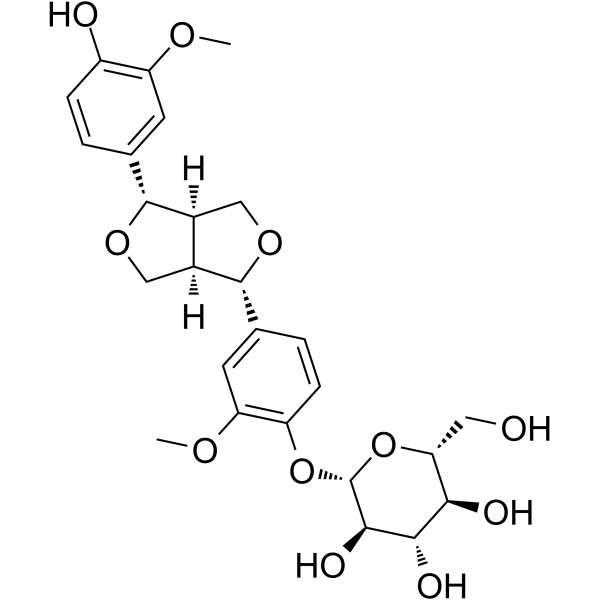
Pinoresinol 4-O-β-D-glucopyranoside
Based on 1 publication(s) in Google Scholar
Pinoresinol 4-O-β-D-glucopyranoside ((+)-Pinoresinol 4-O-β-D-glucopyranoside) is an orally active α-glucosidase inhibitor, with an IC50 of 48.13 μg/mL. Pinoresinol 4-O-β-D-glucopyranoside binds to estrogen receptors. Pinoresinol 4-O-β-D-glucopyranoside inhibits phosphodiesterase. Pinoresinol 4-O-β-D-glucopyranoside exhibits various activities such as antioxidant, anti-inflammatory, anti-hyperglycemic, hepatoprotective and anti-epileptic effects.
For research use only. We do not sell to patients.
- Purity : 99.89%
- CAS No.: 69251-96-3
- Formula: C26H32O11
- Molecular Weight:520.53
-
Storage:
4°C, sealed storage, away from moisture and light
* In solvent : -80°C, 6 months; -20°C, 1 month (sealed storage, away from moisture and light)

To place orders, for customer services and technical support, please contact: MedChemExpress USA
Tel: 609-228-6898 E-mail: [email protected] [email protected]


-
 Biological Activity
-
Chemical Information
-
Solvent & Solubility
- Purity & Documentation
- References
-
 Help & FAQs



Publications Citing Use of MedChemExpress (MCE) Pinoresinol 4-O-β-D-glucopyranoside
More

Biological Activity
Description
|
α‑glucosidase 48.13 μg/mL (IC50) |
In Vitro
Pinoresinol 4-O-β-D-glucopyranoside (0.1 μM-0.1 mM; 24 h) activates estrogen receptor (ER)-dependent transcription of both transfected and endogenous target genes in Hela cells and MCF-7 cells, and induces pS2 mRNA expression in MCF-7 cells in a dose-dependent manner[1].
Pinoresinol 4-O-β-D-glucopyranoside shows no inhibitory activity against A/PR/8/34 (H1N1) virus in MDCK cells[2].
Pinoresinol 4-O-β-D-glucopyranoside shows promising antioxidant activity with an IC50 of 34.5 μg/mL in the ABTS assay[4].
Pinoresinol 4-O-β-D-glucopyranoside exhibits a potent α-glucosidase inhibition, with an IC50 of 48.13 μg/mL[4].
Pinoresinol 4-O-β-D-glucopyranoside (2.5-150 μg/mL) displays a substantial antioxidant activity in the DPPH scavenging capacity assay, with an IC50 of 44.2 μg/mL and a TAC of 737.7 μmol/g[7].
MedChemExpress (MCE) has not independently confirmed the accuracy of these methods. They are for reference only.
-
Cell Line:MCF-7 cells, MDA-MB-231 cells
-
Concentration:1, 10, 100 μM
-
Incubation Time:5 days
-
Result:Enhanced the proliferation of MCF-7 cells.
Inhibited the proliferation of MDA-MB-231 cells at doses that influenced MCF-7 cells.
In Vivo
Pinoresinol 4-O-β-D-glucopyranoside (25-50 mg/kg; p.o.; twice with the second dose 1 h before pilocarpine injection) ameliorates the seizures in a dose-dependent manner in lithium/Pilocarpine (HY-B0726A)-induced epileptic seizures rats, manifested by retarding seizure onset, reducing the number of rats developing seizures, and enhancing the survival of animals after seizure exposure[7].
MedChemExpress (MCE) has not independently confirmed the accuracy of these methods. They are for reference only.
-
Animal Model:Male Swiss albino mice (weight: 27-30 g), CCl4-induced hepatotoxicity model and Streptozotocin-induced hyperglycaemia model[4]
-
Dosage:50 mg/kg b.w.
-
Administration:Oral gavage (p.o.), 20 days in the hepatotoxicity experiment; 10 days in the hyperglycaemia experiment
-
Result:Led to a 33.94% decline in AST, a 3.01% decline in ALT, and a 49.96% decline in LPO levels (in the CCl4-induced hepatotoxicity model).
Significantly enhanced CAT, SOD, and TAS levels by 130%, 90.45%, and 61.39% respectively compared to the CCl4-treated group (in the CCl4-induced hepatotoxicity model).
Caused a 37.83% reduction in serum glucose level and a 25.37% increase in insulin level (in the Streptozotocin-induced hyperglycaemia model).
Reduced lipid peroxide levels by 51.77% and increased serum levels of CAT, SOD, and TAS by 93.02%, 70.79%, and 101.90%, respectively (in the Streptozotocin-induced hyperglycaemia model).


Chemical Information
-
CAS No. 69251-96-3
-
Appearance Solid
-
Molecular Weight 520.53
-
Formula C26H32O11
-
Color White to light yellow
-
SMILES
COC(C=C1[C@@H]2[C@](CO[C@@H]3C4=CC(OC)=C(O)C=C4)([H])[C@]3([H])CO2)=C(C=C1)O[C@@H]([C@@H]([C@@H](O)[C@@H]5O)O)O[C@@H]5CO
-
Synonyms
(+)-Pinoresinol 4-O-β-D-glucopyranoside
-
Structure Classification
-
Initial Source
-
Shipping
Room temperature in continental US; may vary elsewhere.
-
Storage
4°C, sealed storage, away from moisture and light
* In solvent : -80°C, 6 months; -20°C, 1 month (sealed storage, away from moisture and light)


Publications (1)
-
Journal Impact Factor
-
Most Recent
-
Phytomedicine
Exploring Cistanche's therapeutic potential and molecular mechanisms in asthma treatment. [Abstract]2025 Jan:136:156265. PMID: 39612890


Solvent & Solubility
In Vitro:
DMSO : 100 mg/mL (192.11 mM; Need ultrasonic; Hygroscopic DMSO has a significant impact on the solubility of product, please use newly opened DMSO)
Please refer to the solubility information to select the appropriate solvent. Once prepared, please aliquot and store the solution to prevent product inactivation from repeated freeze-thaw cycles.
Storage method and period of stock solution: -80°C, 6 months; -20°C, 1 month (sealed storage, away from moisture and light). When stored at -80°C, please use it within 6 months. When stored at -20°C, please use it within 1 month.
Please refer to the solubility information to select the appropriate solvent. Once prepared, please aliquot and store the solution to prevent product inactivation from repeated freeze-thaw cycles.
Storage method and period of stock solution: -80°C, 6 months; -20°C, 1 month (sealed storage, away from moisture and light). When stored at -80°C, please use it within 6 months. When stored at -20°C, please use it within 1 month.
Concentration (start) × Volume (start) = Concentration (final) × Volume (final)
In Vivo:
Select the appropriate dissolution method based on your experimental animal and administration route.
- For the following dissolution methods, please ensure to first prepare a clear stock solution using an In Vitro approach and then sequentially add co-solvents:
- To ensure reliable experimental results, the clarified stock solution can be appropriately stored based on storage conditions. As for the working solution for In Vivo experiments, it is recommended to prepare freshly and use it on the same day.
- The percentages shown for the solvents indicate their volumetric ratio in the final prepared solution. If precipitation or phase separation occurs during preparation, heat and/or sonication can be used to aid dissolution.
Add each solvent one by one: 10% DMSO 40% PEG300 5% Tween-80 45% Saline
Solubility: ≥ 2.5 mg/mL (4.80 mM); Clear solution
This protocol yields a clear solution of ≥ 2.5 mg/mL (saturation unknown).
Taking 1 mL working solution as an example, add 100 μL DMSO stock solution (25.0 mg/mL) to 400 μL PEG300, and mix evenly; then add 50 μL Tween-80 and mix evenly; then add 450 μL Saline to adjust the volume to 1 mL.
Preparation of Saline: Dissolve 0.9 g sodium chloride in ddH₂O and dilute to 100 mL to obtain a clear Saline solution.
Add each solvent one by one: 10% DMSO 90% (20% SBE-β-CD in Saline)
Solubility: ≥ 2.5 mg/mL (4.80 mM); Clear solution
This protocol yields a clear solution of ≥ 2.5 mg/mL (saturation unknown).
Taking 1 mL working solution as an example, add 100 μL DMSO stock solution (25.0 mg/mL) to 900 μL 20% SBE-β-CD in Saline, and mix evenly.
Preparation of 20% SBE-β-CD in Saline (4°C, storage for one week): 2 g SBE-β-CD powder is dissolved in 10 mL Saline, completely dissolve until clear.
In Vivo Dissolution Calculator
Please enter the basic information of animal experiments:
-
-
-
-
Recommended: Prepare an additional quantity of animals to account for potential losses during experiments.
Please enter your animal formula composition:
-
%DMSO +
Recommended: Keep the proportion of DMSO in working solution below 2% if your animal is weak.
-
%+
-
+%Tween-80 + +
-
%Saline +
The co-solvents required include: DMSO, . All of co-solvents are available by MedChemExpress (MCE). , Tween 80. All of co-solvents are available by MedChemExpress (MCE).
Working solution concentration: 0.22 mg/mL
Method for preparing stock solution: mg drug dissolved in μL DMSO. Stock solution concentration: mg/mL. * In solvent : -80°C, 6 months; -20°C, 1 month (sealed storage, away from moisture and light)
1. Take μL DMSO stock solution;
2. Add μL .
μL , mix evenly;
3. Then add μL Tween 80, mix evenly;
4. Then add μL
Please ensure that the stock solution in the first step is dissolved to a clear state, and add co-solvents in sequence. You can use ultrasonic heating (ultrasonic cleaner, recommended frequency 20-40 kHz), vortexing, etc. to assist dissolution.


Purity & Documentation
-
Data Sheet (288 KB)
-
SDS (254 KB)
- English - EN (254 KB)
- Français - FR (254 KB)
- Deutsch - DE (254 KB)
- Norwegian - NO (254 KB)
- Español - ES (254 KB)
- Swedish - SV (254 KB)
- Italian - IT (254 KB)
- Korean - KR (254 KB)
- Portuguese - PT (254 KB)
-
Handling Instructions (2659 KB)
References
[1]. Wang H, et al. Estrogenic properties of six compounds derived from Eucommia ulmoides Oliv. and their differing biological activity through estrogen receptors α and β. Food Chem. 2011 Nov 15;129(2):408-416. [Content Brief]
[2]. Parhira S, et al. In vitro anti-influenza virus activities of a new lignan glycoside from the latex of Calotropis gigantea. PLoS One. 2014 Aug 7;9(8):e104544. [Content Brief]
[3]. Ma X, et al. Comparative Study on the Absorption and Metabolism of Pinoresinol and Pinoresinol-4-O-β-D-Glucopyranoside in Mice. Mol Nutr Food Res. 2023 Dec;67(24):e2300536. [Content Brief]
[4]. Youssef FS, et al. Pinoresinol-4-O-β-D-glucopyranoside: a lignan from prunes (Prunus domestica) attenuates oxidative stress, hyperglycaemia and hepatic toxicity in vitro and in vivo. J Pharm Pharmacol. 2020 Dec;72(12):1830-1839. [Content Brief]
[5]. Li Y, et al. UPLC-MS Method for Simultaneous Determination of Geniposidic Acid, Two Lignans and Phenolics in Rat Plasma and its Application to Pharmacokinetic Studies of Eucommia ulmoides Extract in Rats. Eur J Drug Metab Pharmacokinet. 2016 Oct;41(5):595-603. [Content Brief]
[6]. Zhang Y, et al. Production of pinoresinol diglucoside, pinoresinol monoglucoside, and pinoresinol by Phomopsis sp. XP-8 using mung bean and its major components. Appl Microbiol Biotechnol. 2015 Jun;99(11):4629-43. [Content Brief]
[7]. Youssef FS, et al. A Potent Lignan from Prunes Alleviates Inflammation and Oxidative Stress in Lithium/Pilocarpine-Induced Epileptic Seizures in Rats. Antioxidants (Basel). 2020 Jul 2;9(7):575. [Content Brief]


Complete Stock Solution Preparation Table
Please refer to the solubility information to select the appropriate solvent. Once prepared, please aliquot and store the solution to prevent product inactivation from repeated freeze-thaw cycles.
Storage method and period of stock solution: -80°C, 6 months; -20°C, 1 month (sealed storage, away from moisture and light). When stored at -80°C, please use it within 6 months. When stored at -20°C, please use it within 1 month.
| Optional Solvent | Concentration Solvent Mass | 1 mg | 5 mg | 10 mg | 25 mg |
|---|---|---|---|---|---|
| DMSO | 1 mM | 1.9211 mL | 9.6056 mL | 19.2112 mL | 48.0280 mL |
| 5 mM | 0.3842 mL | 1.9211 mL | 3.8422 mL | 9.6056 mL | |
| 10 mM | 0.1921 mL | 0.9606 mL | 1.9211 mL | 4.8028 mL | |
| 15 mM | 0.1281 mL | 0.6404 mL | 1.2807 mL | 3.2019 mL | |
| 20 mM | 0.0961 mL | 0.4803 mL | 0.9606 mL | 2.4014 mL | |
| 25 mM | 0.0768 mL | 0.3842 mL | 0.7684 mL | 1.9211 mL | |
| 30 mM | 0.0640 mL | 0.3202 mL | 0.6404 mL | 1.6009 mL | |
| 40 mM | 0.0480 mL | 0.2401 mL | 0.4803 mL | 1.2007 mL | |
| 50 mM | 0.0384 mL | 0.1921 mL | 0.3842 mL | 0.9606 mL | |
| 60 mM | 0.0320 mL | 0.1601 mL | 0.3202 mL | 0.8005 mL | |
| 80 mM | 0.0240 mL | 0.1201 mL | 0.2401 mL | 0.6003 mL | |
| 100 mM | 0.0192 mL | 0.0961 mL | 0.1921 mL | 0.4803 mL |


Pinoresinol 4-O-β-D-glucopyranoside Related Classifications
HY-N2168 Related Classifications
 Powered by Bioz