



Polyoxin D

Based on 1 Customer Validation
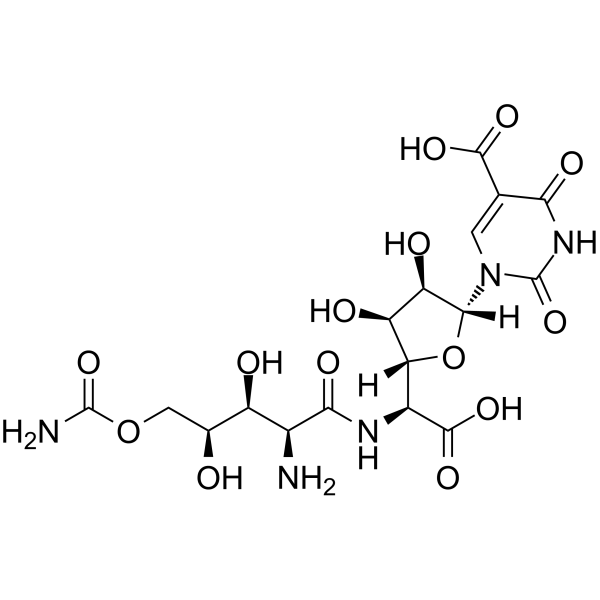
Polyoxin D (Polyoxorim) is an Antifungal Antibiotic. Polyoxin D inhibits Chitin synthase with an I50 of 1 mM for Stomoxys calcitrans chitin synthase. Polyoxin D causes swelling and rupture of fungal hyphal tips and budding yeast cells, haustorial encasement, haustorial wall thickening, widening of the extrahaustorial matrix, and cytoplasmic vesicles and tubular structures. Polyoxin D causes swelling of filamentous chains in Candida albicans and morphological changes in Agaricus bisporus and Coprinus cinereus. Polyoxin D is used in research on bean rust and Candida albicans infections.
For research use only. We do not sell to patients.
- Purity : 99.92%
- CAS No.: 22976-86-9
- Formula: C17H23N5O14
- Molecular Weight:521.39
-
Storage:Powder -20°C, 3 years , 4°C, 2 years ; In solvent -80°C, 6 months , -20°C, 1 month

To place orders, for customer services and technical support, please contact: MedChemExpress USA
Tel: 609-228-6898 E-mail: [email protected] [email protected]


-
 Biological Activity
-
Chemical Information
- Purity & Documentation
- References
-
 Help & FAQs


All Antibiotic Isoforms
More

Biological Activity
Description
In Vitro
Polyoxin D (0.4 mM; 24 h or 48 h post-inoculation) inhibits fungal growth in Pinto leaves, and compared with oxycarboxin treatment, treatment at 24 hr allows more infection sites to develop necrotic cells and lobed, non-fluorescent haustoria, suggesting their continued survival[1].
Polyoxin D (0.4 mM; 24 h or 48 h post-inoculation) results in a higher incidence of necrotic cells in the incompatible interaction with cultivar 765, especially when applied at 48 h[1].
Polyoxin D (0.4 mM; 24 h or 48 h post-inoculation) causes haustorial collapse and encasement by callose-like material at 24 hr, whereas treatment at 48 hr leads to haustorial wall thickening (100-140 nm) and a slightly electron-opaque extrahaustorial matrix (30-70 nm) in the compatible interaction[1].
Polyoxin D (0.4 mM; 24 h or 48 h post-inoculation) induces shriveled infected hyphae, silica deposition, and thick-walled (130-190 nm) lobed haustoria at 24 hr, whereas treatment at 48 hr has a lesser effect in incompatible interactions[1].
Polyoxin D (20-120 μM; 16 h) inhibits the elongation of isolated stipes of Coprinus cinereus when administered by microinjection[3].
Polyoxin D, as a chitin synthase inhibitor, is a useful tool for studying the effects of chitin synthesis on the morphological development of germinating Mucor rouxii spores[5].
Polyoxin D affects the germination and morphological development of Trichoderma viride [5].
Polyoxin D inhibits the growth of both the mycelial and yeast-like forms of Mucor rouxii without significantly affecting its dimorphism[5].
Polyoxin D (0.02-2 mM; 16 h) inhibits the elongation of isolated stipes and fruiting bodies of Coprinus cinereus when applied by basal immersion[3].
Polyoxin D inhibits S. calcitrans chitin synthase with an I50 of 1 mM, and this differential sensitivity is related to its Km for UDP-GlcNAc[4].
Polyoxin D causes the accumulation of UDP-GlcNAc in cultured cockroach leg regenerates[4].
Polyoxin D inhibits chitin synthase in cell-free systems from S. calcitrans and T. castaneum[4].
MedChemExpress (MCE) has not independently confirmed the accuracy of these methods. They are for reference only. .


Chemical Information
-
CAS No. 22976-86-9
-
Appearance Solid
-
Molecular Weight 521.39
-
Formula C17H23N5O14
-
Color White to off-white
-
SMILES
OC(C(C(N1)=O)=CN([C@H]2[C@H](O)[C@H](O)[C@@H]([C@H](NC([C@H]([C@@H]([C@H](COC(N)=O)O)O)N)=O)C(O)=O)O2)C1=O)=O
-
Synonyms
Polyoxorim
-
Shipping
Room temperature in continental US; may vary elsewhere.
-
Storage
Powder -20°C 3 years 4°C 2 years In solvent -80°C 6 months -20°C 1 month


Purity & Documentation
-
Data Sheet (277 KB)
-
SDS (254 KB)
- English - EN (254 KB)
- Français - FR (254 KB)
- Deutsch - DE (254 KB)
- Norwegian - NO (254 KB)
- Español - ES (254 KB)
- Swedish - SV (254 KB)
- Italian - IT (254 KB)
- Korean - KR (254 KB)
- Portuguese - PT (254 KB)
-
Handling Instructions (2659 KB)
References

Calculators
Concentration (start) × Volume (start) = Concentration (final) × Volume (final)


Polyoxin D Related Classifications
HY-136461 Related Classifications
 Powered by Bioz