



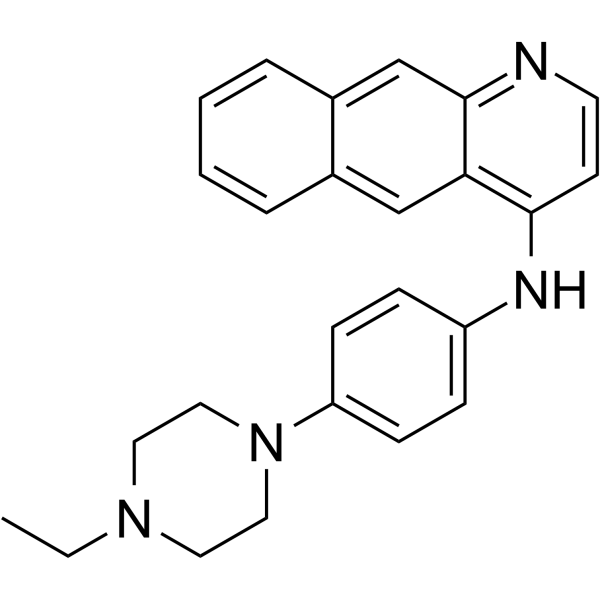
Quinoprazine
Quinoprazine is a potent inhibitor of Vaccinia virus DNA synthesis with an IC50 value of 10 μM. Quinoprazine has antimalarial activity against Plasmodium berghei and also displays antiprion potency, significantly decreases PrPSc levels-.
Nur für Forschungszwecke. Wir verkaufen nicht an Patienten.
- CAS. Nr.: 115618-99-0
- Formel: C25H26N4
- Molecular Weight:382.50
-
Speicherung:
Please store the product under the recommended conditions in the Certificate of Analysis.

To place orders, for customer services and technical support, please contact: MedChemExpress USA
Tel: 609-228-6898 E-mail: [email protected] [email protected]


-
 Biologische Aktivität
-
Chemical Information
- Protokoll
- Reinheit & Dokumentation
- Verweise
-
 Help & FAQs


Alle Parasite Isoform-spezifische Produkte anzeigen
More

Biologische Aktivität
Beschreibung
IC50 & Target
Vaccinia virus DNA synthesis[2]
In Vitro
Quinoprazine shows antimalarial action against Plasmodium berghei, the chloroquine-resistant isolate LN-K65[1].
Quinoprazine blocks Vaccinia Virus infection by inhibiting DNA synthesis[2].
Quinoprazine (IND2118) displays good antiprion potency and inhibits baseline PrPSc with reducing rates of 76% (dividing cells) and 51% (nondividing cells), respectively. Reducing PrPSc levels by >30% is considered to have good antiprion potency[3][4].
Quinoprazine (IND2118) shows low cytotoxicity with reducing rates of 25% (dividing cells) and 24% (nondividing cells), respectively. Reducing cells <30% is considered to have a safe effect[3][4].
MedChemExpress (MCE) has not independently confirmed the accuracy of these methods. They are for reference only. Further protocols information, click here.
In Vivo
Quinoprazine (0.2-0.5 g/kg; p.o.; single dose) acts against the adult Hymenolepis nana. Exptl. and cures infected mice radically[5].
MedChemExpress (MCE) has not independently confirmed the accuracy of these methods. They are for reference only.


Chemical Information
-
CAS. Nr. 115618-99-0
-
Molecular Weight 382.50
-
Formel C25H26N4
-
SMILES
CCN(CC1)CCN1C(C=C2)=CC=C2NC3=C4C=C5C=CC=CC5=CC4=NC=C3
-
Versand
Room temperature in continental US; may vary elsewhere.
-
Speicherung
Please store the product under the recommended conditions in the Certificate of Analysis.

Protokoll
-
EdU Incorporation Assay (Click Chemistry-Based DNA Synthesis Measurement)
The EdU incorporation assay measures DNA synthesis by adding the thymidine analog 5-ethynyl-2′-deoxyuridine to cells or tissues, where it is incorporated into newly synthesized DNA during S phase. Incorporated EdU is detected by copper-catalyzed azide-alkyne cycloaddition, in which a fluorescent azide covalently reacts with the ethynyl group on EdU, allowing S-phase cells to be detected by fluorescence microscopy, flow cytometry, or high-content imaging. EdU detection does not require DNA denaturation or anti-BrdU antibody access, which preserves sample structure and improves compatibility with immunostaining and multiparameter cytometry compared with BrdU-based detection. EdU can be cytotoxic in a cell-type- and exposure-dependent manner, so pulse duration, concentration, and continuous-labeling designs should be validated for each cell type.
-
Cell Cytotoxicity Assay
Cytotoxicity assays are usually based on the assessment of cell membrane damage, which can also be indirectly detected by measuring cell viability. Detection methods include MTT assay, CKK-8 assay, LDH assay and ATP assay, etc.
-
BrdU Incorporation Assay
Bromodeoxyuridine (BrdU) incorporation assay is based on the principle that BrdU, a thymidine analog, is incorporated into newly synthesized DNA during the S phase of the cell cycle, thereby serving as a marker of DNA replication and cellular proliferation. Incorporated BrdU can be detected using anti-BrdU antibodies following DNA denaturation, enabling visualization or quantification of proliferating cells through immunochemical detection methods such as immunofluorescence or immunohistochemistry.


Reinheit & Dokumentation
Verweise
[1]. Mikhaĭlitsyn FS, et al. The search for new antiparasitic agents. 10. The synthesis, toxicological and antimalarial properties of nitrogen-containing heterocycles with a 4-(4-alkylpiperazinyl-1) phenylamine substituent (the preparation quinoprazine). Med P [Content Brief]
[4]. Silber BM, et al. Antiprion compounds that reduce PrP(Sc) levels in dividing and stationary-phase cells. Bioorg Med Chem. 2013 Dec 15;21(24):7999-8012. [Content Brief]
[5]. Mikhaĭlitsyn FS, et al. The search for new antiparasitic agents. 8. The synthesis and study of the acute toxicity, anti-alveolar hydatid and antihymenolepiasis activity of 1-alkyl-4[4-(heterylamino)phenyl]piperazines]. Med Parazitol (Mosk). 1991 Sep-Oct;( [Content Brief]

Calculators
Konzentration (Stammlösung) × Volumen (Stammlösung) = Konzentration (Ziellösung) × Volumen (Ziellösung)


Quinoprazine Related Classifications
HY-147371 Related Classifications
 Powered by Bioz