
345 Results for "

paracolon bacillus

" in MedChemExpress (MCE) Product Catalog:
Products (345)

345 Results for "paracolon bacillus" in MCE Product Catalog:

Cat. No.: HY-N10850
CAS No.: 849590-42-7
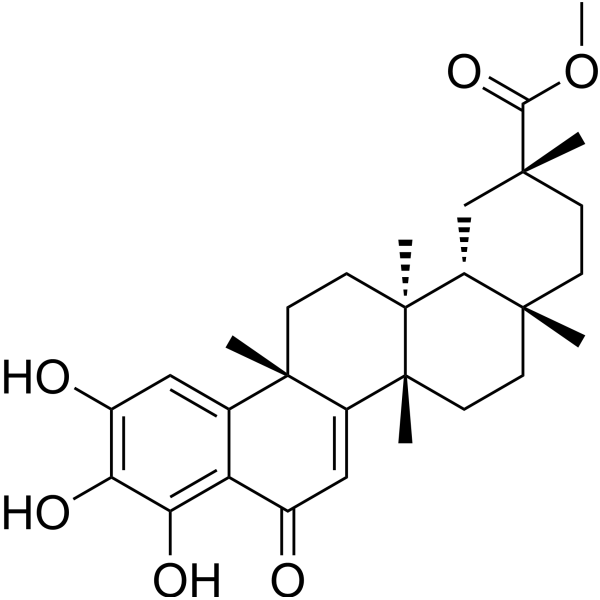
Blepharotriol is a phenolic triterpene that can be found in Maytenus blepharodes. Blepharotriol shows antimicrobial activity with a MIC value of 8-4 µg/ml for Bacillus subtilis. Blepharotriol shows cytotoxic activity with IC50s of 12.2, >20, >20 µM for HeLa, Hep-2, Vero cells, respectively .
loading...
    loading...
Cat. No.: HY-N20641
CAS No.: 3059457-35-8
Turonicin A is an anti-fungal and anti-bacterial agent found in Australian Streptomyces sp. MST-123921. Turonicin A inhibits growth of Candida albicans and Saccharomyces cerevisiae fungi. Turonicin A inhibits growth of Bacillus subtilis and Staphylococcus aureus bacteria. Turonicin A can be used for the research of fungal infections, bacterial infections .
loading...
    loading...
Cat. No.: HY-P701906
Purity:  ≥ 90%, as determined by reducing SDS-PAGE.
Synonyms: BSU02470; ycbD; gucD; 2,5-dioxovalerate dehydrogenase; alphaKGSA dehydrogenase; EC:1.2.1.26; Alpha-ketoglutaric semialdehyde dehydrogenase
Species:  
Others
Source:  
E. coli
loading...
    loading...
Cat. No.: HY-157376
Casein Agar can be used for casein decomposition test of Bacillus cereus. The composition of 1 liter of Casein Agar contains contains: 10.0 g casein, 3.0 g beef infusion powder, 5.0 g sodium chloride, 2.0 g dipotassium hydrogen phosphate and 15.0 g agar .
loading...
    loading...
Cat. No.: HY-N18360
CAS No.: 66081-38-7
Synonyms: Tunicamycin 17:1
Tunicamycin X (Tunicamycin 17:1) is a nucleoside Antibiotic. Tunicamycin X is isolated from Streptomyces xinghaiensis SCSIO S15077. Tunicamycin X acts as a growth inhibitor against bacteria and fungi. Tunicamycin X inhibits the growth of Bacillus thuringiensis strains. Tunicamycin X inhibits the growth of Candida albicans strains .
loading...
    loading...
Cat. No.: HY-117831
CAS No.: 19056-78-1
Research Areas:  

Infection

NSC-79887 is a nucleoside hydrolase (NH) inhibitor with activity against Bacillus anthracis. NSC-79887 is considered a good candidate inhibitor of nucleoside hydrolases for biological testing and further development. The pharmacokinetic (ADMET) prediction of NSC-79887 showed that all physicochemical parameters were within the acceptable range for human use .
loading...
    loading...
Cat. No.: HY-157933
Research Areas:  

Infection

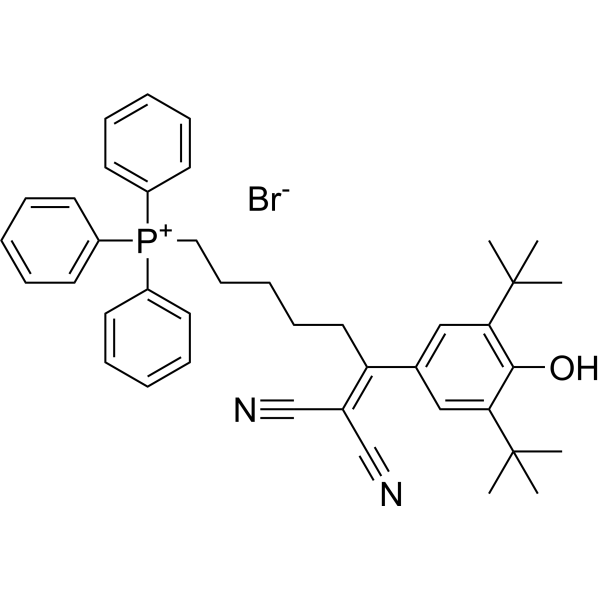
SF-C5-TPP is an potent mitochondria-targeted protonophoric uncoupler. SF-C5-TPP has significant proton transfer activity on model planar bilayer lipid membranes. SF-C5-TPP inhibits the growth of Bacillus subtilis with a MIC of 2 μM >[1].
loading...
    loading...
Cat. No.: HY-17586AS
CAS No.: 1126461-54-8
Synonyms: MDL-63397-d6; BI-397-d6
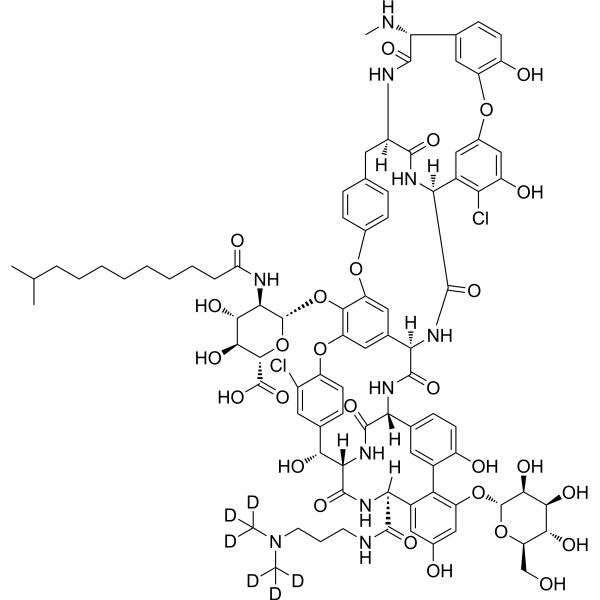
Dalbavancin-d6 is the deuterium labeled Dalbavancin . Dalbavancin (MDL-63397) is a semisynthetic lipoglycopeptide antibiotic with potent bactericidal activity against Gram-positive bacteria. Dalbavancin inhibits Staphylococcus aureus and Bacillus anthracis with MIC90s of 0.06 μg/mL and 0.25 μg/mL, respectively .
loading...
    loading...
Cat. No.: HY-N19233
Geministatin B is a potent antibiotic that can be found in the fungus Austroacremonium gemini MST-FP2131. Geministatin B exhibits antibacterial activity against Gram-positive bacteria including Bacillus subtilis, Staphylococcus aureus, and methicillin-resistant S. aureus (MRSA). Geministatin B can be used for the research of bacterial infections .
loading...
    loading...
Cat. No.: HY-N20670
CAS No.: 1192767-71-7
Aquastatin D is an antibacterial agent that inhibits the growth of Gram-positive bacteria, including Bacillus subtilis, Staphylococcus aureus, and methicillin-resistant S. aureus. Aquastatin D also inhibits the growth of the yeast Saccharomyces cerevisiae. Aquastatin D exhibits no cytotoxicity against mammalian cell lines and can be used in studies of bacterial and fungal infections .
loading...
    loading...
Cat. No.: HY-N3346
CAS No.: 132951-90-7
Synonyms: 10-epi-Eucarobustol F
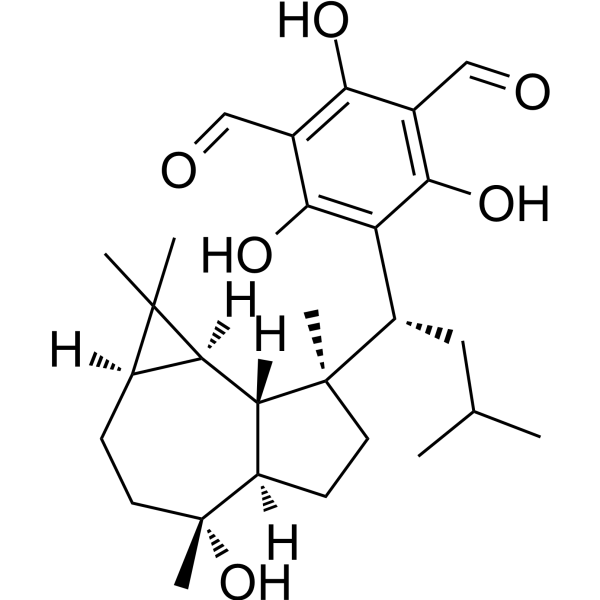
Macrocarpal A (10-epi-Eucarobustol F) is an antibacterial agent, which can be isolated from the leaves of Eucalyptus macrocarpa. Macrocarpal A inhibits the growth of Bacillus subtilis PCI219 (minimum inhibitory concentration below 0.2 µM) and Staphylococcus aureus FDA209P (minimum inhibitory concentration is 0.4 µM) .
loading...
    loading...
Cat. No.: HY-W286362
CAS No.: 6832-98-0
Synonyms: Palmitic acid anilide
Target:  

Bacterial

Research Areas:  

Infection

Palmitanilide (Palmitic acid anilide) is an antibacterial agent against Gram-positive bacteria. Palmitanilide can electrostatically bind to relevant components in the cell walls of Gram-positive bacteria (such as Bacillus cereus), alter the cell membrane structure, and affect the normal functions of the cells. Palmitanilide is promising for research of infectious diseases caused by Gram-positive bacteria .
loading...
    loading...
Cat. No.: HY-Y0760R
CAS No.: 586-38-9
Synonyms: 3-Anisic acid (Standard); NSC 27014 (Standard); m-Methoxybenzoic acid (Standard)
3-Methoxybenzoic acid (3-Anisic acid; NSC 27014; m-Methoxybenzoic acid) (Standard) is the analytical standard of 3-Methoxybenzoic acid. This product is intended for research and analytical applications. 3-Methoxybenzoic acid is a substituted benzoic acid and precursor for synthesis of hydrazide-hydrazone derivatives active against Gram-positive bacteria, including Bacillus spp .
loading...
    loading...
Cat. No.: HY-118565
CAS No.: 18463-11-1
Rhizocarpic acid (Compound 2) is a secondary metabolite of lichen. Rhizocarpic acid effectively inhibits the growth of bacteria, such as Bacillus subtilis and Staphylococcus aureus, as well as murine myeloma NS-1 cells. Rhizocarpic acid is an antioxidant and an insect antifeedant with an ED50 of 71 μmol/g dry weight against neonate larvae of the Egyptian cotton leaf worm Spodoptera littoralis .
loading...
    loading...
Cat. No.: HY-E71335
Research Areas:  

Others

γ-D-Glutamyl-meso-diaminopimelate peptidase (EC 3.4.19.11) is a 45-kDa metallopeptidase from Bacillus sphaericus, the substrates being components of the bacterial spore wall. A member of peptidase family M14 (carboxypeptidase A family) . Endopeptidase II has similar activity, but differs in cellular location, molecular mass and catalytic mechanism.
loading...
    loading...
Cat. No.: HY-N14111
CAS No.: 1246172-08-6
Cuevaene A can be isolated from the strain of gdmAI-disrupted Streptomyces sp. LZ35 and. Cuevaene A displays moderate activity against Gram-positive bacteria (e.g., Bacillus subtilis strain ATCC 11060) and modest activity against fungi (e.g., Fusarium verticillioides strain S68 and Rhizoctonia solani strain GXE4) .
loading...
    loading...
Cat. No.: HY-N16446
CAS No.: 345295-46-7
Stromemycin is a stromelysin inhibitor. Stromemycin exhibits weak antibacterial activity against Staphylococcus aureus, vancomycin-resistant Enterococcus faecium, and Bacillus subtilis when used alone. Stromemycin shows a significant increase in antibacterial efficacy when combined with Compound 5. Stromemycin does not possess a significant cell-killing effect on HCT-116 cells .
loading...
    loading...
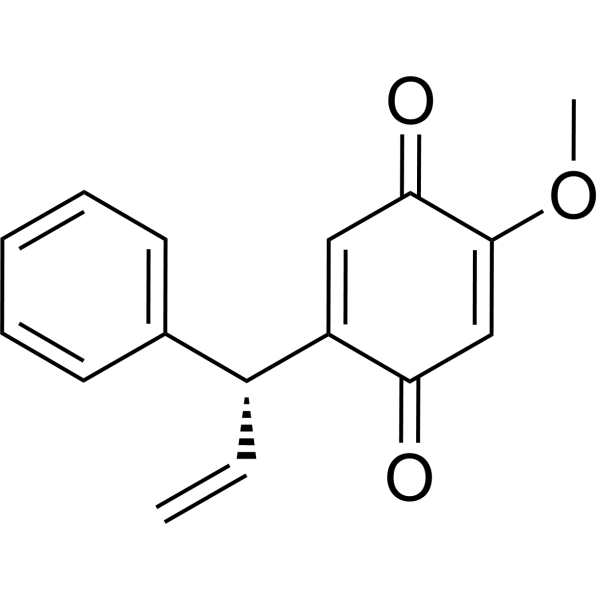
Cat. No.: HY-N9746
CAS No.: 4646-86-0
(R)-4-Methoxydalbergione is a urease inhibitor with IC50s of 59.72 and 67.33 μM for Bacillus pasteurii urease and Jack bean urease. (R)-4-Methoxydalbergione also has antiplasmodial activity. (R)-4-Methoxydalbergione can be isolated from Ranunculus repens .
loading...
    loading...
Cat. No.: HY-137323
CAS No.: 109539-58-4
Leucinostatin H is a polypeptide antibiotic discovered in Paecilomyces marquandii, characterized by a tertiary amine-oxide terminal group. Leucinostatin H exhibits inhibitory activity against Gram-positive bacteria, such as Bacillus subtilis, B. cereus, and Staphylococcus aureus (MIC 10-100 μg/mL). Leucinostatin H holds potential for research in anti-infective and plant disease control applications .
loading...
    loading...
Cat. No.: HY-179026
HCA-6 is a calcium-channel and P-glycoprotein blocker. HCA-6 can induce cancer cells apoptosis and increase anticancer activity of Cisplatin (HY-17394). HCA-6 also exhibits antibacterial activity against Bacillus subtilis. HCA-6 can be used for the research of cancer and infection, such as breast cancer .
loading...
    loading...

