345 Results for "

paracolon bacillus

" in MedChemExpress (MCE) Product Catalog:
Products (345)

345 Results for "paracolon bacillus" in MCE Product Catalog:

Cat. No.: HY-N7781
CAS No.: 39025-24-6
Synonyms: (E)-Guggulsterone
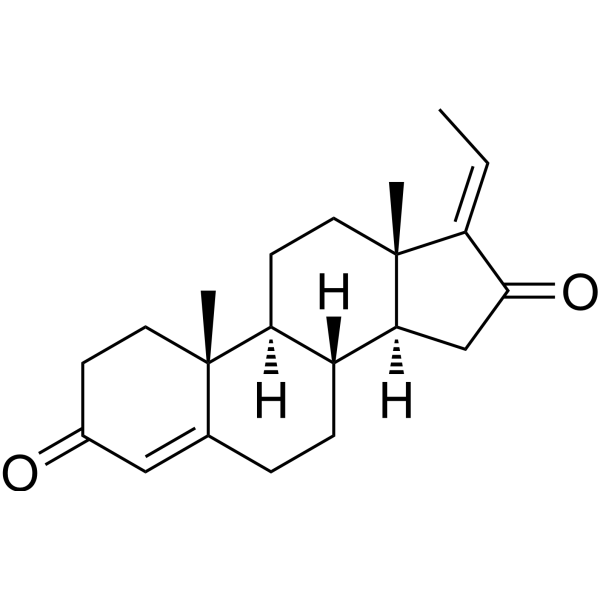
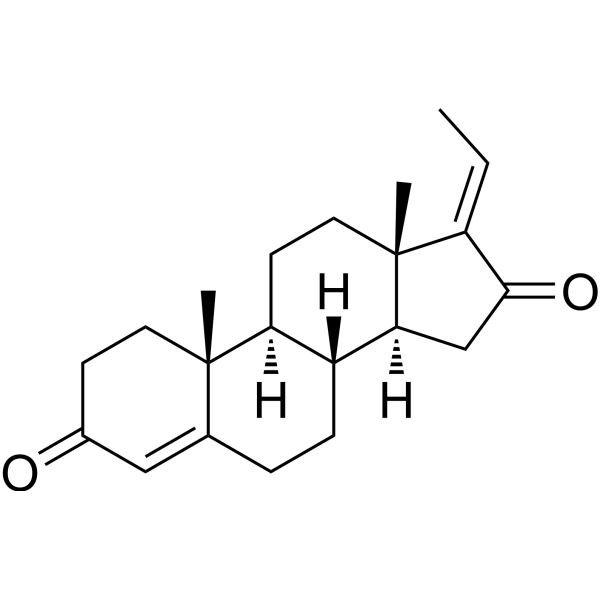
(-)-(E)-Guggulsterone ((E)-Guggulsterone) is an orally active natural stereoisomer of Guggulsterone (HY-107738). (-)-(E)-Guggulsterone is an antagonist for the Farnesoid X Receptor (FXR) with an IC50 of 24.06 μM and possesses potent hypolipidemic properties. (-)-(E)-Guggulsterone suppresses dengue virus (DENV) replication by upregulating antiviral interferon responses by inducing HO-1 expression via Nrf2 activation. (-)-(E)-Guggulsterone exhibits antibacterial activities against Bacillus subtilis, Staphylococcus aureus and Pseudomonas aeruginosa. (-)-(E)-Guggulsterone has cardiac protective and antioxidant activities in rats .
loading...
    loading...
Cat. No.: HY-W714137
CAS No.: 4430-39-1
Synonyms: Lesquerellin; 6-Methylthiohexyl isothiocyanate
Target:  

Bacterial

Research Areas:  

Infection

(6-Isothiocyanatohexyl)(methyl)sulfane (Lesquerellin; 6-Methylthiohexyl isothiocyanate) is an isothiocyanate found in wasabi (W. japonica) and has various biological activities. (6-Isothiocyanatohexyl)(methyl)sulfane is active against the bacterium Bacillus subtilis and the fungus T. mentagrophytes (MIC=25 μg/mL). (6-Isothiocyanatohexyl)(methyl)sulfane also has anthelmintic activity against blue mussel (M. edulis). (6-Isothiocyanatohexyl)(methyl)sulfane has antifouling activity when applied to polyvinyl chloride (PVC) panels at a concentration of 50 μmol/cm2 in a conventional immersion test.
loading...
    loading...
Cat. No.: HY-W746100
CAS No.: 2508224-28-8
Synonyms: (S)-2-Hydroxy-4-methylpentanoic acid-d3
(S)-Leucic acid-d3 ((S)-2-Hydroxy-4-methylpentanoic acid-d3) is the deuterated-labeled (S)-Leucic acid (HY-30215). (S)-Leucic acid ((S)-2-Hydroxy-4-methylpentanoic acid) is an α-hydroxy acid found in the fermentation products of Bacillus granulobacter pectinovorum. (S)-Leucic acid is an isomer of Leucic acid (HY-30216A) and a leucine metabolite. (S)-Leucic acid acts as a D-unit subunit precursor in the biosynthesis of cryptophycins in the Nostoc cyanobacterial symbiont. (S)-Leucic acid is used in metabolism-related studies .
loading...
    loading...
Cat. No.: HY-K6022

MCE ECM Gentle Dissociation Solution is a gentle ECM-degrading enzyme mixture derived from marine bacteria and Bacillus species, specifically formulated for efficient and low-damage digestion of in-vitro cell systems. It selectively degrades extracellular matrix components while minimizing disruption to the cell membrane and intercellular junctions, thereby significantly reducing mechanical stress during dissociation. This product is compatible with a wide range of cell types, including stem cell colonies, primary cells, neural cells, and organoids, and is particularly well suited for gentle yet effective dissociation of brain organoids and other complex 3D structures.

loading...
    loading...
Cat. No.: HY-133101
CAS No.: 1031727-34-0
Synonyms: 14-Norpseurotin
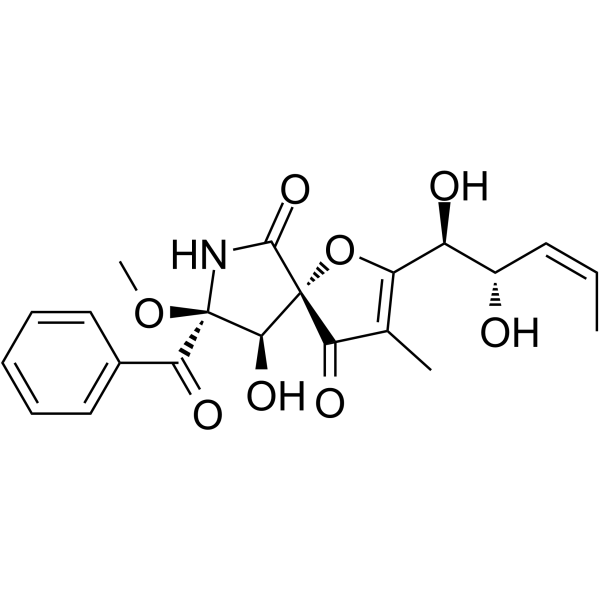
14-Norpseurotin A (14-Norpseurotin) is an Antibacterial, antimalarial, and anticancer agent. 14-Norpseurotin A is isolated from various fungi of the Aspergillus genus. 14-Norpseurotin A induces neurite outgrowth. 14-Norpseurotin A inhibits the growth of Escherichia coli, Bacillus subtilis, and Micrococcus lysoleikticus. 14-Norpseurotin A exhibits antileishmanial activity against L. donovani, antiplasmodial activity against P. falciparum, and shows no activity against T. cruzi. 14-Norpseurotin A exerts anticancer activity against breast cancer. 14-Norpseurotin A is used in research related to leishmaniasis, malaria, and breast cancer .
loading...
    loading...
Cat. No.: HY-183851
CAS No.: 639048-45-6
Target:  

Bacterial mRNA

Research Areas:  

Infection

KKL-55 is a broad-spectrum antibacterial agent that inhibits the trans-translation pathway and the ClpXP protease. KKL-55 suppresses trans-translation of non-stop mRNA, interferes with the binding of EF-Tu to tmRNA, and inhibits the proteolysis of substrates by ClpXP. KKL-55 blocks spore germination of Bacillus anthracis and protects macrophages from damage induced by anthrax toxin. By virtue of its inhibitory effect on ClpXP, KKL-55 synergistically enhances the antibacterial activity of antibiotics against drug-resistant Staphylococcus aureus. KKL-55 can be used in studies related to bacterial infections .
loading...
    loading...
Cat. No.: HY-B0914R
CAS No.: 112-38-9
Synonyms: Undecylenic acid (Standard)
10-Undecenoic acid (Standard) is the analytical standard of 10-Undecenoic acid. This product is intended for research and analytical applications. 10-Undecenoic acid (Undecylenic acid) is an antifungal agent. 10-Undecenoic acid inhibits Aβ oligomerization, scavenges ROS and inhibits μ-calpain activity. 10-Undecenoic acid has neuroprotective effects. 10-Undecenoic acid has anticancer effects on a variety of tumors. 10-Undecenoic acid inhibits C. albicans biofilm formation and MRSA infection. 10-Undecenoic acid inhibits quorum sensing signals of Bacillus subtilis and Pseudomonas aeruginosa .
loading...
    loading...
Cat. No.: HY-N13838
CAS No.: 22518-03-2
8,9-Dehydro-7,9-diisobutyryloxythymol is a Thymol (HY-N6810) derivative, as well as an antibacterial agent. 8,9-Dehydro-7,9-diisobutyryloxythymol can be found in the aerial parts of Ageratina adenophora, with selective activity against Gram-positive bacterial strains including Bacillus cereus. 8,9-Dehydro-7,9-diisobutyryloxythymol does not exhibit detectable in vitro cytotoxic activity against human cancer cell lines. 8,9-Dehydro-7,9-diisobutyryloxythymol can be used for the research of bacterial infection .
loading...
    loading...
Cat. No.: HY-N3686S1
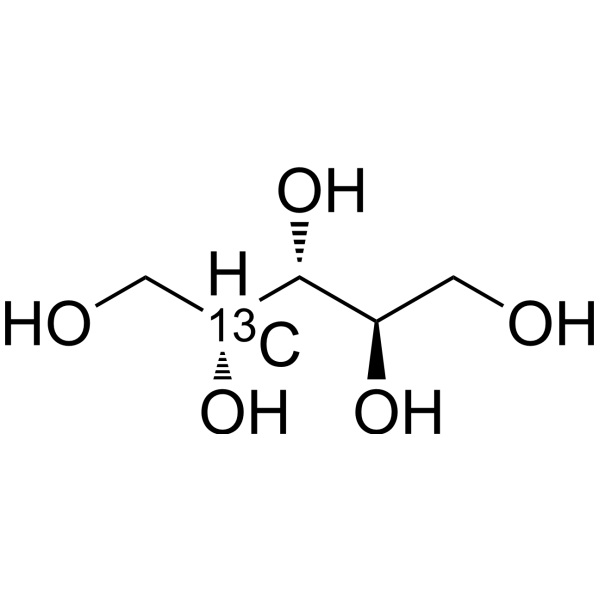
D-Arabitol- 13C-1 is the 13C labeled D-Arabitol. D-Arabitol is an orally active D-enantiomer of arabitol. D-Arabitol modulates the composition of gut microbiota, increases short-chain fatty acids, and promotes AMPK-PGC-1α-related browning of white adipose tissue. D-Arabitol improves weight gain, fat accumulation, insulin resistance, lipid deposition and inflammatory responses. D-Arabitol serves as the sole carbon/energy source for Bacillus methanolicus MGA3, a strain that can co-utilize it with mannitol. D-Arabitol is applicable to obesity-related research.
loading...
    loading...
Cat. No.: HY-N3686S2
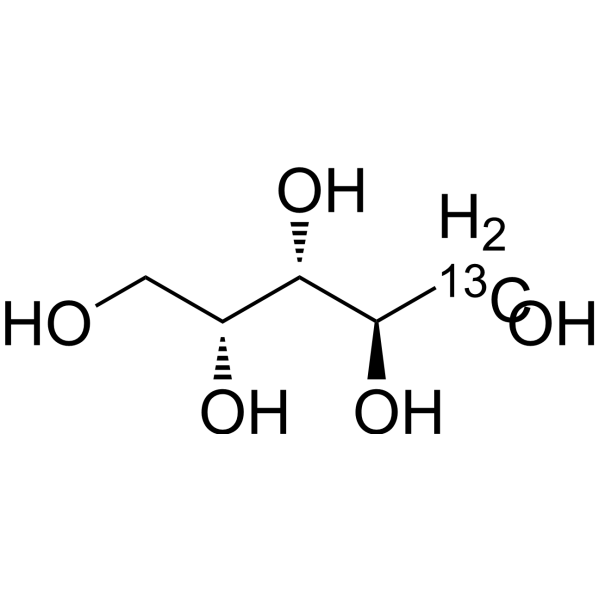
D-Arabitol- 13C-2 is the 13C labeled D-Arabitol. D-Arabitol is an orally active D-enantiomer of arabitol. D-Arabitol modulates the composition of gut microbiota, increases short-chain fatty acids, and promotes AMPK-PGC-1α-related browning of white adipose tissue. D-Arabitol improves weight gain, fat accumulation, insulin resistance, lipid deposition and inflammatory responses. D-Arabitol serves as the sole carbon/energy source for Bacillus methanolicus MGA3, a strain that can co-utilize it with mannitol. D-Arabitol is applicable to obesity-related research.
loading...
    loading...
Cat. No.: HY-N7781R
CAS No.: 39025-24-6
Synonyms: (E)-Guggulsterone (Standard)
(-)-(E) -guggulsterone (Standard) is the analytical standard for (-)-(E) -guggulsterone ((E)-Guggulsterone) (HY-N7781). (-)-(E)-Guggulsterone is an orally active natural stereoisomer of Guggulsterone (HY-107738). (-)-(E)-Guggulsterone is an antagonist for the Farnesoid X Receptor (FXR) with an IC50 of 24.06 μM and possesses potent hypolipidemic properties. (-)-(E)-Guggulsterone suppresses dengue virus (DENV) replication by upregulating antiviral interferon responses by inducing HO-1 expression via Nrf2 activation. (-)-(E)-Guggulsterone exhibits antibacterial activities against Bacillus subtilis, Staphylococcus aureus and Pseudomonas aeruginosa. (-)-(E)-Guggulsterone has cardiac protective and antioxidant activities in rats.
loading...
    loading...
Cat. No.: HY-W019599
CAS No.: 14173-39-8
Synonyms: L-PCPA
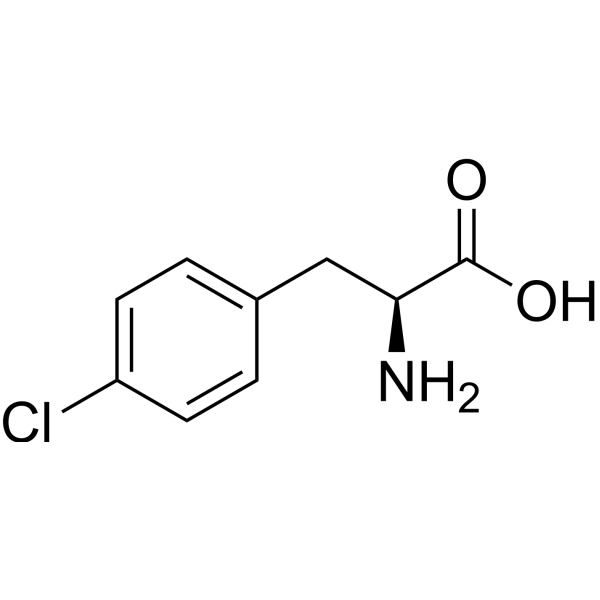
4-Chloro-L-phenylalanine (L-PCPA) is a tryptophan hydroxylase inhibitor targeting TPH1 and TPH2, with the activity of blocking serotonin biosynthesis. 4-Chloro-L-phenylalanine reduces the levels of serotonin and its metabolites in the brain without impairing the survival of serotonergic neurons. 4-Chloro-L-phenylalanine enhances anhedonic, depression-like and anxiety-like behaviors in mice with depleted noradrenergic and dopaminergic neurons. 4-Chloro-L-phenylalanine acts as a decarboxylation substrate for aromatic L-amino acid decarboxylase from Bacillus atrophaeus. 4-Chloro-L-phenylalanine can be used in studies related to Parkinson's disease .
loading...
    loading...
Cat. No.: HY-12028R
CAS No.: 167869-21-8
PD98059 (Standard) is the analytical standard of PD98059. This product is intended for research and analytical applications. PD98059 is a potent and selective MEK inhibitor with an IC50 of 5 µM. PD98059 binds to the inactive form of MEK, thereby preventing the activation of MEK1 (IC50 of 2-7 µM) and MEK2 (IC50 of 50 µM) by upstream kinases. PD98059 is a ERK1/2 signaling inhibitor. PD98059 is a ligand for the aryl hydrocarbon receptor (AHR), and suppresses TCDD binding (IC50 of 4 μM) and AHR transformation (IC50 of 1 μM). PD98059 also inhibits Mycobacterium bovis Bacillus CalmetteGuerin (BCG)-induced autophagy .
loading...
    loading...
Cat. No.: HY-137502A
CAS No.: 1542213-03-5
Target:  

Bacterial

Research Areas:  

Infection

ML267 free base is a blood-brain barrier permeable Antibacterial agent and bacterial phosphopantetheinyl transferase (PPTase) inhibitor, with an IC50 of 0.29 μM against Bacillus subtilis Sfp-PPTase and an IC50 of 8.1 μM against bacterial AcpS-PPTase. ML267 free base attenuates bacterial secondary metabolism, activity, and the production of Sfp-PPTase-dependent metabolites. ML267 free base inhibits the growth of Gram-positive bacteria, including Methicillin (HY-121544)-resistant Staphylococcus aureus. ML267 free base is applicable to research related to bacterial infections, including methicillin-resistant Staphylococcus aureus infections .
loading...
    loading...
Cat. No.: HY-N3686R
CAS No.: 488-82-4
D-Arabitol (Standard) is the analytical standard of D-Arabitol (HY-N3686). This product is intended for research and analytical applications. D-Arabitol is an orally active D-enantiomer of arabitol. D-Arabitol modulates the composition of gut microbiota, increases short-chain fatty acids, and promotes AMPK-PGC-1α-related browning of white adipose tissue. D-Arabitol improves weight gain, fat accumulation, insulin resistance, lipid deposition and inflammatory responses. D-Arabitol serves as the sole carbon/energy source for Bacillus methanolicus MGA3, a strain that can co-utilize it with mannitol. D-Arabitol is applicable to obesity-related research .
loading...
    loading...
Cat. No.: HY-W756467
CAS No.: 2733149-80-7
Synonyms: 1-Cyclopropyl-6,7-difluoro-8-methoxy-4-oxo-1,4-dihydroquinoline-3-carboxylic Acid-13C,d3
Antibacterial agent 265- 13C,d3 (1-Cyclopropyl-6,7-difluoro-8-methoxy-4-oxo-1,4-dihydroquinoline-3-carboxylic Acid- 13C,d3) is the deuterium labeled and 13C-labeled Antibacterial agent 265 (HY-W018629). Antibacterial agent 265 (Compound 2) is an antibacterial agent. Antibacterial agent 265 shows antibacterial activity against Staphylococcus Aureus, Micrococcus Luteus, Bacillus subtilis, gram-negative Escherichia coli, Pseudomonas aeruginosa and Flavobacterium devorans .
loading...
    loading...
Cat. No.: HY-153575
Target:  

PROTACs Bacterial

Research Areas:  

Infection

BacPROTAC-1 is a BacPROTAC degrader that induces the degradation of the target protein mSA by recruiting ClpC/ClpC1. BacPROTAC-1 binds to mSA, Bacillus subtilis ClpCNTD and Mycobacterium smegmatis ClpC1NTD with Kd values of 3.9, 2.8 and 0.69 μM, respectively. BacPROTAC-1 forms a ternary complex between the substrate and ClpC, promotes ClpC reassembly and activation, and induces ATP-dependent degradation of mSA and mSA fusion model substrates via the ClpCP or ClpC1P1P2 protease system. BacPROTAC-1 can be used in studies on bacterial targeted protein degradation, bacterial protein homeostasis and antibacterial target discovery .
loading...
    loading...
Cat. No.: HY-181939
Target:  

Bacterial

Research Areas:  

Infection

Antibacterial agent 329 (Compound 9c) is an antibacterial agent. Antibacterial agent 329 inhibits the activity of MraY. Antibacterial agent 329 exhibits antibacterial activity against Escherichia coli K12 and Bacillus subtilis W23 with a MIC of 16 μg/mL, but shows no activity against Pseudomonas fluorescens Pf-5. Antibacterial agent 329 exerts antibacterial activity against Acinetobacter baumannii 19606, Staphylococcus aureus MRSA USA300 JE2, Enterobacter cloacae 19434, Klebsiella pneumoniae 700603 and Enterococcus faecium 19434, with MIC values of 8, 8, 16-32, 16-32 and 16 μg/mL, respectively, while it shows no activity against Pseudomonas aeruginosa NCTC 13437 .
loading...
    loading...
Cat. No.: HY-B0914AR
CAS No.: 557-08-4
Synonyms: Zinc undecylenate (Standard)
10-Undecenoic acid (zinc salt) (Standard) is the analytical standard of 10-Undecenoic acid (zinc salt). This product is intended for research and analytical applications. 10-Undecenoic acid zinc salt (Undecylenic acid zinc salt) is an antifungal agent. 10-Undecenoic acid zinc salt inhibits Aβ oligomerization, scavenges ROS and inhibits μ-calpain activity. 10-Undecenoic acid zinc salt has neuroprotective effects. 10-Undecenoic acid zinc salt has anticancer effects on a variety of tumors. 10-Undecenoic acid zinc salt inhibits C. albicans biofilm formation and MRSA infection. 10-Undecenoic acid zinc salt inhibits quorum sensing signals of Bacillus subtilis and Pseudomonas aeruginosa .
loading...
    loading...
Cat. No.: HY-N4157R
CAS No.: 5171-37-9
Isopteropodine (Standard) is the analytical standard of Isopteropodine (HY-N4157). This product is intended for research and analytical applications. Isopteropodine is a positive modulator that selectively acts on muscarinic M1 and 5-HT2 receptors. Isopteropodine has an EC50 of 9.92 μM for acetylcholine and 14.5 μM for 5-HT. Isopteropodine also has antibacterial activity against Gram-positive bacteria, with MICs of 150 μg/mL and 250 μg/mL for Staphylococcus aureus and Bacillus subtilis, respectively. Isopteropodine enhances receptor function by increasing the affinity of agonists for receptors and can also inhibit the growth of specific Gram-positive bacteria, and can be used in cognitive impairment and antibacterial research .
loading...
    loading...

