
14-Norpseurotin A
14-Norpseurotin A (14-Norpseurotin) is an Antibacterial, antimalarial, and anticancer agent. 14-Norpseurotin A is isolated from various fungi of the Aspergillus genus. 14-Norpseurotin A induces neurite outgrowth. 14-Norpseurotin A inhibits the growth of Escherichia coli, Bacillus subtilis, and Micrococcus lysoleikticus. 14-Norpseurotin A exhibits antileishmanial activity against L. donovani, antiplasmodial activity against P. falciparum, and shows no activity against T. cruzi. 14-Norpseurotin A exerts anticancer activity against breast cancer. 14-Norpseurotin A is used in research related to leishmaniasis, malaria, and breast cancer.
For research use only. We do not sell to patients.
- CAS No.: 1031727-34-0
- Formula: C21H23NO8
- Molecular Weight:417.41
-
Storage:
Please store the product under the recommended conditions in the Certificate of Analysis.
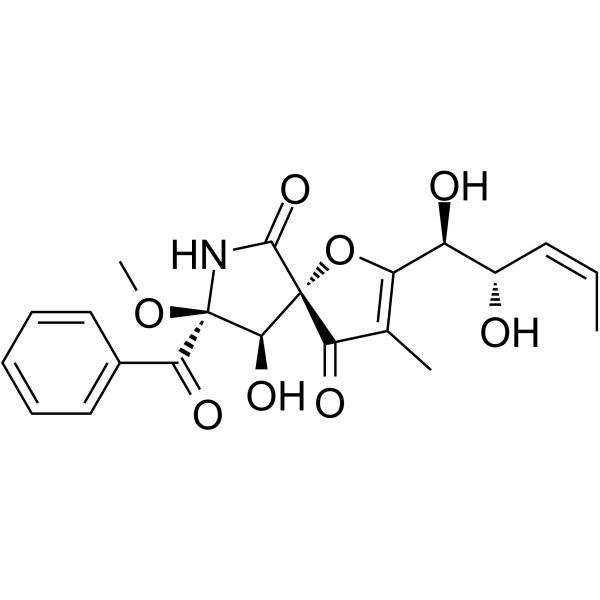
Biological Activity
Description
|
Fungal Metabolite |
Leishmania |
Cellular Effect
|
Cell Line
|
Type | Value | Description | References |
|---|---|---|---|---|
| K562 | IC50 |
41 μM
Compound: 4
|
Cytotoxicity against human K562 cells after 48 hrs by MTT assay
|
[PMID: 19256529] |
In Vitro
14-Norpseurotin A (10.0 µM; 2 days) significantly induces robust neurite outgrowth in rat pheochromocytoma PC12 cells[1].
MedChemExpress (MCE) has not independently confirmed the accuracy of these methods. They are for reference only. Further protocols information, click here.
Chemical Information
-
CAS No. 1031727-34-0
-
Molecular Weight 417.41
-
Formula C21H23NO8
-
SMILES
O=C(N1)[C@@](OC([C@@H](O)[C@@H](O)/C=C\C)=C2C)(C2=O)[C@@H](O)[C@]1(OC)C(C3=CC=CC=C3)=O
-
Synonyms
14-Norpseurotin
-
Structure Classification
-
Initial Source
-
Shipping
Room temperature in continental US; may vary elsewhere.
-
Storage
Please store the product under the recommended conditions in the Certificate of Analysis.
Protocols
-
PC12 NGF-Induced Neuronal Differentiation Culture
PC12 cells are a rat adrenal pheochromocytoma clonal line that responds to NGF by stopping proliferation and extending branching neurite-like processes; after longer NGF exposure, cells develop long processes and neuronal-like ultrastructural and functional features. NGF-induced differentiation is read out mainly by neurite outgrowth, reduced proliferation, microtubule assembly, and neuronal differentiation-associated proteins such as MAPs, tau, GAP-43, and synapsin-1.
-
Research Protocol for Infectious Diseases
Infectious-disease experiments test how pathogens interact with host barriers, innate immune receptors, inflammatory signaling, pathogen replication, and tissue injury; pattern-recognition receptors such as TLRs, RIG-I-like receptors, NOD-like receptors, and inflammasomes detect microbial molecules and activate NF-κB, interferon, and cytokine responses. The central hypothesis is that infection severity reflects the balance between pathogen burden and host response: protective inflammation restricts pathogen growth, whereas excessive or mislocalized inflammation contributes to tissue damage and disease phenotype. Unresolved questions include which host pathways are protective versus pathogenic, why some infection models fail to translate to human disease, and which combined readouts best predict clinically relevant infection outcomes.
-
SH-SY5Y Neuronal Differentiation Culture
SH-SY5Y neuronal differentiation culture uses sequential exposure to retinoic acid and neurotrophic factors to reduce proliferative neuroblastoma-like behavior and induce neuron-like morphology, including neurite extension, neuronal marker expression, and, in RA/BDNF protocols, greater synaptic-marker expression than undifferentiated culture. Retinoic acid is commonly used as the initiating differentiation cue, while BDNF in serum-reduced or serum-free medium supports later maturation and neurotrophic-factor-dependent neuron-like survival.
-
SH-SY5Y neuronal-like differentiation
SH-SY5Y neuronal-like differentiation uses defined culture conditions to shift proliferative human neuroblastoma cells toward a neuron-like state, mainly assessed by reduced proliferation, neurite extension, neuronal-marker expression, and, in some protocols, increased dependence on neurotrophic support. Retinoic acid (RA) is commonly used for the first differentiation phase, and sequential RA followed by brain-derived neurotrophic factor (BDNF) in serum-free medium is a well-characterized approach for generating neuron-like SH-SY5Y cultures with extensive neurite outgrowth. The primary readouts are morphology-based neurite outgrowth and marker-based confirmation using proteins such as βIII-tubulin, MAP2, GAP43, synaptophysin, NeuN, NSE, TH, or related neuronal/synaptic markers, depending on the study endpoint.
-
Cell differentiation
Cell differentiation refers to the process in which cells of the same origin gradually produce cell groups with different morphological structure and functional characteristics.
-
PC12 NGF-induced neuronal-like differentiation
PC12 cells are a rat adrenal pheochromocytoma-derived clonal cell line that responds to nerve growth factor by stopping proliferation and extending neurites, producing a sympathetic neuron-like phenotype used to study neuronal differentiation and neurite outgrowth. NGF acts through TrkA-dependent signaling, and neurite outgrowth is associated with ERK/Akt signaling, microtubule organization, neuronal-marker expression, and increased electrophysiological neuronal features such as sodium-channel density. The main assay readout is morphological differentiation, usually measured as the percentage of neurite-bearing cells, neurite length, neurite number, or total neurite length per cell. Additional readouts include GAP-43, tyrosine hydroxylase, βIII-tubulin, neurofilament, synapsin I, synaptophysin, ERK phosphorylation, Akt phosphorylation, and sodium-channel current density.
-
Breast Cancer Modeling
Breast cancer is a heterogeneous cancer, and it has been distinguished into four subtypes: luminal A, luminal B, HER2-positive and basal-like. Molecular mutations, epigenetic alterations, hormone exposure and immune microenvironment are related to the progression of breast cancer.
Purity & Documentation
References
[1]. Ge HM, et al. Bioactive alkaloids from endophytic Aspergillus fumigatus. Journal of natural products. 2009 Apr;72(4):753-5. [Content Brief]
[3]. Zhang M, et al. Cytotoxic alkaloids and antibiotic nordammarane triterpenoids from the marine-derived fungus Aspergillus sydowi. Journal of natural products. 2008 Jun;71(6):985-9. [Content Brief]
Calculators
Concentration (start) × Volume (start) = Concentration (final) × Volume (final)

