60 Results for "

DR5

" in MedChemExpress (MCE) Product Catalog:
Products (60)

60 Results for "DR5" in MCE Product Catalog:

Cat. No.: HY-N1524
CAS No.: 465-74-7
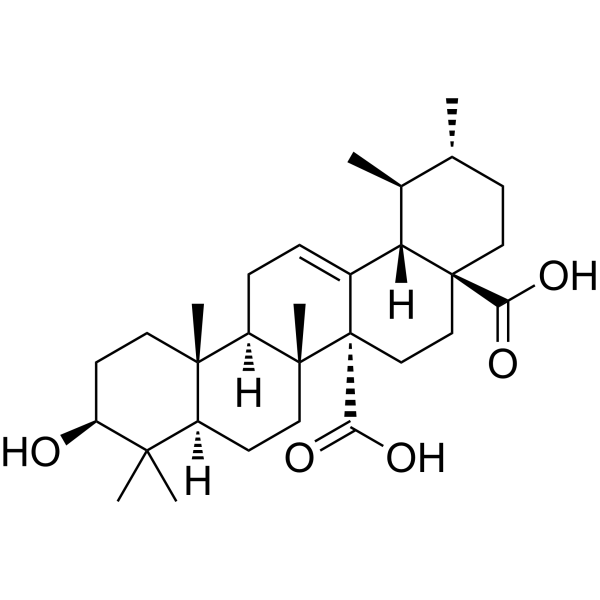
Quinovic acid is triterpene. Quinovic acid can ameliorate the Amyloid-β burden, p53 expression and cholesterol accumulation by deterring the oxidative stress through upregulating the Nrf2/HO-1 pathway. Quinovic acid can induce cancer cells apoptosis by upregulating death receptor 5 (DR5). Quinovic acid can be used for the researches of cancer, inflammation, metabolic and neurological disease, such as lung cancer and Alzheimer’s disease (AD) .
loading...
    loading...
Cat. No.: HY-18343
CAS No.: 259199-65-0
Target:  

MDM-2/p53 Apoptosis

Research Areas:  

Cancer

CP-31398 can stabilize the active conformation of p53 and promote p53 activity in cancer cells with either mutant or wild-type p53. In addition, CP-31398 can upregulate p53 target genes, such as p21WAF1/Cip1 and KILLER/DR5. CP-31398 exerts an inhibitory effect on tumor growth .
loading...
    loading...
Cat. No.: HY-163801
Research Areas:  

Neurological Disease

Nurr1 agonist 9 (Compound 36) is an agonist for Nurr1 with an EC50 of 0.090 µM and a Kd of 0.17 µM. Nurr1 agonist 9 activates the Nurr1 homodimer (NurRE, EC50=0.094 µM) and the Nurr1-RXR heterodimer (DR5, EC50=0.165 µM). Nurr1 agonist 9 induces the expression of Nurr1-regulated tyrosine hydroxylase (TH) in organoid Parkinson's Disease model. Nurr1 agonist 9 is human brain endothelial cell barrier prmeable .
loading...
    loading...
Cat. No.: HY-P990901
CAS No.: 2796349-94-3
Synonyms: IGM-8444

Target:  

TNF Receptor Apoptosis

Research Areas:  

Cancer

Aplitabart (IGM-8444) is a pentameric IgM death receptor 5 (DR5) agonist antibody with a KD of 85 nM and an apparent affinity of 11 pM. Aplitabart induces DR5 multimerization, thereby triggering cancer cell apoptosis via the extrinsic apoptotic pathway apoptosis. Aplitabart is applicable to cancer-related research such as colorectal cancer and gastric cancer .
loading...
    loading...
Cat. No.: HY-172940
CAS No.: 2761081-30-3
Target:  

Apoptosis

Research Areas:  

Cancer

TBP-134 induce apoptosis primarily through DR5 and causes G2/M phase arrest. TBP-134 can be used in the research for pancreatic tumor .
loading...
    loading...
Cat. No.: HY-N1582
CAS No.: 33429-83-3
Synonyms: 3,4′-Dimethylquercetin
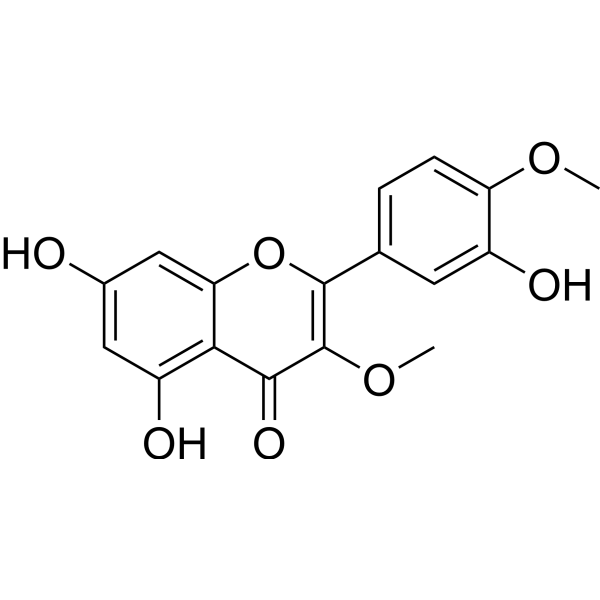
Quercetin 3,4′-dimethyl ether (3,4′-Dimethylquercetin) is a dimethoxyflavone can be isolated from Combretum quadrangulare. Quercetin 3,4′-dimethyl ether overcomes TRAIL resistance by enhancing DR5 expression and has anti-tumor activity .
loading...
    loading...
Cat. No.: HY-N13302
CAS No.: 11028-42-5
Target:  

Others

Cedrene regulates auxin transport and signal transduction in Arabidopsis, and thus stimulates the plants root development. Cedrene affects the Arabidopsis roots morphology by increasing the lateral roots, promoting the elongation of primary roots, affecting the expression of the auxin response gene DR5 and auxin transporters such as PIN2 and PIN3 .
loading...
    loading...
Cat. No.: HY-168877
FMP is a Platinum(IV) complexe. FMP significantly upregulates the expression of γ-H2AX and p53. FMP increases the production of ROS. FMP markedly upregulates the expressions of Apoptosis-related proteins (DR5, Fas, caspase-8, Cyt-c, caspase-3, cleaved-PARP1, Bax). FMP shows antiproliferative activity against breast cancer .
loading...
    loading...
Cat. No.: HY-P992340

Research Areas:  

Cancer

CTB006 is a monoclonal antibody targeting a humanized chimeric recombinant anti-DR5. CTB006 specifically binds to and activates DR5, thereby inducing tumor cell apoptosis, inhibiting tumor growth and reducing tumor drug resistance. 177Lu-radiolabeled CTB006 can deliver targeted radiotherapy to tumor cells; while 89Zr- or 177Lu-labeled CTB006 can serve as a PET/CT imaging agent for detecting DR5 expression levels in preclinical tumor models and screening cancers with DR5 overexpression. CTB006 can be applied to research related to gastrointestinal cancer, colorectal cancer and other solid tumors .
loading...
    loading...
Cat. No.: HY-P992473

Target:  

TNF Receptor

Research Areas:  

Inflammation/Immunology Cancer

TAS266 is a tetrameric nanobody agonist targeting DR5. TAS266 selectively induces cancer cell death. TAS266 triggers sustained tumor regression in xenograft models and also elicits immunogenic responses including antibody binding. TAS266 exhibits superior anti-tumor efficacy compared with traditional DR5-targeting strategies. TAS266 can be used in research related to pancreatic cancer and advanced solid tumors .
loading...
    loading...
Cat. No.: HY-P80109
Synonyms: CD262, DR5, KILLER, TRAILR2, TRICK2, ZTNFR9, UNQ160/PRO186, TNFRSF10B, Tumor necrosis factor receptor superfamily member 10B, Death receptor 5, TNF-related apoptosis-inducing ligand receptor 2, TRAIL receptor 2, TRAIL-R2

Host:  

Rabbit

Application:  

WB, IHC-P, FC

Reactivity:  

Human

loading...
    loading...
Cat. No.: HY-P11902
Research Areas:  

Cancer

IRS1 is an integrin-targeted, ROS-responsive self-assembling peptide prodrug molecule with selective anti-cancer activity against integrin-overexpressing tumor cells. IRS1 contains an RGD motif for integrin binding, can covalently bind to DR4/DR5, and promotes DR4/DR5 aggregation. After oxidation by ROS, IRS1 undergoes a morphological transition from nanoparticles to nanofibers, exposes the pharmacophore of Chlorambucil (HY-13593), disrupts cell membrane integrity, activates the extrinsic apoptosis pathway, and can penetrate and inhibit the three-dimensional uveal melanoma spheroid model. IRS1 can be used for the research of uveal melanoma .
loading...
    loading...
Cat. No.: HY-183402
CAS No.: 917813-60-6
Synonyms: GO-Y026
Research Areas:  

Cancer

FLLL12 (GO-Y026) is a curcumin analog anticancer agent. FLLL12 inhibits the phosphorylation of AKT, Bcl-2, Bid, EGFR, mTOR, FOXO1a, FOXO3a, STAT3, HER2/neu, as well as pancreatic AKT/STAT3; upregulates the expression of Bim and DR5; and activates PTPs. FLLL12 regulates downstream pathways, induces mitochondria-mediated and DR5-dependent extrinsic apoptosis, inhibits cancer cell viability, proliferation, anchorage-independent growth and migration, and exerts a synergistic effect with Doxorubicin (HY-15142A). FLLL12 can be used in research related to head and neck squamous cell carcinoma, breast cancer, prostate cancer, pancreatic cancer, lung cancer, colon cancer and colorectal cancer [5] .
loading...
    loading...
Cat. No.: HY-121200
CAS No.: 25279-67-8
Azadirone sensitized cancer cells to TNF-related apoptosis-inducing ligand (TRAIL) through ROS-ERK-CHOP-mediated up-regulation of DR5 and DR4 expression, down-regulation of cell survival proteins, and up-regulation of proapoptotic proteins (Bid). Azadirone has antiplasmodial activity .
loading...
    loading...
Cat. No.: HY-181955
MS1129 is a DNMT degrader that induces proteasomal degradation of DNMT1, DNMT3A and DNMT3B proteins. MS1129 upregulates TRAIL, DR4 and DR5 proteins, downregulates the decoy receptor DcR2, and activates TRAIL-dependent apoptosis via the HIF-1/2 and Caspase-10 pathways. MS1129 is applicable to the research of VHL-deficient clear cell renal cell carcinoma .
loading...
    loading...
Cat. No.: HY-P85577
Synonyms: Fas like protein; Apoptosis inducing protein TRICK2A/2B; Apoptosis inducing receptor TRAIL R2; CD 262; CD262; CD262 antigen; Cytotoxic TRAIL receptor 2; Death domain containing receptor for TRAIL/Apo 2L; Death domain containing receptor for TRAIL/Apo2L; Death receptor 5; DR 5; DR5; Fas like protein precursor; KILLER; KILLER/DR5; OTTHUMP00000123492; OTTHUMP00000123493; p53 regulated DNA damage inducible cell death receptor; killer; p53 regulated DNA damage inducible cell death receptor; killer; TNF related apoptosis inducing ligand receptor 2; TNF related apoptosis inducing ligand receptor 2; TNF-related apoptosis-inducing ligand receptor 2; TNFRSF10B; TR10B_HUMAN; TRAIL R2; TRAIL receptor 2; TRAIL-R2; TRAILR2; TRANCER; TRICK2; TRICK2A; TRICK2B; TRICKB; Tumor necrosis factor receptor like protein ZTNFR9; Tumor necrosis factor receptor like protein ZTNFR9; Tumor necrosis factor receptor superfamily member 10b; Tumor necrosis factor receptor superfamily, member 10b; ZTNFR9.

Host:  

Mouse

Application:  

WB, ICC/IF

Reactivity:  

Human, Mouse

loading...
    loading...
Cat. No.: HY-RS14796
Research Areas:  

Others

TNFRSF10B Human Pre-designed siRNA Set A contains three designed siRNAs for TNFRSF10B gene (Human), as well as a negative control, a positive control, and a FAM-labeled negative control.

loading...
    loading...
Cat. No.: HY-W009929
CAS No.: 18979-55-0
Synonyms: 4-(Hexyloxy)phenol
Target:  

Apoptosis Caspase PARP

Research Areas:  

Cancer

AC-45594 (4-(Hexyloxy)phenol) is a UPR activator. AC-45594 induces endoplasmic reticulum stress, activates the unfolded protein response (UPR), and drives the transition from adaptive stress signaling to terminal stress signaling, ultimately leading to cell Apoptosis. AC-45594 activates Caspase-3, induces PARP cleavage, and increases the protein level of DR5. AC-45594 selectively inhibits the growth of Ewing sarcoma cells .
loading...
    loading...
Cat. No.: HY-187538
Research Areas:  

Neurological Disease

DR/5-HT7AR Ligand-1 is a ligand with a Ki value of 1.24 nM against human D2R, 5.78 nM against human D3R, 0.67 nM against human 5-HT1AR, and 19.9 nM against human 5-HT7AR. DR/5-HT7AR Ligand-1 can be used for the research of schizophrenia .
loading...
    loading...
Cat. No.: HY-183143
CAS No.: 1392014-36-6
Lss-11 is a topoisomerase inhibitor. LSS-11 enhances cell death in cancer cells by inducing apoptosis through increasing the DR5 protein level and PARP1 cleavage. LSS-11 dose-dependently reduces STAT3 phosphorylation, downregulates its target genes MDR1 and MRP1, reduces P-gp protein expressionwithout affecting P-gp transport function. Lss-11 is a chemosensitizer and shows synergistic anticancer effect with Paclitaxel (HY-B0015). Lss-11 can be used for the research of paclitaxel-resistant lung cancer .
loading...
    loading...

