604 Results for "

SCO2 mutations

" in MedChemExpress (MCE) Product Catalog:
Products (604)

604 Results for "SCO2 mutations" in MCE Product Catalog:

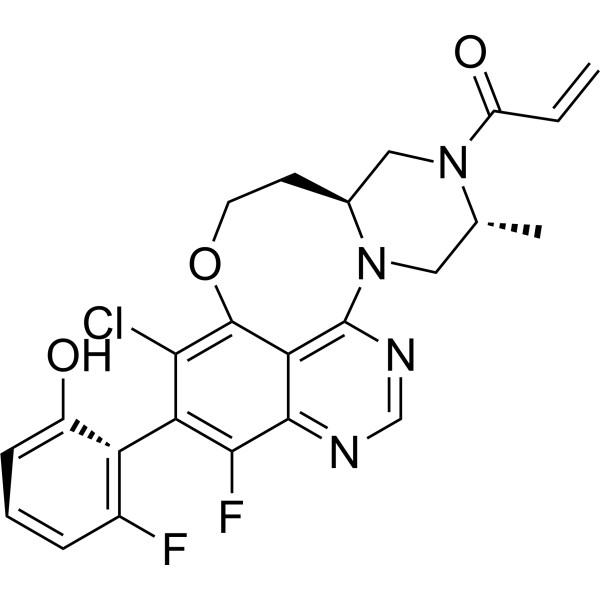
Cat. No.: HY-155770
Target:  

FLT3

Research Areas:  

Cancer

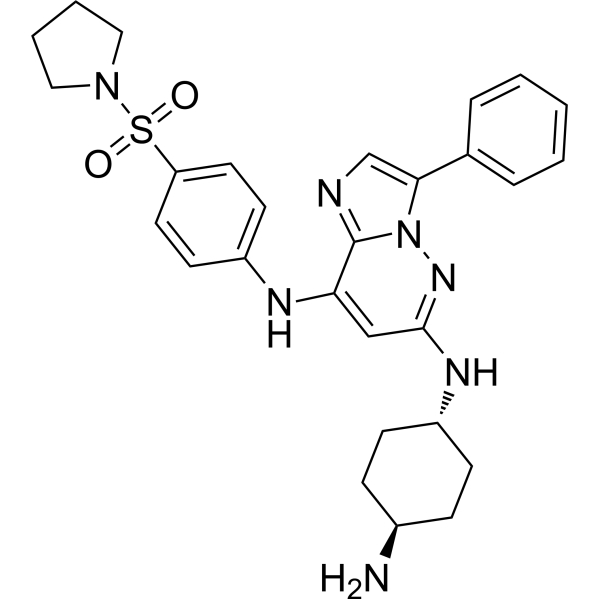
FLT3-IN-20 (compound 34f) is a potent FLT3 inhibitor with IC50 values of 1 and 4 nM for FLT3-D835Y and FLT3-ITD, respectively. FLT3-IN-20 has anti-proliferation efficacy in FLT3-ITD-positive AML cell lines MV4-11 and MOLM-13 (7 and 9 nM, respectively) and the MOLM-13 variant (4 nM) with the FLT3-ITD-D835Y mutation. FLT3-IN-20 can be used in research of cancer .
loading...
    loading...
Cat. No.: HY-156698
CAS No.: 2570251-68-0
Purity:  98.64%
Target:  

PROTACs EGFR

Research Areas:  

Cancer

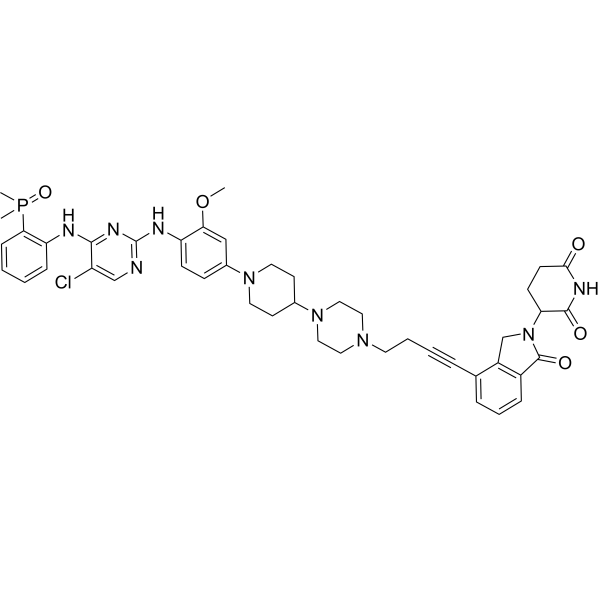
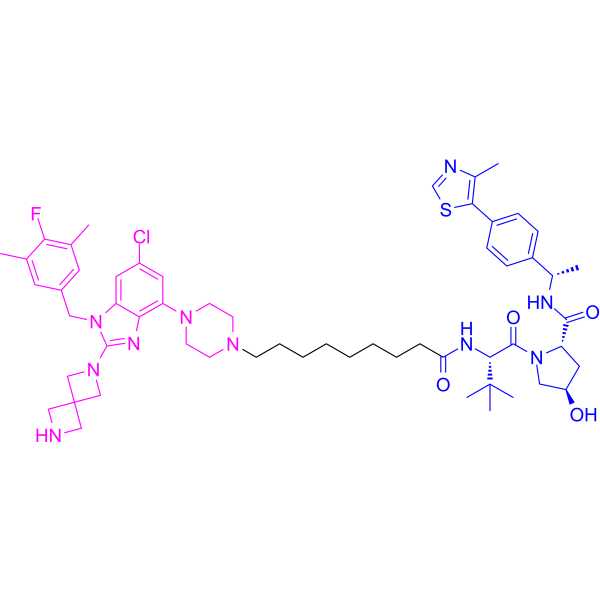
HJM-561 is a selective and effective orally active EGFR PROTAC degrader. HJM-561 is able to overcome the triple EGFR mutations that are resistant to Osimertinib (HY-15772). HJM-561 exhibits potent degradation of EGFR Del19/T790M/C797S (DC50: 9.2 nM) and L858R/T790M/C797S (DC50: 5.8 nM), and has anti-tumor activity (pink: EGFR ligand (HY-12857); blue: CRBN ligand (HY-A0003); black: linker) .
loading...
    loading...
Cat. No.: HY-159958
CAS No.: 3037315-44-6
Target:  

Potassium Channel

Research Areas:  

Neurological Disease

KNa1.1-IN-2 (Compound Z05) is a selective KNa1.1 channel inhibitor with blood-brain barrier penetration, particularly effective against the hERG channel. KNa1.1-IN-2 works by binding to the KNa1.1 channel and blocking the channel activity induced by Gain-of-function (GOF) mutations, effectively intervening in KCNT1-related epilepsy. Additionally, KNa1.1-IN-2 inhibits the GOF mutant Y796H. KNa1.1-IN-2 holds promise for research into KCNT1-related epilepsy disorders .
loading...
    loading...
Cat. No.: HY-161785
CAS No.: 3035639-05-2
Target:  

Apoptosis EGFR

Research Areas:  

Cancer

EGFR-IN-117 (Compound 8h) exhibits inhibitory activity against EGFR mutation, targets the tumor environment, and induces apoptosis of cancer cells. EGFR-IN-117 inhibits proliferations of H1975, PC-9, and EGFR mutant cells BaF3-EGFR L858R/T790M/C797S and BaF3– C797S/Del19/T790M, with IC50 of 13 nM, 19 nM, 1.2 nM and 1.3 nM, respectively. EGFR-IN-117 exhibits antitumor efficacy in mouse models .
loading...
    loading...
Cat. No.: HY-168012
CAS No.: 3054023-07-0
Target:  

Ras Phosphatase

Research Areas:  

Cancer

Pan-RAS-IN-6 (compound 24) is an inhibitor targeting DUSP6, which reduces MAPK activation in the brain of the NCI-H1373-Luc model (DUSP6), at the same time, it shows significant tumor growth inhibition and tumor regression effects in the NSCLC brain metastasis mouse model. Pan-RAS-IN-6 shows high selectivity and strong inhibitory effects, especially in KRAS mutation-related signaling pathways, demonstrating varying inhibitory activity against different KRAS mutants and interacting proteins. The IC50 values for KRAS G12C, G12D, and G12V are 1.3 nM, 4.7 nM, and 0.3 nM, respectively .
loading...
    loading...
Cat. No.: HY-173250
Target:  

PROTACs Ras Apoptosis

Research Areas:  

Cancer

YN14-H is a potent mutant KRAS G12C PROTAC degrader. The DC50 values of YN14-H in NCI-H358 and MIA PaCa-2 cells are 28.9 nM and 18.1 nM, respectively, with corresponding IC50 values of 42 nM and 21 nM. YN14-H degrades KRAS G12C in a ubiquitin-proteasome system-dependent manner, thereby significantly inducing apoptosis and inhibiting cell migration. YN14-H can be used for targeting tumors with KRAS G12C mutations (such as non-small cell lung cancer, pancreatic cancer, etc.) .
loading...
    loading...
Cat. No.: HY-175252
Research Areas:  

Cancer

PROTAC EGFR degrader 14 is a EGFR PROTAC degrader, with a DC50 of 2.9 nM against EGFR L858R/T790M/C797S. PROTAC EGFR degrader 14 forms a stable ternary complex by bridging the ATP-binding pocket of the target protein EGFR with VHL E3 ubiquitin ligase, induces efficient and specific degradation of EGFR mutants via the ubiquitin-proteasome system, and ultimately induces cell cycle arrest and apoptosis. PROTAC EGFR degrader 14 can be used in studies related to non-small cell lung cancer carrying the EGFR C797S drug-resistant mutation .
loading...
    loading...
Cat. No.: HY-17654
CAS No.: 1429497-30-2
Target:  

EGFR mTOR

Research Areas:  

Cancer

BIEGi-1 is an EGFR inhibitor. BIEGi-1 effectively disrupts the EGFR-Rheb interaction in cells. BIEGi-1 robustly inhibits EGFR kinase activity (reduces p-Y1068-EGFR) as well as mTORC1 activation (reduces p-T389-S6K1) in EGFR-mutant cells. BIEGi-1 shows strong antiproliferative effects on EGFR-mutant PC9 and HCC827 cells with IC50 values of 17 nM and 20 nM, respectively. BIEGi-1 can be used for the study of cancers harboring EGFR mutations, such as non-small cell lung cancer (NSCLC) .
loading...
    loading...
Cat. No.: HY-184458
CAS No.: 1009821-64-0
Target:  

Casein Kinase

Research Areas:  

Cancer

CX-5279 free acid is an efficient and selective CK2 inhibitor with IC50 values for nCK2 and CK2α of 2.73 and 0.91 nM, respectively. CX-5279 free acid is sensitive to mutations at Val66, Ile174, and V66I174AA, with IC50 values of 13.8, 12.5, and 23.35 nM, respectively. CX-5279 free acid's inhibitory activity against PIM1 is very weak, with a IC50 value of 8.52 μM. CX-5279 free acid exhibits anti-proliferative activity in various cancer cell lines. CX-5279 free acid can be used for research on cancers such as pancreatic cancer and leukemia .
loading...
    loading...
Cat. No.: HY-187625
CAS No.: 153312-20-0
Research Areas:  

Infection

Tgg-II-23A is a non-nucleoside HIV-1 reverse transcriptase inhibitor, with an IC50 of 136 μM against HIV-1 NL4-3 reverse transcriptase . Tgg-II-23A exhibits antiviral activity against wild-type HIV-1, but shows reduced activity against TIBO R82150 (HY-19111)-resistant HIV-1 strains carrying reverse transcriptase mutations. Tgg-II-23A does not inhibit the replication of HIV-2. Tgg-II-23A can be used in studies related to HIV-1 infection [2].
loading...
    loading...
Cat. No.: HY-P990204

Target:  

LAG-3

Research Areas:  

Inflammation/Immunology Cancer

Anti-Mouse LAG-3 (D265A) Antibody (C9B7W) is an anti-mouse LAG-3 IgG1 monoclonal antibody. Anti-Mouse LAG-3 (D265A) Antibody (C9B7W) is a chimeric antibody of the original C9B7W antibody (HY-P99141). Anti-Mouse LAG-3 (D265A) Antibody (C9B7W) contains the D265A mutation region. Anti-Mouse LAG-3 (D265A) Antibody (C9B7W) can be used for research on cancer .
loading...
    loading...
Cat. No.: HY-P990240

Target:  

TNF Receptor

Research Areas:  

Inflammation/Immunology Cancer

Anti-Mouse GITR (LALA-PG) Antibody (DTA-1) is an anti-mouse GITR IgG2a monoclonal antibody. Anti-Mouse GITR (LALA-PG) Antibody (DTA-1) is a chimeric antibody of the original DTA-1 antibody (HY-P990124). Anti-Mouse GITR (LALA-PG) Antibody (DTA-1) contains the LALA-PG mutation region. Anti-Mouse GITR (LALA-PG) Antibody (DTA-1) can be used for research on cancer and allergic conditions. The recommed isotype control of Anti-Mouse GITR (LALA-PG) Antibody (DTA-1) is Mouse IgG2a kappa, Isotype Control (HY-P99978).
loading...
    loading...
Cat. No.: HY-P990241

Target:  

TNF Receptor

Research Areas:  

Inflammation/Immunology Cancer

Anti-Mouse GITR (D265A) Antibody (DTA-1) is an anti-mouse GITR IgG1 monoclonal antibody. Anti-Mouse GITR (D265A) Antibody (DTA-1) is a chimeric antibody of the original DTA-1 antibody (HY-P990124). Anti-Mouse GITR (D265A) Antibody (DTA-1) contains the D265A mutation region. Anti-Mouse GITR (D265A) Antibody (DTA-1) can be used for research on cancer and allergic conditions. The recommed isotype control of Anti-Mouse GITR (D265A) Antibody (DTA-1) is Mouse IgG1 kappa, Isotype Control (HY-P99977).
loading...
    loading...
Cat. No.: HY-P990742
CAS No.: 2762499-30-7
Synonyms: TJ-CD4B; ABL111; TJ033721
Target:  

TNF Receptor Claudin

Research Areas:  

Inflammation/Immunology Cancer

Givastomig (ABL111, TJ033721) is a bispecific antibody (BsAb) inhibitor. Givastomig can specifically binds to Claudin18.2 (CLDN 18.2) on the surface of cancer cells and 4-1BB (CD137, TNFRSF9) on the surface of activated T cells and natural killer (NK) cells. Givastomig is engineered to contain a single Fc-domain mutation (asparagine to alanine) to eliminate Fc-effector function. Givastomig-bound cell lines expressing a range of CLDN18.2 levels with high affinity and induced 4-1BB activation only in the context of CLDN18.2 binding. Givastomig can be used for the study of colon carcinoma .
loading...
    loading...
Cat. No.: HY-P99123A

Target:  

CD28

Anti-Mouse CD28 (LALA-PG) Antibody (D665) is an anti-mouse CD28 IgG2a monoclonal antibody. Anti-Mouse CD28 (LALA-PG) Antibody (D665) is a chimeric antibody of the original D665 antibody (HY-P990793). Anti-Mouse CD28 (LALA-PG) Antibody (D665) contains the LALA-PG mutation region. Anti-Mouse CD28 Antibody (D665) induces the activation of T cells. Anti-Mouse CD28 Antibody (D665) can be used for research on neurological conditions, inflammation, immunology and cancer, such as Parkinson disease (PD), arthritis and graft-versus-host disease (GVHD).
loading...
    loading...
Cat. No.: HY-111772A
CAS No.: 2229860-99-3
Purity:  99.44%
Synonyms: (R)-VX-445
Target:  

Drug Isomer CFTR

Research Areas:  

Inflammation/Immunology

(R)-Elexacaftor ((R)-VX-445) is the enantiomer of Elexacaftor (HY-111772). Elexacaftor is an orally active CFTR modulator that targets nucleotide-binding domain 1. Elexacaftor stabilizes misfolded F508del-CFTR protein, enhances its trafficking to the plasma membrane, and significantly improves metabolic stability, thermal stability and ion conductivity. Elexacaftor not only restores chloride transport function in nasal epithelial cells and rescues multiple CFTR mutation subtypes, but also exerts multiplicative synergistic effects with Ivacaftor (HY-13017), and is often used in a triple combination therapy with Tezacaftor (HY-15448). Elexacaftor is widely used in basic and clinical translational research on cystic fibrosis [2] .
loading...
    loading...
Cat. No.: HY-112823S
Synonyms: HS-10296-d6
Almonertinib-d6 (HS-10296-d6) is the deuterium labeled Almonertinib (HY-112823). Almonertinib (HS-10296) is an orally available, irreversible, third-generation EGFR tyrosine kinase inhibitor with high selectivity for EGFR-sensitizing and T790M resistance mutations. Almonertinib shows great inhibitory activity against T790M, T790M/L858R and T790M/Del19 (IC50: 0.37, 0.29 and 0.21 nM, respectively), and is less effective against wild type (3.39 nM). Almonertinib is used for the research of the non-small cell lung cancer [2].
loading...
    loading...
Cat. No.: HY-132844
CAS No.: 1801756-06-8
Purity:  98.25%
Synonyms: HL-085
Target:  

MEK

Research Areas:  

Cancer

Tunlametinib is a highly selective, orally active MEK1/2 inhibitor (IC50=1.9 nM, MEK1). Tunlametinib blocks the RAS-RAF-MEK-ERK signaling pathway, arrests tumor cell cycle and promotes apoptosis. Tunlametinib potently inhibits the proliferation of RAS/RAF mutant cancer cells (such as BRAF V600E, KRAS G12C mutant cells). Tunlametinib shows synergistic anti-tumor effects with BRAF/KRASG12C/SHP2 inhibitors, Docetaxel (HY-B0011). Tunlametinib can be used to study targeted therapy for RAS/RAF mutation-driven malignancies (such as melanoma, colorectal cancer, and non-small cell lung cancer) [2].
loading...
    loading...
Cat. No.: HY-145737
CAS No.: 2913185-35-8
Target:  

PROTACs SOS1 Ras PERK

Research Areas:  

Cancer

PROTAC SOS1 degrader-1 is a degrader of SOS1 PROTAC, with a DC50 of 98.4 nM and a Kd value of 44 nM. PROTAC SOS1 degrader-1 induces the formation of a ternary complex with SOS1 and the VCB E3 ubiquitin ligase complex, thereby promoting the ubiquitination and proteasomal degradation of SOS1. PROTAC SOS1 degrader-1 reduces KRAS-GTP levels, inhibits the phosphorylation of ERK in the RAS-RAF-MEK-ERK pathway, and suppresses the proliferation of cancer cells carrying KRAS mutations. PROTAC SOS1 degrader-1 inhibits tumor growth in mouse xenograft models. PROTAC SOS1 degrader-1 can be used for the research of KRAS-driven cancers .
loading...
    loading...
Cat. No.: HY-146223A
Purity:  98.00%
Target:  

Ras PI3K p38 MAPK Apoptosis

Research Areas:  

Cancer

(3R,10R,14aS)-AZD4625 is the isomer of AZD4625 (HY-146223), and can be used as an experimental control. AZD4625 is an orally active, selective irreversible, covalent allosteric GTPase KRASG12C inhibitor with an IC50 of 3 nM. AZD4625 can inhibit the MAPK pathway (with decreased pCRAF, pMEK, and pERK) and the PI3K pathway (with decreased pAKT and pS6), and induce cell apoptosis. AZD4625 has no binding and inhibition of wild-type RAS or isoforms carrying non-KRASG12C mutations. AZD4625 can be used for the study of KRASG12C mutant non-small cell lung cancer [2].
loading...
    loading...

