85 Results for "

lymph

" in MedChemExpress (MCE) Product Catalog:
Products (85)

85 Results for "lymph" in MCE Product Catalog:

Cat. No.: HY-159753
Research Areas:  

Inflammation/Immunology

HS105 is a vaccine adjuvant and a key component in vaccines. Adjuvants can be divided into immunostimulants and delivery systems. Adjuvants can not only enhance the intensity and durability of immune responses, but also affect the type of immune responses. On the one hand, immunostimulants promote the production of antigen signals and co-stimulatory signals by targeting Toll-like receptors (TLRs) and other pattern recognition receptors (PRRs), leading to the maturation and activation of antigen presenting cells (APCs), thereby enhancing adaptive immune responses; on the other hand, delivery systems are carrier materials that promote antigen delivery by prolonging the bioavailability of loaded antigens and targeting antigens to lymph nodes or APCs. Several common adjuvants include: saponins, TLRs agonists, polysaccharides, nanoparticles, cytokines, and mucosal adjuvants .
loading...
    loading...
Cat. No.: HY-12017B
CAS No.: 1159490-85-3
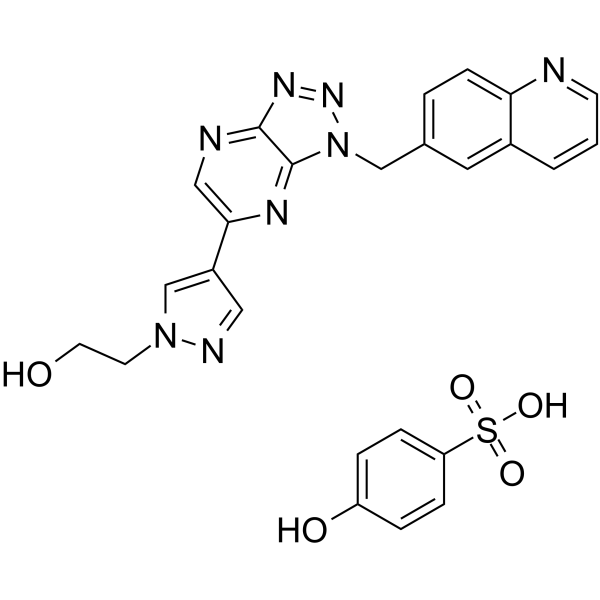
PF-04217903 phenolsulfonate is an orally active, highly selective ATP-competitive c-Met kinase inhibitor with a Ki value of 4.8 nM and a Kd value of 4.5 nM. PF-04217903 phenolsulfonate blocks c-Met and HGF signaling pathways, inhibits MET phosphorylation, and blocks downstream MAPK, PI3K/AKT and PLCγ1 pathways. PF-04217903 phenolsulfonate suppresses tumor proliferation, survival, migration, invasion, angiogenesis and metastasis, induces apoptosis, and enhances efferocytosis, Annexin A1 expression and resolution of inflammation. PF-04217903 phenolsulfonate retains activity against several c-Met mutants (M1131T, V1220I, H1094R). PF-04217903 phenolsulfonate increases the incidence of subarachnoid hemorrhage and reduces survival rate without altering aneurysm formation, and also prevents lymph node metastasis induced by VEGF inhibition. PF-04217903 phenolsulfonate is applicable to research related to tumors (pancreas, stomach, lung, brain, colon, breast, kidney, melanoma, etc.), intracranial aneurysms and inflammatory diseases (gouty arthritis, neutrophilic pleuritis) .
loading...
    loading...
Cat. No.: HY-K0308

MCE Mouse CD4+ Cells Positive Selection Kit is designed for the isolation of CD4+ cells from single cell suspensions of mouse spleen cells, lymph nodes or other tissues.

loading...
    loading...
Cat. No.: HY-K0309

MCE Mouse CD8+ T Cells Negative Selection Kit is designed for the isolation of CD8+ T cells from single cell suspensions of mouse spleen cells and lymph nodes.

loading...
    loading...
Cat. No.: HY-K1067

MCE Exosome Isolation and Purification Kit (From Tissue) provides a simple and effective method to isolate and purify intact exosomes from a variety of tissues (such as brain, heart, lung, liver, muscle, lymph nodes, thymus, embryo, tumor, etc.).

loading...
    loading...
Cat. No.: HY-182960
CAS No.: 749262-82-6
KRP-203 monophosphate is a monophosphate of KRP-203 (HY-13660). KRP-203 is an orally active sphingosine-1-phosphate receptor (S1PR) modulator that blocks the signal required by T cells to egress from lymph nodes and other lymphoid organs .
loading...
    loading...
Cat. No.: HY-185284
Target:  

Liposome

Research Areas:  

Others

MeDZ lipid is a zwitterion-type ionizable endosomal membrane destabilizer and anti-inflammatory agent that promotes endosomal escape. When incorporated into LNP formulations, MeDZ lipid enhances mRNA expression in lymph node antigen-presenting cells and promotes cytotoxic T cell activation. MeDZ lipid is compatible with existing targeted nanoparticle formulations to improve mRNA delivery efficiency .
loading...
    loading...
Cat. No.: HY-P11928
CAS No.: 3121532-43-9
Target:  

CCR ERK

Research Areas:  

Cancer

TC6-D3 is a proteolysis-resistant peptide and also a CC chemokine receptor 7 (CCR7) inhibitor, with a Kd value of 403 nM against mouse targets. TC6-D3 blocks the interaction between CCR7 and its ligands CCL19 and CCL21, and inhibits the activation of the ERK1/2 pathway. TC6-D3 reduces the migratory capacity of tumor cells in vitro. TC6-D3 inhibits tumor growth and lymph node metastasis in vivo. TC6-D3 restores T cell cytotoxicity, promotes CD8+ T cell infiltration, and enhances anti-tumor immune responses. TC6-D3 can be used in studies related to lymph node metastasis .
loading...
    loading...
Cat. No.: HY-P72739
Purity:  ≥ 95%, as determined by reducing SDS-PAGE.
Synonyms: CLEC4M; Dendritic Cell-Specific ICAM-3-Grabbing Non-Integrin 2; Prev. CD209L; DC-SIGN-Related Protein; Prev. CD299; L-SIGN; DC-SIGNR; Liver/lymph Node-Specific ICAM-3 Grabbing Non-Integrin; DC-SIGN2; Liver/lymph Node-Specific ICAM-3-Grabbing Non-Integrin
Species:  
Human
Source:  
HEK293
loading...
    loading...
Cat. No.: HY-P76219A
Purity:  ≥ 90%, as determined by reducing SDS-PAGE.
Synonyms: CLEC4M; Dendritic Cell-Specific ICAM-3-Grabbing Non-Integrin 2; Prev. CD209L; DC-SIGN-Related Protein; Prev. CD299; L-SIGN; DC-SIGNR; Liver/lymph Node-Specific ICAM-3 Grabbing Non-Integrin; DC-SIGN2; Liver/lymph Node-Specific ICAM-3-Grabbing Non-Integrin
Species:  
Human
Source:  
HEK293
loading...
    loading...
Cat. No.: HY-P76219
Purity:  ≥ 90%, as determined by reducing SDS-PAGE.
Synonyms: CLEC4M; Dendritic Cell-Specific ICAM-3-Grabbing Non-Integrin 2; Prev. CD209L; DC-SIGN-Related Protein; Prev. CD299; L-SIGN; DC-SIGNR; Liver/lymph Node-Specific ICAM-3 Grabbing Non-Integrin; DC-SIGN2; Liver/lymph Node-Specific ICAM-3-Grabbing Non-Integrin
Species:  
Human
Source:  
HEK293
loading...
    loading...
Cat. No.: HY-K0361

MCE Mouse Pan B Cell Negative Selection Kit enables the efficient isolation of total B cells from mouse spleen, lymph nodes, bone marrow, or peritoneal lavage fluid. The principle involves using biotin-labeled monoclonal antibodies to label non-target cells (non-B cells), followed by the removal of these non-target cells through streptavidin-labeled magnetic beads, achieving the selective isolation of mouse B Cells.

loading...
    loading...
Cat. No.: HY-K0357

MCE Mouse Mature B Cell Negative Selection Kit enables the efficient isolation of mature B cells from single-cell suspensions prepared from mouse spleen, lymph nodes, or bone marrow. The principle involves using biotin-labeled monoclonal antibodies to label non-target cells (non-B cells), followed by the removal of these non-target cells through streptavidin-labeled magnetic beads, achieving the selective isolation of mouse mature B cells.

loading...
    loading...
Cat. No.: HY-W761985
CAS No.: 65907-30-4
Target:  

Insecticide

Research Areas:  

Inflammation/Immunology

Furathiocarb is a carbamate pro-insecticide and a contact allergen. Furathiocarb is commonly used in studies related to contact allergy. Furathiocarb induces significant proliferation of MHC II-positive B cells in auricular lymph node cells and induces the production of Th1 cytokines (such as IL-2, TNF-γ and IFN-γ). However, Furathiocarb does not induce respiratory allergy in mice. After absorption through the abdominal skin of isolated rats, Furathiocarb is completely metabolized into carbofuran, and its permeation amount increases with time and dosage. The skin permeation rates of both emulsifiable concentrate (EC) and wettable powder (WP) formulations of Furathiocarb are higher than that of Furathiocarb itself, with no significant difference between the two formulations .
loading...
    loading...
Cat. No.: HY-159751
Research Areas:  

Inflammation/Immunology

HS101 is a vaccine adjuvant and a key component in vaccines. Adjuvants can be divided into immunostimulants and delivery systems. Adjuvants can not only enhance the intensity and durability of immune responses, but also affect the type of immune responses. On the one hand, immunostimulants promote the production of antigen signals and co-stimulatory signals by targeting Toll-like receptors (TLRs) and other pattern recognition receptors (PRRs), leading to the maturation and activation of antigen presenting cells (APCs), thereby enhancing adaptive immune responses; on the other hand, delivery systems are carrier materials that promote antigen delivery by prolonging the bioavailability of loaded antigens and targeting antigens to lymph nodes or APCs. Several common adjuvants include: saponins, TLRs agonists, polysaccharides, nanoparticles, cytokines, and mucosal adjuvants .
loading...
    loading...
Cat. No.: HY-P702872
Purity:  ≥ 90%, as determined by reducing SDS-PAGE.
Synonyms: LASP1; Lasp-1; LIM And SH3 Protein 1; Metastatic lymph Node Gene 50 Protein; MLN50; MLN 50; LIM And SH3 Domain Protein 1; LASP-1
Species:  
Human
Source:  
E. coli
loading...
    loading...
Cat. No.: HY-P702873
Purity:  ≥ 90%, as determined by reducing SDS-PAGE.
Synonyms: LASP1; Lasp-1; LIM And SH3 Protein 1; Metastatic lymph Node Gene 50 Protein; MLN50; MLN 50; LIM And SH3 Domain Protein 1; LASP-1
Species:  
Mouse
Source:  
E. coli
loading...
    loading...
Cat. No.: HY-169478
CAS No.: 2924606-55-1
Target:  

Liposome

Research Areas:  

Cancer

Lipid N2-3L is an ionizable cationic lipid (pKa = 8.99) that can be used to generate supramolecular lipid nanoparticles (SMLNPs) for mRNA delivery. Lipid nanoparticles formed by encapsulating a luciferase reporter gene with Lipid N2-3L were detected to accumulate in the lymph nodes of mice, indicating that they can effectively enter the mouse immune system. Lipid nanoparticles formed by encapsulating ovalbumin mRNA and the TLR7/8 agonist Resiquimod (HY-13740) with Lipid N2-3L were able to reduce tumor volume and increase survival in the MC-38-OVA mouse colon cancer model. Lipid N2-3L can be used in the research of drug delivery for cancer-related therapies .
loading...
    loading...
Cat. No.: HY-182365
EED-IN-4 is an orally active, EZH2-selective immunomodulator and EED-H3K27me3 inhibitor (EED, IC50=28.21 nM) with anti-inflammatory activity. In mouse models, EED-IN-4 preferentially and persistently accumulates in lymph nodes after oral administration. By reducing the H3K27me3 level of dendritic cells and inhibiting their migration, EED-IN-4 reduces the infiltration of immune cells into the central nervous system and effectively alleviates spinal cord inflammation. EED-IN-4 shows weak inhibitory activity against hERG channels and is non-mutagenic, with no obvious toxicity observed upon long-term oral administration. EED-IN-4 can be used for the research of multiple sclerosis .
loading...
    loading...
Cat. No.: HY-P811085
Synonyms: CD62L, Lnhr, Ly-22, Ly22, Sell, L-selectin, CD62 antigen-like family member L, Leukocyte adhesion molecule 1, Leukocyte-endothelial cell adhesion molecule 1, lymph node homing receptor, lymphocyte antigen 22, lymphocyte surface MEL-14 antigen, LAM-1, LECAM1

Host:  

Rabbit

Application:  

WB, IHC-P

Reactivity:  

Human, Mouse, Rat

loading...
    loading...

