76 Results for "

proteasomal pathway

" in MedChemExpress (MCE) Product Catalog:
Products (76)

76 Results for "proteasomal pathway" in MCE Product Catalog:

Cat. No.: HY-174858
CAS No.: 3100207-58-4
Target:  

PROTACs ASK1 p38 MAPK

Research Areas:  

Inflammation/Immunology

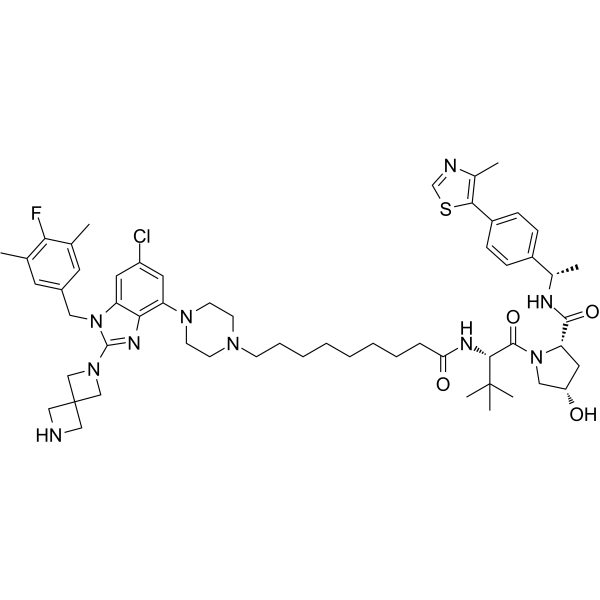
dASK1-VHL is an ASK1 PROTAC degrader that recruits VHL. dASK1-VHL induces ubiquitination and proteasomal degradation of ASK1 by forming a ternary complex, and inhibits the downstream p38 MAPK signaling pathway. dASK1-VHL can be used in studies of metabolic dysfunction-associated steatohepatitis .
loading...
    loading...
Cat. No.: HY-174877
CAS No.: 3068162-16-0
Target:  

PROTACs HDAC

Research Areas:  

Cancer

PROTAC HDAC6 degrader 6 is a HDAC6 PROTAC degrader that recruits CRBN, and also a photoactivatable photochemical targeting chimeric (PHOTAC). PROTAC HDAC6 degrader 6 switches between cis and trans conformations upon illumination, in which the cis conformation binds HDAC6 and CRBN to form a ternary complex, and induces HDAC6 degradation via ubiquitin-like modification, polyubiquitination and proteasomal pathways. PROTAC HDAC6 degrader 6 can be used in the research of multiple myeloma .
loading...
    loading...
Cat. No.: HY-178964
CAS No.: 2760847-82-1
Research Areas:  

Cancer

PROTAC RET Degrader 1 is an orally active, blood-brain barrier-penetrant RET PROTAC degrader with a DC50 of 1.7 nM. PROTAC RET Degrader 1 binds to CRBN and forms a ternary complex with RET, mediating proteasomal degradation of RET, while also selectively mediating the degradation of SALL4. PROTAC RET Degrader 1 inhibits the RET signaling pathway, hERG channel activity, and Cyp3A4 enzyme activity; it suppresses cancer cell growth and induces tumor regression. PROTAC RET Degrader 1 can be used in research related to RET-driven cancers .
loading...
    loading...
Cat. No.: HY-162972
CAS No.: 2995357-09-8
Target:  

PROTACs PD-1/PD-L1

Research Areas:  

Inflammation/Immunology Cancer

PROTAC PD-L1 degrader-2 is a PD-L1 PROTAC degrader with an IC50 of 197.4 nM and a Kd of 301 nM. PROTAC PD-L1 degrader-2 induces PD-L1 endocytosis, drives degradation via the proteasomal and lysosomal pathways, and inhibits the PD-1/PD-L1 interaction. As an immune activator, PROTAC PD-L1 degrader-2 increases the levels of CD4 +, CD8 +, granzyme B and perforin. PROTAC PD-L1 degrader-2 can be used in studies related to colon cancer immunology .
loading...
    loading...
Cat. No.: HY-162280
CAS No.: 3034024-77-3
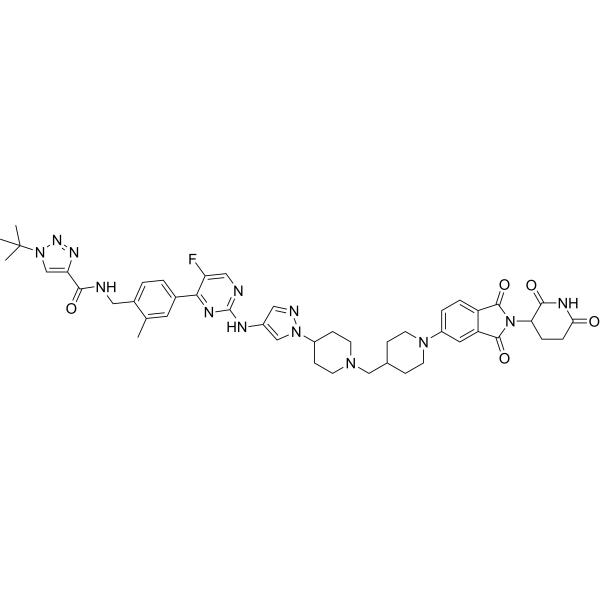
PROTAC BTK Degrader-9 is a potent BTK PROTAC degrader with a DC50 of 1.29 nM (in Mino cells at 4 h). PROTAC BTK Degrader-9 induces the formation of a stable ternary complex with BTK and the CRBN E3 ubiquitin ligase, thereby mediating proteasomal degradation of BTK in a CRBN-dependent manner. PROTAC BTK Degrader-9 downregulates the RANKL-activated BTK-PLCγ2-Ca 2+-NFATc1 signaling pathway. PROTAC BTK Degrader-9 alleviates alveolar bone resorption in periodontitis models of Mus musculus (house mouse). PROTAC BTK Degrader-9 can be used in research related to periodontitis .
loading...
    loading...
Cat. No.: HY-168492
CAS No.: 3038386-42-1
TrxR/EGFR-IN-1 is a TrxR/GFR inhibitor and a Gefitinib (HY-50895) derivative. TrxR/EGFR-IN-1 inhibits TrxR and EGFR, downregulates p‑EGFR, p‑AKT, and p‑ERK; promotes GPX4 protein degradation through dual autophagy-lysosomal and proteasomal pathways, triggering ferroptosis. TrxR/EGFR-IN-1 induces endoplasmic reticulum stress, immunogenic cell death, and apoptosis, increasing intracellular ROS and oxidative stress. TrxR/EGFR-IN-1 exhibits in vitro antiproliferative activity against both Gefitinib-sensitive and Gefitinib-resistant non-small cell lung cancer. TrxR/EGFR-IN-1 inhibits tumor growth in the PC9GR xenograft tumor model. TrxR/EGFR-IN-1 can be used for lung cancer-related research .
loading...
    loading...
Cat. No.: HY-144657
CAS No.: 2913176-81-3
Target:  

PROTACs SOS1 Drug Isomer Ras

Research Areas:  

Cancer

(4S)-PROTAC SOS1 degrader-1 is a stereoisomer of PROTAC SOS1 degrader-1 (HY-145737). PROTAC SOS1 degrader-1 (Compound 9d) is a degrader of SOS1 PROTAC, with a DC50 of 98.4 nM and a Kd value of 44 nM. PROTAC SOS1 degrader-1 induces the formation of a ternary complex with SOS1 and the VCB E3 ubiquitin ligase complex, thereby promoting the ubiquitination and proteasomal degradation of SOS1. PROTAC SOS1 degrader-1 reduces KRAS-GTP levels, inhibits the phosphorylation of ERK in the RAS-RAF-MEK-ERK pathway, and suppresses the proliferation of cancer cells carrying KRAS mutations. PROTAC SOS1 degrader-1 inhibits tumor growth in mouse xenograft models. PROTAC SOS1 degrader-1 can be used for the research of KRAS-driven cancers .
loading...
    loading...
Cat. No.: HY-174469
CAS No.: 3070438-79-5
PROTAC PI3K/110β degrader-2 is a VHL-recruiting PI3K/110β PROTAC degrader, with DC50 values of 1.258 μM and 2.185 μM in MCF-7/ADM and A549/DDP cells, respectively. PROTAC PI3K/110β degrader-2 induces proteasomal degradation of PI3K/110β, inhibits phosphorylation of AKT and expression of Bcl-2, while suppressing the activity and expression of P-gp. It also induces endoplasmic reticulum stress and mitochondrial apoptosis via the PERK/CHOP pathway. PROTAC PI3K/110β degrader-2 exerts anti-tumor activity against multidrug-resistant cancer cells both in vitro and in vivo, and produces a synergistic effect when combined with Doxorubicin (HY-15142A) or Cisplatin (HY-17394), making it applicable for the research of multidrug-resistant cancers .
loading...
    loading...
Cat. No.: HY-176421
CAS No.: 3070438-85-3
PROTAC PI3K/110β degrader-1 is a VHL-recruiting PROTAC degrader targeting PI3K/110β, with DC50 values of 0.416 μM (MCF-7) and 19.66 μM (A549), respectively. PROTAC PI3K/110β degrader-1 recruits VHL to induce proteasomal degradation of PI3K/110β. It activates endoplasmic reticulum stress (ERS)-mediated mitochondrial apoptosis via the PERK/ATF4/CHOP unfolded protein response (UPR) pathway, downregulates p-AKT and Bcl-2, upregulates Bax, cleaved-caspase-9 and cleaved-caspase-3, inhibits the expression and activity of P-gp, and exerts synergistic anti-tumor effects with Doxorubicin (Adriamycin, ADM) (HY-15142A) and Cisplatin (DDP) (HY-17394). PROTAC PI3K/110β degrader-1 can be used in research related to multidrug-resistant cancers .
loading...
    loading...
Cat. No.: HY-172595
Research Areas:  

Cancer

Apoptosis inducer 48 (5d) is an apoptotic agent. Apoptosis inducer 48 inhibits the growth of triple-negative breast cancer cells. Apoptosis inducer 48 attenuates proteasomal degradation via the ubiquitin-proteasome pathway, leading to G2/M phase cell cycle arrest and the induction of apoptotic .
loading...
    loading...
Cat. No.: HY-168190
Target:  

PROTACs

Research Areas:  

Cancer

PROTAC TBL1X degrader-1 is a TBL1X PROTAC degrader. PROTAC TBL1X degrader-1 induces TBL1X degradation via the Cereblon-mediated proteasomal pathway. PROTAC TBL1X degrader-1 exerts cytotoxic effects on cancer cells. PROTAC TBL1X degrader-1 can be used in studies related to diffuse large B-cell lymphoma .
loading...
    loading...
Cat. No.: HY-175538
Research Areas:  

Cancer

USP10-IN-4 is a potent ubiquitin-specific protease 10 (USP10) inhibitor with an IC50 of 10.87 μM and a Kd of 365 nM. USP10-IN-4 effectively inhibits USP10-mediated proteasomal degradation of downstream proteins YAP and p53, leading to the subsequent downregulation of CDK4 in the p53 signaling pathway. USP10-IN-4 promotes apoptosis in HCC cells and inhibits the onset and progression of liver cancer. USP10-IN-4 can used for the study of hepatocellular carcinoma (HCC) .
loading...
    loading...
Cat. No.: HY-179033
Nur77 antagonist 2 (Compound 12b) is an orally active Nur77 antagonist with a KD value of 0.42 μM. Nur77 antagonist 2 exhibits proliferative activity on liver cancer cells. Nur77 antagonist 2 stabilizes Nur77 by inhibiting its ubiquitin-proteasomal degradation, leading to Nur77-dependent apoptosis via the ASK1-JNK/p38 pathway. Nur77 antagonist 2 inhibits tumor growth in the HCCLM3 xenograft model. Nur77 antagonist 2 can be used for the study of hepatocellular carcinoma (HCC) .
loading...
    loading...
Cat. No.: HY-162815
Research Areas:  

Cancer

PROTAC SMARCA2/4 degrader-26 is a SMARCA2/4 PROTAC degrader with selective anti-tumor activity against lung cancer cells. PROTAC SMARCA2/4 degrader-26 degrades SMARCA2 and SMARCA4 via the PROTAC-mediated proteasomal pathway. It induces DNA damage and apoptosis in tumor cells, while inhibiting migration and colony formation of lung cancer cells; in addition, it damages normal vascular endothelial cells and exhibits significant off-target-related cytotoxicity. PROTAC SMARCA2/4 degrader-26 serves as the parent scaffold to construct the GSH-responsive prodrug PROTAC SMARCA2/4 degrader-25 (HY-162813), a derivative that shows drastically reduced cytotoxicity against normal cells. PROTAC SMARCA2/4 degrader-26 can be used in lung cancer-related research .
loading...
    loading...
Cat. No.: HY-169134
Research Areas:  

Cancer

PROTAC 20S proteasome subunit β5 degrader 1 is a PROTAC degrader targeting the 20S proteasome subunit β5, with a DC50 of 0.11 μM. PROTAC 20S proteasome subunit β5 degrader 1 forms a ternary complex with the CRBN E3 ligase, induces ubiquitination of the 20S proteasome subunit β5, and promotes its degradation via the proteasomal pathway. PROTAC 20S proteasome subunit β5 degrader 1 disrupts cell cycle progression, promotes apoptosis, and inhibits cell proliferation and migration. PROTAC 20S proteasome subunit β5 degrader 1 exhibits significant proliferation-inhibitory activity against various tumor cells, suppresses tumor growth in in vivo xenograft models, and overcomes the resistance of multiple myeloma cells to Bortezomib (HY-10227). PROTAC 20S proteasome subunit β5 degrader 1 can be used in studies related to pharyngeal cancer and drug-resistant multiple myeloma .
loading...
    loading...
Cat. No.: HY-171441
CAS No.: 3063673-73-1
Target:  

PROTACs STAT

Research Areas:  

Inflammation/Immunology Cancer

PROTAC STAT6 degrader-11 is a STAT6 PROTAC degrader that recruits E3 ubiquitin ligase to induce degradation via the proteasomal pathway. STAT6 degrader-1 can be used in the research of cancer and inflammatory diseases .
loading...
    loading...
Cat. No.: HY-181289
CAS No.: 3036372-80-9
SelDeg51 is a selective FKBP51 PROTAC degrader with a Kd value of 18 nM and a Dmax of 90%. SelDeg51 induces proteasomal degradation of FKBP51 via the FKBP51:SelDeg51:VCB ternary complex and reactivates the glucocorticoid receptor signaling pathway. SelDeg51 can be used for research on stress-related mental disorders, chronic pain, and obesity .
loading...
    loading...
Cat. No.: HY-181590
Target:  

PROTACs SNIPERs YAP IAP

Research Areas:  

Cancer

PROTAC TEAD1/IAP degrader-3 is a TEAD1/IAP PROTAC degrader. PROTAC TEAD1/IAP degrader-3 recruits the cIAP1 and XIAP E3 ligases to form a ternary complex, drives proteasomal degradation of TEAD1, and triggers autoubiquitination and proteasomal degradation of cIAP1. PROTAC TEAD1/IAP degrader-3 inhibits cell proliferation. PROTAC TEAD1/IAP degrader-3 regulates Hippo pathway activity by downregulating CTGF gene expression in a TEAD-dependent manner. PROTAC TEAD1/IAP degrader-3 is applicable to the research of mesothelioma .
loading...
    loading...
Cat. No.: HY-181955
MS1129 is a DNMT degrader that induces proteasomal degradation of DNMT1, DNMT3A and DNMT3B proteins. MS1129 upregulates TRAIL, DR4 and DR5 proteins, downregulates the decoy receptor DcR2, and activates TRAIL-dependent apoptosis via the HIF-1/2 and Caspase-10 pathways. MS1129 is applicable to the research of VHL-deficient clear cell renal cell carcinoma .
loading...
    loading...
Cat. No.: HY-183717
Research Areas:  

Cancer

M4K3233 is a selective ALK2 PROTAC degrader with a pDC50 of 7.3 and a pIC50 of 6.6. M4K3233 recruits CRBN to form a ternary complex with ALK2, mediating ALK2 degradation via the proteasomal and lysosomal pathways. M4K3233 induces moderate downregulation of RIPK2 and significant downregulation of SIK3 in mammalian cells. M4K3233 is applicable to research related to glioblastoma .
loading...
    loading...

