740 Results for "

polymerases

" in MedChemExpress (MCE) Product Catalog:
Products (740)

740 Results for "polymerases" in MCE Product Catalog:

Cat. No.: HY-177903
CAS No.: 2003231-25-0
Research Areas:  

Cancer

Triptolide-6-succinate-β-D-glucose (Compound 2) is a glucose-conjugated derivative of Triptolide (HY-32735). Triptolide-6-succinate-β-D-glucose is a tumor-selective prodrug targeting glucose transporters ( GLUT). Triptolide-6-succinate-β-D-glucose can induce the degradation of the RPB subunit of RNA polymerase II. Triptolide-6-succinate-β-D-glucose inhibits the proliferation of HEK293T cells with an IC50 value of 268 nM. Triptolide-6-succinate-β-D-glucose can be used for the research of cancer, such as prostatic cancer .
loading...
    loading...
Cat. No.: HY-181778
CAS No.: 3099256-57-9
Research Areas:  

Infection

RdRP-IN-10 is a SARS-CoV-2 RNA-dependent RNA polymerase (RdRp) inhibitor with an IC50 value of 5.78 μM. RdRP-IN-10 forms covalent binds with SARS-CoV-2 nsp8 Cys114, disrupts nsp8-nsp12 stabilizing interactions. RdRP-IN-10 inhibits SARS-CoV-2 RdRp-mediated RNA polymerization without interfering with RNA-RdRp complex binding. RdRP-IN-10 exerts antiviral effects in cellular models. RdRP-IN-10 can be used for the research of SARS-CoV-2 infection .
loading...
    loading...
Cat. No.: HY-E70529
Research Areas:  

Infection

Ribonucleoside vanadyl complexes are a class of potent RNase and Taq polymerase inhibitors. Ribonucleoside vanadyl complexes protect RNA during RNA isolation by inhibiting ribonucleases, and also reduce the viability of bacteria and eukaryotic cells by interfering with ribosomal subunit assembly. Ribonucleoside vanadyl complexes block PCR and reverse transcription reactions templated by viral nucleic acids and enhance the effects of antibiotics against Staphylococcus aureus, but do not directly inhibit protein synthesis. Ribonucleoside vanadyl complexes can be effectively removed by phenol-chloroform extraction, thus enabling subsequent PCR analysis. Ribonucleoside vanadyl complexes can be applied in research related to chronic hepatitis C (HCV) and Staphylococcus aureus infection .
loading...
    loading...
Cat. No.: HY-N6818R
CAS No.: 5631-70-9
Synonyms: TMF (Standard)
5,​7,​4'-​Trimethoxyflavone (Standard) is the analytical standard of 5,​7,​4'-​Trimethoxyflavone. This product is intended for research and analytical applications. 5,7,4’-Trimethoxyflavone can be isolated from the medicinal plant Kaempferia parviflora (KP). 5,7,4’-Trimethoxyflavone is a CFTR activator and EC50 is 64 μM. 5,7,4’-Trimethoxyflavone induces apoptosis, increases proteolytic activation of caspase-3, and degradation of ADP-ribose polymerase (PARP) protein. 5,7,4’-Trimethoxyflavone has antitumor activity. 5,7,4’-Trimethoxyflavone can be used to prevent skin aging and oxidative stress .
loading...
    loading...
Cat. No.: HY-103019AR
CAS No.: 1610358-53-6
Synonyms: (±)-BAY-1251152 (Standard); (±)-VIP152 (Standard)
Research Areas:  

Cancer

(±)-Enitociclib (Standard) is the analytical standard of (±)-Enitociclib (HY-103019A). This product is intended for research and analytical applications. (±)-Enitociclib ((±)-BAY-1251152) is the racemic mixture of Enitociclib (HY-103019E). Enitociclib is a selective CDK9 inhibitor and apoptosis inducer. Enitociclib inhibits CDK9 activity and reduces the phosphorylation of Ser2 in the carboxyl-terminal domain (CTD) of RNA polymerase Pol II, thereby downregulating the transcription of key oncogenes such as MYC and MCL1. Enitociclib has anti-proliferative activity targeting MYC+ lymphoma and multiple myeloma (MM) cells, and has synergistic effects with Bortezomib (HY-10227) and Lenalidomide (HY-A0003), and can be used in the research of hematological malignancies .
loading...
    loading...
Cat. No.: HY-181557
CAS No.: 3077714-09-8
SY-589 is an orally active DNA polymerase Polθ helicase domain inhibitor (IC50=2.29 nM) and DNA damage inducer. SY-589 inhibits the ATPase activity of the Polθ helicase domain and blocks the Polθ-mediated microhomology-mediated end joining (MMEJ) DNA repair pathway (IC50=0.85 nM). SY-589 also induces the accumulation of DNA double-strand breaks by increasing γ-H2AX levels. SY-589 exerts antiproliferative effects on BRCA2-deficient cells and is used in the research of HR-deficient tumors .
loading...
    loading...
Cat. No.: HY-185215
CAS No.: 1770840-57-7
Target:  

DNA/RNA Synthesis RSV

Research Areas:  

Infection

GS-646089 is a broad-spectrum antiviral nucleoside analog that exhibits significant inhibitory activity against respiratory syncytial virus (RSV), human metapneumovirus (hMPV), rhinovirus (enterovirus) and enteroviruses. The IC50 of GS-646089 targeting RNA-dependent RNA polymerase (RdRp) ranges from 43 to 46 nM. GS-646089 blocks viral replication by being converted into a triphosphate metabolite intracellularly, which competes with ATP for incorporation into nascent RNA strands and acts as an immediate chain terminator. GS-646089 is the parent compound of the double prodrug GS-7682 (HY-161877), and is used in studies of acute respiratory viral infections and infections caused by related pathogens .
loading...
    loading...
Cat. No.: HY-103019BR
CAS No.: 1610408-96-2
Synonyms: (R)-Enitociclib (Standard); (-)-BAY-1251152 (Standard); (-)-VIP152 (Standard)
(-)-Enitociclib (Standard) is the analytical standard of (-)-Enitociclib (HY-103019B). This product is intended for research and analytical applications. (-)-Enitociclib ((R)-Enitociclib) is an enantiomer of Enitociclib (HY-103019E) with an optical rotation of (-). Enitociclib is a selective CDK9 inhibitor and apoptosis inducer. Enitociclib inhibits CDK9 activity and reduces the phosphorylation of Ser2 in the carboxyl-terminal domain (CTD) of RNA polymerase Pol II, thereby downregulating the transcription of key oncogenes such as MYC and MCL1. Enitociclib has anti-proliferative activity targeting MYC+ lymphoma and multiple myeloma (MM) cells, and has synergistic effects with Bortezomib (HY-10227) and Lenalidomide (HY-A0003), and can be used in the research of hematological malignancies .
loading...
    loading...
Cat. No.: HY-103586R
CAS No.: 1191237-69-0
Research Areas:  

Infection

GS-441524 (Standard) is the analytical standard of GS-441524 (HY-103586). GS-441524 is a potent, orally active and CNS-penetrant viral RNA-dependent RNA polymerase inhibitor. GS-441524 competes with natural nucleosides to block viral RNA transcription as an alternative substrate and RNA chain terminator. GS-441524 inhibits the replication of feline infectious peritonitis virus, African swine fever virus, and severe acute respiratory syndrome coronavirus 2. GS-441524 reduces viral RNA levels in cats. GS-441524 can be used in research related to feline infectious peritonitis, African swine fever, and coronavirus disease 2019 (COVID-19) .
loading...
    loading...
Cat. No.: HY-103586S2
CAS No.: 2647440-98-8
GS-441524-d is the deuterium labeled GS-441524 (HY-103586). GS-441524 is a potent, orally active and CNS-penetrant viral RNA-dependent RNA polymerase inhibitor. GS-441524 competes with natural nucleosides to block viral RNA transcription as an alternative substrate and RNA chain terminator. GS-441524 inhibits the replication of feline infectious peritonitis virus, African swine fever virus, and severe acute respiratory syndrome coronavirus 2. GS-441524 reduces viral RNA levels in cats. GS-441524 can be used in research related to feline infectious peritonitis, African swine fever, and coronavirus disease 2019 (COVID-19) .
loading...
    loading...
Cat. No.: HY-10444R
CAS No.: 478182-28-4
Synonyms: 4'-Azidocytidine (Standard)
Research Areas:  

Infection

R-1479 (Standard) is the analytical standard of R-1479 (HY-10444). This product is intended for research and analytical applications. R-1479 (4'-Azidocytidine), a nucleoside analogue, is a specific inhibitor of RNA-dependent RNA polymerase (RdRp) of HCV. R-1479 inhibits HCV replication in the HCV subgenomic replicon system (IC50=1.28 μM) . R-1479 is a click chemistry reagent, it contains an Azide group and can undergo copper-catalyzed azide-alkyne cycloaddition reaction (CuAAc) with molecules containing Alkyne groups. It can also undergo strain-promoted alkyne-azide cycloaddition (SPAAC) reactions with molecules containing DBCO or BCN groups.
loading...
    loading...
Cat. No.: HY-114216
CAS No.: 1310694-75-7
Target:  

Endogenous Metabolite

Research Areas:  

Infection

DBPR110 is a nonstructural protein 5A (NS5A) inhibitor with inhibitory activity against hepatitis C virus (HCV). DBPR110 exhibited a 50% effective concentration (EC50) of 3.9 ± 0.9 pM and a selectivity index value of over 12,800,000 by reducing HCV1b replicon reporter expression. DBPR110 also effectively reduced the activity of HCV2a replicon with an EC50 of 228.8 pM and a selectivity index value of over 173,130. DBPR110 showed synergy with interferon alpha (IFN-α), NS3 protease inhibitors, and NS5B polymerase inhibitors. The results of DBPR110 suggest that it may be an effective small molecule inhibitor against HCV NS5A .
loading...
    loading...
Cat. No.: HY-120105
CAS No.: 170747-33-8
NSC666715 is a DNA polymerase β (Pol-β) inhibitor. NSC666715 directly and specifically interacts with Pol-β, interferes with its binding to damaged DNA, blocks its dRP lyase activity, and inhibits Pol-β-mediated SN- and LP-BER. NSC666715 induces AP site accumulation and S-phase cell cycle arrest, and triggers senescence and apoptosis (apoptosis) via the p53/p21 pathway in colorectal cancer cells. NSC666715 enhances TMZ (HY-17364)-induced DNA damage, senescence and apoptosis, and potentiates the cytotoxicity of TMZ. NSC666715 inhibits tumor growth in colon cancer xenograft models. NSC666715 can be used in research related to colorectal cancer .
loading...
    loading...
Cat. No.: HY-123034
CAS No.: 1189558-88-0
Target:  

CDK Bcl-2 Family Apoptosis

Research Areas:  

Cancer

CDKI-83 is a potent CDK9 and CDK1 inhibitor with Ki values of 21 nM and 72 nM for CDK9/T1 and CDK1/B, respectively. CDKI-83 demonstrates effective anti-proliferative activity in human tumour cell lines with a GI50<1 μM. CDKI-83 effectively induces apoptosis in A2780 human ovarian cancer cells. CDKI-83 reduces phosphorylation at Ser-2 of RNA polymerase II (RNAPII) by inhibiting cellular CDK9 activity, and down-regulates Mcl-1 and Bcl-2. CDKI-83 has the potential for anti-cancer research .
loading...
    loading...
Cat. No.: HY-128974R
CAS No.: 69227-93-6
Synonyms: Lauryl Maltoside (Standard)
Research Areas:  

Others

N-Dodecyl-β-D-maltoside (Standard) is the analytical standard of N-Dodecyl-β-D-maltoside (HY-128974). This product is intended for research and analytical applications. N-Dodecyl-β-D-maltoside (Lauryl Maltoside) is a non-ionic detergent. N-Dodecyl-β-D-maltoside has strong adsorption on alumina, titanium dioxide and hematite. N-Dodecyl-β-D-maltoside can promote the reactivation of various proteins. N-Dodecyl-β-D-maltoside can effectively stabilize photoactive reaction center complexes (RCs) and inhibit the degradation of Rhodopseudomonas spheroides R-26 reaction center in solution. N-Dodecyl-β-D-maltoside can be used for purification and stabilization of RNA polymerase and for detection of protein-lipid interactions .
loading...
    loading...
Cat. No.: HY-128974S
CAS No.: 849110-74-3
Synonyms: Lauryl Maltoside-d25
N-Dodecyl-β-D-maltoside-d25 (Lauryl Maltoside-d25) is deuterium labeled N-Dodecyl-β-D-maltoside (HY-128974). N-Dodecyl-β-D-maltoside is a non-ionic detergent. N-Dodecyl-β-D-maltoside has strong adsorption on alumina, titanium dioxide and hematite. N-Dodecyl-β-D-maltoside can promote the reactivation of various proteins. N-Dodecyl-β-D-maltoside can effectively stabilize photoactive reaction center complexes (RCs) and inhibit the degradation of Rhodopseudomonas spheroides R-26 reaction center in solution. N-Dodecyl-β-D-maltoside can be used for purification and stabilization of RNA polymerase and for detection of protein-lipid interactions .
loading...
    loading...
Cat. No.: HY-151829
CAS No.: 2616562-74-2
Target:  

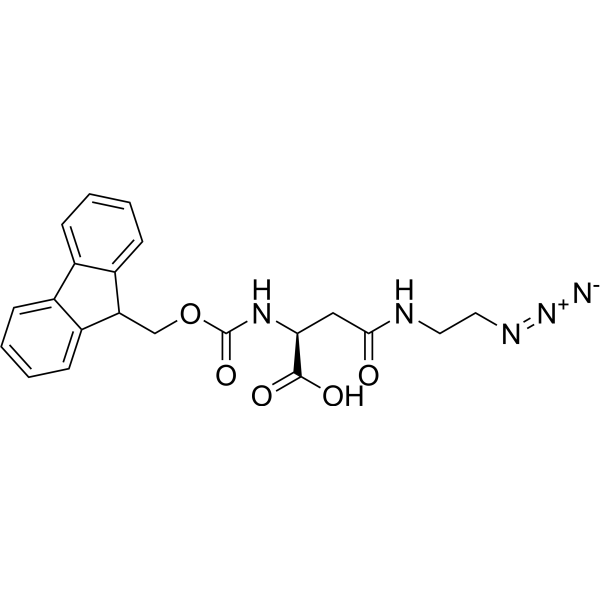
ADC Linkers

Research Areas:  

Others

Fmoc-L-Asn(EDA-N3)-OH is a click chemistry reagent containing an azide group. This building block is reported in literature for the modification of Amanitin via Click Chemistry. Alpha-Amanitin is the deadliest member of the amatoxin peptide family produced by the death-cap mushroom A. phalloides. It is an orally available, rigid, bicyclic octapeptide and one of the most lethal known natural products (LD50 = 50-100 μg/kg) acting as highly selective allosteric inhibitor of the RNA polymerase II . It contains an azide group and can undergo copper-catalyzed azide-alkyne cycloaddition (CuAAc) with molecules containing alkyne groups. It can also undergo ring strain-promoted alkyne-azide cycloaddition (SPAAC) with molecules containing DBCO or BCN groups.
loading...
    loading...
Cat. No.: HY-16561G
CAS No.: 501-36-0
Synonyms: trans-Resveratrol (GMP); SRT501 (GMP)
Resveratrol (GMP) is Resveratrol (HY-16561) produced by using GMP guidelines. GMP small molecules work appropriately as an auxiliary reagent for cell therapy manufacture. Resveratrol (trans-Resveratrol; SRT501), a natural polyphenolic phytoalexin that possesses anti-oxidant, anti-inflammatory, cardioprotective, and anti-cancer properties. Resveratrol (SRT 501) has a wide spectrum of targets including mTOR, JAK, β-amyloid, Adenylyl cyclase, IKKβ, DNA polymerase. Resveratrol also is a specific SIRT1 activator . Resveratrol is a potent pregnane X receptor (PXR) inhibitor . Resveratrol is an Nrf2 activator, ameliorates aging-related progressive renal injury in mice model . Resveratrol increases production of NO in endothelial cells .
loading...
    loading...
Cat. No.: HY-183073
Research Areas:  

Cancer

TZ1104 is a PROTAC-based CDK7 degrader, with a DC50 of 0.88 nM. TZ1104 forms a ternary complex with VHL E3 ligase and CDK7 to trigger proteasome-dependent CDK7 degradation, destabilizing the CDK7-cyclin H-MAT1 complex. TZ1104 suppresses phosphorylation of RNA polymerase II CTD Ser5, CDK1 Thr161, and CDK2 Thr160. TZ1104 activates the p53-p21 axis and suppresses oncogenic Myc signaling. TZ1104 induces cell cycle arrest, apoptosis, and differentiation of acute leukemia cells. TZ1104 can be used for the research of acute leukemia .

loading...
    loading...
Cat. No.: HY-B0879AR
CAS No.: 129-46-4
Synonyms: Suramin hexasodium salt (Standard)
Suramin (sodium salt) (Standard) is the analytical standard of Suramin (sodium salt). This product is intended for research and analytical applications. Suramin sodium salt (Suramin hexasodium salt) is a reversible and competitive protein-tyrosine phosphatases (PTPases) inhibitor . Suramin sodium salt is a potent inhibitor of sirtuins: SirT1 (IC50=297 nM), SirT2 (IC50=1.15 μM), and SirT5 (IC50=22 μM) . Suramin sodium salt is a competitive inhibitor of reverse transcriptase (DNA topoisomerase II: IC50=5 μM) . Suramin sodium salt is a potent SARS-CoV-2 RNA-dependent RNA polymerase (RdRp) inhibitor . Suramin sodium salt efficiently inhibits IP5K and is an antiparasitic, anti-neoplastic and anti-angiogenic agent .
loading...
    loading...

