87 Results for "

inactive form

" in MedChemExpress (MCE) Product Catalog:
Products (87)

87 Results for "inactive form" in MCE Product Catalog:

Cat. No.: HY-119530R
CAS No.: 5581-52-2
Synonyms: BW 57-323 (Standard)
Thiamiprine (Standard) is the analytical standard of Thiamiprine. This product is intended for research and analytical applications. Thiamiprine (BW 57-323) is a compound related to azathioprine. Its nucleoside forms are similar to the parent compound in terms of cytotoxicity in vitro (except for the arabinoside). In the rat adjuvant arthritis model in vivo, its riboside and 2'-deoxyriboside are less active than the parent compound. The arabinoside is inactive and nontoxic. It has similar potency to the other parent compounds tested, but has a different safety profile.
loading...
    loading...
Cat. No.: HY-119821R
CAS No.: 52452-60-5
Thiamiprine (Standard) is the analytical standard of Thiamiprine. This product is intended for research and analytical applications. Thiamiprine (BW 57-323) is a compound related to azathioprine. Its nucleoside forms are similar to the parent compound in terms of cytotoxicity in vitro (except for the arabinoside). In the rat adjuvant arthritis model in vivo, its riboside and 2'-deoxyriboside are less active than the parent compound. The arabinoside is inactive and nontoxic. It has similar potency to the other parent compounds tested, but has a different safety profile.
loading...
    loading...
Cat. No.: HY-101544
CAS No.: 1314021-57-2
Target:  

FGFR

Research Areas:  

Cancer

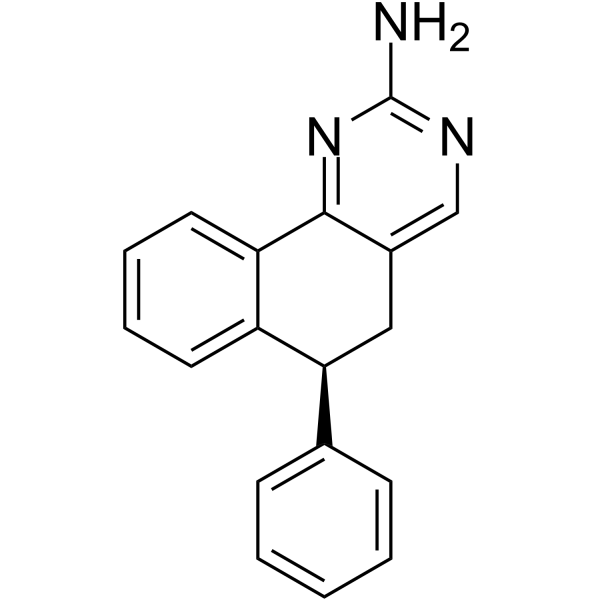
ARQ 069, an analog of ARQ 523, inhibits FGFR in an enantiospecific manner. ARQ 069 targets the unphosphorylated, inactive forms of FGFR1/FGFR2 kinases (IC50s of 0.84 μM and 1.23 μM, respectively). ARQ 069 inhibits FGFR1/FGFR2 autophosphorylation (IC50s of 2.8 and 1.9 μM, respectively) through a mechanism in a non-ATP competitive dependent manner .
loading...
    loading...
Cat. No.: HY-125946R
CAS No.: 145667-75-0
Research Areas:  

Metabolic Disease

Latanoprost lactone diol (Standard) is the analytical standard of Latanoprost lactone diol (HY-125946). This product is intended for research and analytical applications. Latanoprost lactone diol is a small organic molecule derived from Prostaglandin F2α (HY-12956), and is a key synthetic intermediate and inactive metabolically related form of Latanoprost (HY-B0577). Latanoprost lactone diol is significantly upregulated in hypothyroid rats, and its levels can be reversed by the crude polysaccharide, lactone, and oligosaccharide components of the rhizome of Atractylodis macrocephalae. Latanoprost lactone diol can be used for research related to hypothyroidism.
loading...
    loading...
Cat. No.: HY-B1128B
CAS No.: 58648-57-0
Synonyms: Cephamandole lithium
Target:  

Antibiotic Bacterial

Research Areas:  

Infection

Cefamandole (Cephamandole) lithium is a semi-synthetic second-generation cephalosporin antibiotic with broad-spectrum antimicrobial activity. Cefamandole lithium is resistant to hydrolysis by β-lactamases produced by some Gram-negative bacteria. Cefamandole lithium kills Gram-positive cocci and various Gram-negative bacilli mainly by inhibiting cell wall synthesis, but it is inactive against Pseudomonas, Proteus vulgaris and Providencia stuartii, and its efficacy is affected by inoculum size. The plasma elimination half-life of Cefamandole lithium in rats is only 0.4 h, it is mainly excreted in urine in biologically active form, and it hardly penetrates the non-inflamed blood-brain barrier. Cefamandole lithium is widely used in studies related to bacterial infections .
loading...
    loading...
Cat. No.: HY-B1128AR
CAS No.: 30034-03-8
Synonyms: Cephamandole sodium (Standard)
Research Areas:  

Infection

Cefamandole (sodium) (Standard) is the analytical standard of Cefamandole (sodium). This product is intended for research and analytical applications. Cefamandole (Cephamandole) sodium is a semi-synthetic second-generation cephalosporin antibiotic with broad-spectrum antimicrobial activity. Cefamandole sodium is resistant to hydrolysis by β-lactamases produced by some Gram-negative bacteria. Cefamandole sodium kills Gram-positive cocci and various Gram-negative bacilli mainly by inhibiting cell wall synthesis, but it is inactive against Pseudomonas, Proteus vulgaris and Providencia stuartii, and its efficacy is affected by inoculum size. The plasma elimination half-life of Cefamandole sodium in rats is only 0.4 h, it is mainly excreted in urine in biologically active form, and it hardly penetrates the non-inflamed blood-brain barrier. Cefamandole sodium is widely used in studies related to bacterial infections .
loading...
    loading...
Cat. No.: HY-L096
178 compounds

An inactive ingredient is any component of a drug product other than the active ingredient. Inactive ingredients are added during the manufacturing process of pharmaceutical products such as tablets, capsules, suppositories, and injections. In new drug development, once an inactive ingredient has appeared in an approved drug product for a particular route of administration, the inactive ingredient is not considered new and may require a less extensive review the next time it is included in a new drug product.

MCE offers a unique collection of 178 inactive ingredients, which only contain inactive ingredients of the final dosage forms of the drug. MCE Inactive Ingredient library is a powerful tool for aiding in the development of the drug and saving unnecessary time.

Cat. No.: HY-W141446
CAS No.: 144163-68-8
Research Areas:  

Others

VT00065 is a covalent DHS inhibitor. VT00065 forms a redox-dependent covalent bond with the catalytic lysine K329 of DHS, locking the enzyme in an inactive state .
loading...
    loading...
Cat. No.: HY-183417
CAS No.: 15565-46-5
Target:  

Others

Research Areas:  

Others

XuBP is a Rubisco inhibitor with a Ki of approximately 1.3 µM. XuBP binds to uncarbamylated Rubisco to form an inactive complex. XuBP acts as a substrate for Rubisco and undergoes a slow carboxylation reaction to produce two molecules of 3-phosphoglycerate .
loading...
    loading...
Cat. No.: HY-130666
CAS No.: 81050-71-7
Target:  

Endogenous Metabolite

Research Areas:  

Cardiovascular Disease

Chlorambucyl-proline is a chloroplatinyl amino acid derivative with inhibitory activity against bovine pulmonary vasoconstrictor enzyme. Chlorambucyl-proline reacts with the convertase in a 1:1 ratio, and the removal of its radiolabel indicates that the compound has an irreversible inhibitory effect on the enzyme activity. Chlorambucyl-proline binds to the aspartic acid or glutamic acid side chain of the enzyme by forming an ester bond, resulting in irreversible inactivation of the enzyme. The inactivation rate constant of chlororambucyl-proline increases in the pH range of 5-8, indicating that its effect on the enzyme activity is affected by the pH environment .
loading...
    loading...
Cat. No.: HY-P2974A
Target:  

Elastase

Research Areas:  

Metabolic Disease

Elastase, Rat (EC 3.4.21.35) is a form of elastase that is produced in the acinar cells of the pancreas, initially produced as an inactive zymogen and later activated in the duodenum by trypsin. Elastases form a subfamily of serine proteases, characterized by a distinctive structure consisting of two beta-barrel domains converging at the active site that hydrolyze amides and esters amongst many proteins in addition to elastin, a type of connective tissue that holds organs together.
loading...
    loading...
Cat. No.: HY-W746960
CAS No.: 6755-41-5
Synonyms: (+)-trans,trans-ABA
(+)-trans,trans-Abscisic acid ((+)-trans,trans-ABA) is a biologically inactive stereoisomer of ABA that is obtained by UV irradiation from the cis-trans form and exists as a glucose conjugate in plant tissues. (+)-trans,trans-Abscisic acid is used in research on plant hormone metabolism and bud germination .
loading...
    loading...
Cat. No.: HY-P1362FA
Synonyms: Cy5-Amyloid β Peptide (42-1)(human) (TFA
Target:  

Amyloid-β

Research Areas:  

Neurological Disease

Cy5-β-Amyloid (42-1), human is a Cy5 fluorescently-labelled β-Amyloid (42-1, human) peptide (λex= 633 nm and λem= 670 nm) . β-Amyloid (42-1), human is the inactive form of Amyloid β Peptide (1-42). Its active form, β-Amyloid (1-42), may play a key role in the pathogenesis of Alzheimer's disease.
loading...
    loading...
Cat. No.: HY-183293
Target:  

E1/E2/E3 Enzyme

Research Areas:  

Others

Cbl-b-IN-32 is a Cbl-b inhibitor with an IC50 of 6.83 μM. Cbl-b-IN-32 binds to the TKB-LH interface, stabilizes the inactive conformation of Cbl-b, engages Tyr363 via hydrogen bonds and water bridges, and forms hydrogen bonds with Phe261 and Phe263 .
loading...
    loading...
Cat. No.: HY-P11867
CAS No.: 1242439-00-4
Target:  

Wnt β-catenin

Research Areas:  

Others

UM206_L is a linear Wnt fragment peptide derived from conserved Wnt3a/Wnt5a sequences, inactive in soluble form but capable of activating canonical Wnt/β-catenin signaling when conjugated to magnetic nanoparticles and exposed to a high-gradient, time-varying magnetic field or immobilized on glass surfaces .
loading...
    loading...
Cat. No.: HY-107842R
CAS No.: 199596-24-2
Synonyms: NSC693627 (Standard)
Research Areas:  

Cancer

(Z)-JIB-04 (Standard) is the analytical standard of (Z)-JIB-04 (HY-107842). This product is intended for research and analytical applications. (Z)-JIB-04 (NSC693627) is the Z isomer of JIB-04 that has two forms, E (HY-13953) and Z isomers. (Z)-JIB-04 is inactive in epigenetic analysis .
loading...
    loading...
Cat. No.: HY-P11867A
CAS No.: 1242439-01-5
Target:  

Wnt β-catenin

Research Areas:  

Others

UM206_C is a circular Wnt fragment peptide derived from conserved Wnt3a/Wnt5a sequences, inactive in soluble form but capable of activating canonical Wnt/β-catenin signaling when conjugated to magnetic nanoparticles and exposed to a high-gradient, time-varying magnetic field or immobilized on glass surfaces .
loading...
    loading...
Cat. No.: HY-160969
CAS No.: 1642147-15-6
Research Areas:  

Cancer

Spiro-duocarmycin is a DNA minor groove N3-adenine alkylating agent. Spiro-duocarmycin exerts cytotoxic effects via DNA alkylation. Spiro-duocarmycin is the active spirocyclized form of seco-DUBA, which is incorporated as an inactive prodrug into the linker-drug construct of antibody-drug conjugates (ADCs). DUBA serves as an ADC payload that can be conjugated with monoclonal antibodies to synthesize antibody-drug conjugates (ADCs) .
loading...
    loading...
Cat. No.: HY-N13069
CAS No.: 86577-96-0
Target:  

Drug Intermediate

2-Deoxy-20-hydroxyecdysone-22-phosphate is an inactive storage form of insect ecdysteroids. 2-Deoxy-20-hydroxyecdysone-22-phosphate exists in newly laid eggs of the desert locust Schistocerca gregaria. 2-Deoxy-20-hydroxyecdysone-22-phosphate can be enzymatically hydrolyzed by embryonic tissues to release the ecdysteroid 2-deoxy-20-hydroxyecdysone (HY-N17267) .
loading...
    loading...
Cat. No.: HY-E72116
Target:  

UGT

Human UGT2B4 is a UDP-glucuronosyltransferase. UGT2B4 catalyzes the glucuronidation of bile acids, Carvedilol (HY-B0006) and 6-hydroxylated bile acids to form glucuronide derivatives. UGT2B4 participates in the inactivation of endogenous and exogenous substances, including catechol estrogens, C19 steroids, phenols and monoterpenoids. Human UGT2B4 can be used in the research of hypertension, angina pectoris, chronic heart failure and intrahepatic cholestasis .
loading...
    loading...

