
128 Results for "

prenatal fluoride-induced persistent hyper-osteogenesis

" in MedChemExpress (MCE) Product Catalog:
Products (128)

128 Results for "prenatal fluoride-induced persistent hyper-osteogenesis" in MCE Product Catalog:

Cat. No.: HY-168682
CAS No.: 31685-38-8
Research Areas:  

Cancer

Adamantane-Butyl alcohol is a selective and persistent degrader targeting the CDK8-cyclin C complex. Adamantane-Butyl alcohol is the linker for LL-K8-22 (PROTAC CDK8-cyclin C, HY-149209) and HyT .
loading...
    loading...
Cat. No.: HY-W753141
CAS No.: 201612-50-2
Synonyms: 4,4'-DDE-13C12; p,p'-Dichlorodiphenyldichloroethylene-13C12
p,p'-DDE- 13C12 is 13C labeled p,p'-DDE. p,p'-DDE (4,4'-DDE), a major metabolite of persistent dichlorodiphenyltrichloroethane (DDT), is a potent androgen receptor antagonist, with an IC50 of 5 μM and a Ki of 3.5 μM .
loading...
    loading...
Cat. No.: HY-P2428
CAS No.: 95034-26-7
Target:  

Endogenous Metabolite

Research Areas:  

Neurological Disease

RI-61 is a compound that has activity in suppressing migraine, cluster headache, new daily persistent headache and cyclical vomiting syndrome. RI-61 has shown significant efficacy in relieving the symptoms of these disorders. RI-61 helps relieve pain and other related symptoms by modulating the action of neurotransmitters .
loading...
    loading...
Cat. No.: HY-41465R
CAS No.: 74-11-3
Research Areas:  

Others

4-Chlorobenzoic acid (Standard) is the analytical standard of 4-Chlorobenzoic acid (HY-41465). This product is intended for research and analytical applications. 4-Chlorobenzoic acid is a halogenated aromatic compound that can be used as an industrial chemical and an intermediate in drug synthesis. 4-Chlorobenzoic acid is a persistent organic micropollutant and can be biodegraded through a direct dehalogenation pathway .
loading...
    loading...
Cat. No.: HY-P5172
Target:  

Sodium Channel

Research Areas:  

Neurological Disease

MitTx-alpha is a subunit of MitTx. MitTx is a potent, persistent, and selective agonist for acid-sensing ion channels (ASICs). MitTx is highly selective for the ASIC1 subtype at neutral pH; under more acidic conditions (pH<6.5), MitTx massively potentiates (>100-fold) proton-evoked activation of ASIC2a channels .
loading...
    loading...
Cat. No.: HY-129762
CAS No.: 3458-22-8
Synonyms: NSC-102627
Target:  

DNA/RNA Synthesis

Research Areas:  

Cancer

Yoshi-864 (NSC-102627) is an alkylsulfonate DNA crosslinker with anticancer activity. Yoshi-864 extends markedly the survival times of mice bearing L1210 leukemia or Ehrlich ascites carcinoma. Yoshi-864 also has a persistent reduction in ability to synthesize DNA in tumor cells from mice bearing the Ehrlich tumor .
loading...
    loading...
Cat. No.: HY-122351
CAS No.: 245650-17-3
Research Areas:  

Others

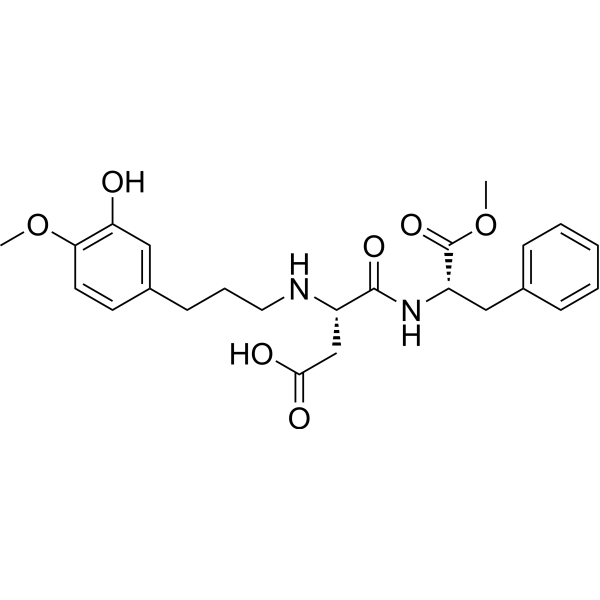
Advantame is an N-substituted derivative of aspartame. Advantame is a high-intensity, low calorie sweetener. Advantame can interact with plasma protein. Advantame has the potential to produce hypotension and inhibit hERG K + channel to produce carditoxicity. Advantame binds to T1R2/T1R3 taste GPCR to form an oligomeric functional selectivity of biased heteromers with NMBR to induce a significant sialidase activity in vitro. Advantame has maternal toxicity (gastrointestinal disturbances) in the prenatal developmental toxicity study in rabbits .
loading...
    loading...
Cat. No.: HY-178973
Target:  

Microtubule/Tubulin

Research Areas:  

Cancer

Microtubule-IN-13 (Compound FB2) is a microtubule inhibitor. Microtubule-IN-13 interferes with microtubule dynamics, leading to defects in the mitotic spindle and persistent mitotic arrest. Microtubule-IN-13 exhibits potent cytotoxicity against multiple cancer cell lines (IC50 = 0.3-2.7 μM). Microtubule-IN-13 can be used for cancer research .
loading...
    loading...
Cat. No.: HY-119800
CAS No.: 86487-64-1
Research Areas:  

Neurological Disease

Setoperone is an orally active and potent 5-HT₂ receptor antagonist and a moderate dopamine D₂ receptor blocker. Setoperone dissociates from the receptors relatively quickly, but it is easily "captured" by serotonin receptors in the body, resulting in persistent receptor inhibition even after elution. Setoperone can be used to study the negative symptoms of type II schizophrenia and associated mood disorders .
loading...
    loading...
Cat. No.: HY-122351AR
CAS No.: 714229-20-6
Research Areas:  

Others

Advantame (Standard) is the analytical standard of Advantame. This product is intended for research and analytical applications. Advantame is an N-substituted derivative of aspartame. Advantame is a high-intensity, low calorie sweetener. Advantame can interact with plasma protein. Advantame has the potential to produce hypotension and inhibit hERG K + channel to produce carditoxicity. Advantame binds to T1R2/T1R3 taste GPCR to form an oligomeric functional selectivity of biased heteromers with NMBR to induce a significant sialidase activity in vitro. Advantame has maternal toxicity (gastrointestinal disturbances) in the prenatal developmental toxicity study in rabbits .
loading...
    loading...
Cat. No.: HY-172131
Target:  

Parasite

Research Areas:  

Infection

Emoquine-1 is an orally active and potent antimalarial drug. Emoquine-1 is efficient against multidrug-resistant Plasmodium parasites, including the Artemisinin-resistant quiescent stage. Emoquine-1 is active against proliferative P. falciparum with IC50 values of 20-55 nM. Emoquine-1 is a candidate to fight Plasmodium parasites resistant to artemisinin-based combination therapies (ACTs) with a capacity to eliminate persistent parasites .
loading...
    loading...
Cat. No.: HY-116778
CAS No.: 51982-36-6
Prostaglandin G2 is a prostaglandin peroxide. Prostaglandin G2 acts as a precursor for thromboxane A2 production, inducing platelet aggregation and serotonin release. Prostaglandin G2 also induces cerebral arteriole injury in anesthetized cats via the generation of reactive oxygen free radicals, triggering persistent vasodilation, reduced reactivity to hypocapnia, and endothelial damage. Prostaglandin G2 can be used in studies related to cerebral arteriole injury .
loading...
    loading...
Cat. No.: HY-18956A
CAS No.: 32597-86-7
Synonyms: (E/Z)-Sephin1 hydrochloride; (E/Z)-IFB-088 hydrochloride
Target:  

Phosphatase

Research Areas:  

Neurological Disease

(E/Z)-Icerguastat hydrochloride ((E/Z)-Sephin1 hydrochloride) is a selective inhibitor with activity that prolongs the phosphorylation effects of eIF2α. (E/Z)-Icerguastat hydrochloride protects cells from defects in proteostasis. (E/Z)-Icerguastat hydrochloride was shown to significantly extend the survival of infected prion mice in a mouse model. (E/Z)-Icerguastat hydrochloride effectively reduces PrPSc expression and prion sequence activity in various neuronal cell lines persistently infected with different prion strains .
loading...
    loading...
Cat. No.: HY-W679754R
CAS No.: 72629-94-8
Synonyms: PFTrDA (Standard)
Pentacosafluorotridecanoic Acid (Standard) is the analytical standard of Pentacosafluorotridecanoic Acid (PFTrDA) (HY-W679754). This product is intended for research and analytical applications.Pentacosafluorotridecanoic Acid is a long-chain perfluoroalkyl carboxylic acid with strong endocrine-disrupting activity. Pentacosafluorotridecanoic Acid exhibits estrogenic effects and disrupts vtg1 transcription as well as sex hormone homeostasis in male Danio rerio. Pentacosafluorotridecanoic Acid disturbs steroidogenesis and HPG axis function in a sex-dependent pattern. Pentacosafluorotridecanoic Acid inhibits CYP17A and CYP11A1 to reduce testosterone and increase E2/T ratio in H295R cells. Pentacosafluorotridecanoic Acid triggers gender-specific immunomodulation after prenatal exposure. Pentacosafluorotridecanoic Acid correlates with lower eczema risk in female infants. Pentacosafluorotridecanoic Acid can be used for the research of endocrine disruption and eczema .
loading...
    loading...
Cat. No.: HY-P10386
Target:  

Bcl-2 Family

Research Areas:  

Cancer

155H1 (Compound 11) is a stapled peptide, that covalently binds hMcl1 (172-323) with IC50 of 18 nM .
loading...
    loading...
Cat. No.: HY-111294
CAS No.: 851389-35-0
Target:  

Dipeptidyl Peptidase

Research Areas:  

Metabolic Disease

ASP4000 hydrochloride is an orally effective dipeptidyl peptidase 4 (DPP4) inhibitor, with an IC50 value of 2.25 nM against human recombinant DPP4, and exhibits hypoglycemic activity. By inhibiting DPP4 activity, ASP4000 hydrochloride reduces the degradation of active glucagon-like peptide-1 (GLP-1), thereby persistently increasing postprandial active GLP-1 levels and improving glycemic control. ASP4000 hydrochloride can be used in studies related to type 2 diabetes .
loading...
    loading...
Cat. No.: HY-B1986R
CAS No.: 72-55-9
Synonyms: 4,4'-DDE (Standard); p,p'-Dichlorodiphenyldichloroethylene (Standard)
p,p'-DDE (Standard) is the analytical standard of p,p'-DDE. This product is intended for research and analytical applications. p,p'-DDE (4,4'-DDE) is the major and persistent metabolite of DDT. p,p'-DDE is a orally active androgen receptor antagonist with an IC50 of 5 μM and a Ki of 3.5 μM. p,p'-DDE can affect the development and function of the male reproductive system. Additionally, high serum concentrations of p,p'-DDE may be a risk factor for type 2 diabetes in women .
loading...
    loading...
Cat. No.: HY-U00346A
CAS No.: 667865-69-2
Target:  

Dipeptidyl Peptidase

Research Areas:  

Metabolic Disease

TS-021 is a selective,orally active,reversible and long-acting DPP-IV inhibitor,and exhibits significant inhibition selectivity against DPP-8 (> 600 fold),DPP-9 (> 1200 fold) and other peptidases (> 15,000 fold). TS-021 inhibits DPP-IV activity in human plasma with an IC50 value of 5.34 nM. TS-021 has long-term persistent plasma drug concentration and potent antihyperglycemic activity,and increases in the active form of GLP-1 .
loading...
    loading...
Cat. No.: HY-115693
CAS No.: 2292123-03-4
Target:  

Bacterial

Research Areas:  

Infection

CAP 3 is a cholic acid-peptide conjugate (CAP) antimicrobial agent. CAP 3 effectively inhibits Gram-negative bacteria, with MIC99 (minimum inhibitory concentration for 99% bacterial killing) values of 8 μM, 16 μM, and 16 μM against E. coli, Klebsiella pneumoniae and Acinetobacter baumannii, respectively. CAP 3 exerts its antibacterial effects by disrupting the structural integrity of the bacterial lipopolysaccharide (LPS) outer membrane. CAP 3 rapidly kills bacteria, inhibits biofilm formation, and effectively combats drug-resistant strains and persistent bacterial infections .
loading...
    loading...
Cat. No.: HY-W040430A
CAS No.: 101832-65-9
(S)-Nornicotine hydrochloride is a nicotine metabolite that crosses the blood-brain barrier. (S)-Nornicotine hydrochloride weakly inhibits human CYP2A6 with a Ki >300 μM. (S)-Nornicotine hydrochloride promotes dopamine release in rat striatal and nucleus accumbens slices and increases endogenous DOPAC overflow through a calcium-dependent nAChR pathway that is sensitive to Mecamylamine (HY-B1395A). (S)-Nornicotine hydrochloride reduces behavioral responses maintained by nicotine or sucrose, exerts analgesic effects in persistent inflammatory pain and neuropathic pain models, and enhances the analgesic effect of morphine. (S)-Nornicotine hydrochloride is useful for research on tobacco dependence and pain .
loading...
    loading...

