228 Results for "

LDL

" in MedChemExpress (MCE) Product Catalog:
Products (228)

228 Results for "LDL" in MCE Product Catalog:

Cat. No.: HY-167870
CAS No.: 116181-54-5
Piceatannol 4'-O-glucoside is an antioxidant. Piceatannol 4'-O-glucoside is active against oxidation of the human LDL. Piceatannol 4'-O-glucoside can be isolated from Mexican Bamboo .
loading...
    loading...
Cat. No.: HY-163141
CAS No.: 2974496-96-1
Target:  

PCSK9

Research Areas:  

Cardiovascular Disease

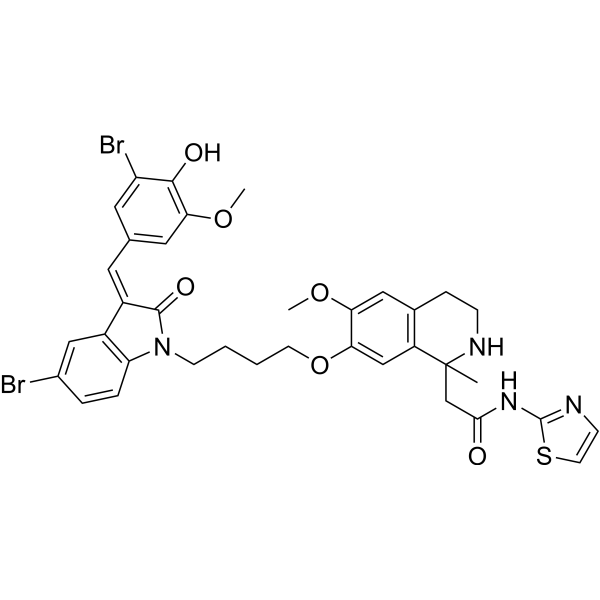
PCSK9-IN-24 (Compound OY3) is a compound that targets PCSK9. PCSK9-IN-24 reduces PCSK9 levels and increases LDL uptake and may be used in atherosclerosis research .
loading...
    loading...
Cat. No.: HY-N7729
CAS No.: 607-11-4
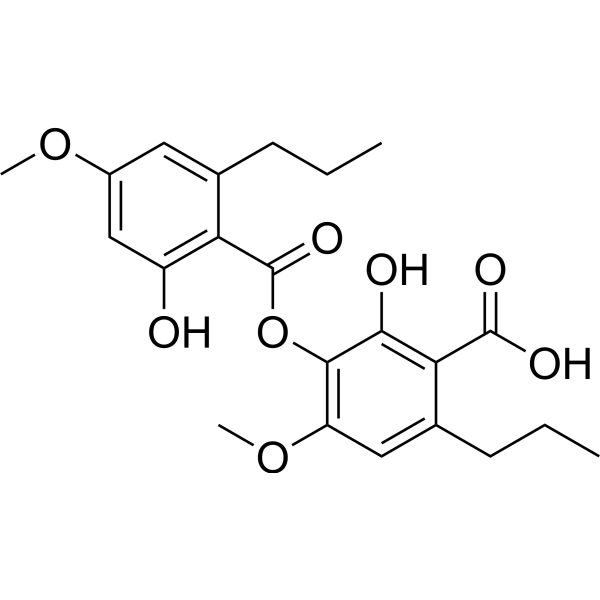
Sekikaic acid is an α-glucosidase (Glucosidase) and α-amylase (Amylases) inhibitor with hypolipidemic, antioxidant and antidiabetic activities. Sekikaic acid significantly reduces LDL, total cholesterol, and total glyceride levels and causes pancreatic beta cell regeneration .
loading...
    loading...
Cat. No.: HY-161938
CAS No.: 1565828-01-4
Target:  

PCSK9 LDLR

Research Areas:  

Metabolic Disease

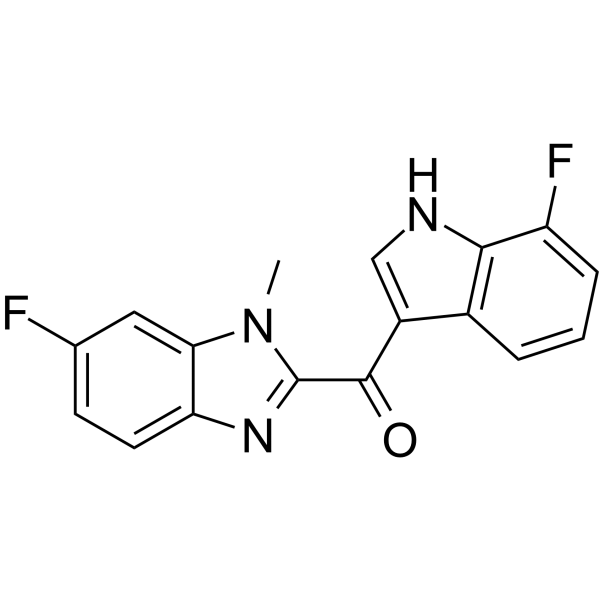
BRD8518 is a PCSK9 inhibitor (EC50=0.23 μM). BRD8518 lowers blood lipids by upregulating LDLR expression and stimulating LDL uptake. BRD8518 can be used in the study of cardiovascular diseases .
loading...
    loading...
Cat. No.: HY-168371
CAS No.: 161923-56-4
1-Palmitoyl-2-13(S)-HODE-sn-glycero-3-PC (13-HODE-PC) is an oxidized phospholipid that contains Palmitic acid (HY-N0830) and 13(S)-HODE (HY-113884B) at the sn-1 and sn-2 positions, respectively. 1-Palmitoyl-2-13(S)-HODE-sn-glycero-3-PC has the ability to compete for the binding of 125I-NO2-LDL (5 g/mL) to CD36-transfected 293 cells, with the IC50 of > 200 μM .
loading...
    loading...
Cat. No.: HY-161942
CAS No.: 2247649-76-7
Target:  

PCSK9

Research Areas:  

Metabolic Disease

PCSK9-IN-31 (Compound WX002) is an orally active PCSK9 inhibitor. PCSK9-IN-31 can lower low-density lipoprotein cholesterol (LDL-C) and total cholesterol (TC) in high cholesterol fed model rats .
loading...
    loading...
Cat. No.: HY-W010697S
Cholesteryl linoleate-d11 is the d11-labeled Cholesteryl linoleate (HY-W010697). Cholesteryl linoleate is a cholesteryl ester with antibacterial activity that is present in low-density lipoprotein (LDL) particles, human nasal fluid, and respiratory epithelial secretions. Cholesteryl linoleate is oxidized by 12/15-lipoxygenase in macrophages and participates in selective uptake and efflux via LDL receptor-related protein. Cholesteryl linoleate does not induce endothelial adhesion molecule expression, nor does it induce monocyte binding to endothelial cells. Cholesteryl linoleate liposomal formulations inhibit the growth of multiple bacteria at physiological nasal fluid concentrations and act synergistically with antimicrobial peptides. Cholesteryl linoleate is useful for research related to atherosclerosis and bacterial infections .
loading...
    loading...
Cat. No.: HY-146085
CAS No.: 2476490-20-5
Target:  

PCSK9

Research Areas:  

Metabolic Disease

PCSK9 modulator-4 (Compound 21) is a potent modulator of PCSK9 with an EC50 value of 0.15 nM. PCSK9 is a recently validated target for lowering low-density lipoprotein cholesterol (LDL-C). PCSK9 modulator-4 has the potential for the research of hyperlipidemia .
loading...
    loading...
Cat. No.: HY-132303
CAS No.: 1432054-03-9
Target:  

CETP

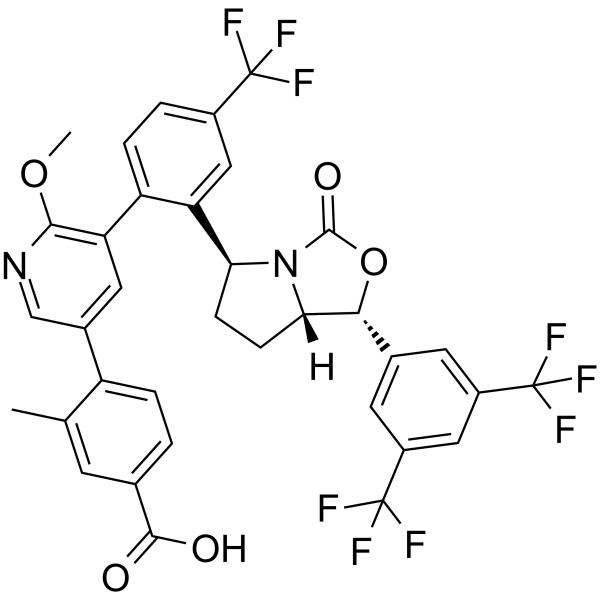
MK-8262 is an orally active and potent cholesteryl ester transfer protein (CETP) inhibitor with an IC50 of 53 nM and a log D of 5.3. MK-8262, a bistrifluoromethyl analogue, has the potential for coronary heart disease (CHD) correlated high-density lipoprotein (HDL) and low-density lipoprotein (LDL) research .
loading...
    loading...
Cat. No.: HY-115357
CAS No.: 1000998-62-8
Target:  

PPAR

Research Areas:  

Metabolic Disease

BMS711939 is a selective agonist for peroxisome proliferator-activated receptor α (PPAR α), with EC50 of 4 nM and 4.5 μM, for human PPARα and human PPARγ. BMS711939 exhibits good pharmacokinetic characters in rats models. BMS711939 increases HDL cholesterol, reduces LDL cholesterol and triglycerides .
loading...
    loading...
Cat. No.: HY-P81166
Synonyms: ox-LDL: LDL (Copper oxidized); Cu2SO4 oxidized low density lipoprotein; oxidized low density lipoprotein; Low density lipoprotein; MDA oxidized LDL; MDA oxidized low density lipoprotein. 氧化型低密度脂蛋白;

Host:  

Rabbit

Application:  

ELISA, IHC-P, IHC-F, FC, ICC/IF

Reactivity:  

Human

loading...
    loading...
Cat. No.: HY-P86713
Synonyms: ox-LDL: LDL(Copper oxidized); Cu2SO4 oxidized low density lipoprotein; oxidized low density lipoprotein; Low density lipoprotein; MDA oxidized LDL; MDA oxidized low density lipoprotein.

Host:  

Mouse

Application:  

IHC-P, IHC-F, IF-Tissue

Reactivity:  

Human, Mouse, Rat

loading...
    loading...
Cat. No.: HY-P86713A
Synonyms: ox-LDL: LDL(Copper oxidized); Cu2SO4 oxidized low density lipoprotein; oxidized low density lipoprotein; Low density lipoprotein; MDA oxidized LDL; MDA oxidized low density lipoprotein.

Host:  

Mouse

Application:  

IHC-P, IHC-F, IF-Tissue

Reactivity:  

Human, Mouse, Rat

loading...
    loading...
Cat. No.: HY-28911
CAS No.: 141-46-8
Target:  

LDLR

Research Areas:  

Others

2-Hydroxyacetaldehyde acts as a ribonucleotide synthesis precursor and a LDL modifier. 2-Hydroxyacetaldehyde specifically targets lysine residues of high-affinity LDL receptors and their apolipoproteins. By blocking the ε-amino groups of apolipoproteins, 2-Hydroxyacetaldehyde prevents receptor recognition, thereby reducing LDL degradation by macrophages. 2-Hydroxyacetaldehyde generates modified LDL, which serves as a probe for investigating non-receptor-dependent catabolic pathways .
loading...
    loading...
Cat. No.: HY-N8353
CAS No.: 149598-71-0
Target:  

Others

Stachybotramide is a natural fungal metabolite with the property of modulating the activity of cholesteryl ester transfer protein (CETP). Stachybotramide stimulates the transfer of cholesteryl esters (CE) from high-density lipoprotein (HDL) to very-low-density lipoprotein (VLDL) and low-density lipoprotein (LDL), increasing the transfer efficiency by 1.3- to 1.5-fold. Stachybotramide slightly reduced the transfer of cholesteryl esters from LDL and VLDL to HDL at 0.5 mM. The effect of Stachybotramide on the transfer of triglycerides (TG) from HDL was not significant. By these results, Stachybotramide was shown to preferentially stimulate the CETP-mediated transfer of cholesteryl esters from HDL to VLDL and LDL .
loading...
    loading...
Cat. No.: HY-N20275
Synonyms: Cashew kernel extract; Anacardium occidentale extract
Category:  

Extract

Target:  

Others

Cashew extract (Cashew kernel extract) is an extract from cashew nuts (Anacardium occidentale) that can lower LDL cholesterol.
loading...
    loading...
Cat. No.: HY-P87726
Synonyms: Low-density lipoprotein receptor, LDL receptor, LDLr

Host:  

Rabbit

Application:  

WB, IHC-P, ICC/IF, ELISA

Reactivity:  

Human, Mouse, Rat

loading...
    loading...
Cat. No.: HY-P810504
Synonyms: CLEC8A, LOX1, OLR1, Oxidized low-density lipoprotein receptor 1, Ox-LDL receptor 1, C-type lectin domain family 8 member A, Lectin-like oxidized LDL receptor 1, Lectin-type oxidized LDL receptor 1, LOX-1, Lectin-like oxLDL receptor 1, hLOX-1

Host:  

Rabbit

Application:  

WB, IHC-P

Reactivity:  

Human, Mouse

loading...
    loading...
Cat. No.: HY-P77444
Purity:  ≥ 90%, as determined by reducing SDS-PAGE.
Synonyms: PLA2G7; LDL-Associated Phospholipase A2; Phospholipase A2 Group VII; Group-VIIA Phospholipase A2; PAFAH; PAF 2-Acylhydrolase; LDL-PLA2; PAF Acetylhydrolase; Lp-PLA2; LDL-PLA(2); Phospholipase A2, Group VII (Platelet-Activating Factor Acetylhydrolase, Plas
Species:  
Mouse
Source:  
HEK293
loading...
    loading...
Cat. No.: HY-116719
CAS No.: 893409-49-9
Target:  

CETP

Research Areas:  

Metabolic Disease

BAY 60-5521 is an orally active cholesteryl ester transfer protein (CETP) inhibitor with an IC50 of 7 nM. BAY 60-5521 inhibits CETP-mediated transfer of cholesteryl esters from HDL to LDL/VLDL, as well as the transfer of triglycerides from LDL/VLDL to HDL. It dose-dependently increases HDL-C and HDL concentrations, and slightly reduces triglyceride levels. BAY 60-5521 can be used in studies related to dyslipidemia .
loading...
    loading...

