104 Results for "

amyloid aggregation

" in MedChemExpress (MCE) Product Catalog:
Products (104)

104 Results for "amyloid aggregation" in MCE Product Catalog:

Cat. No.: HY-163746
Target:  

Cholinesterase (ChE)

Research Areas:  

Neurological Disease

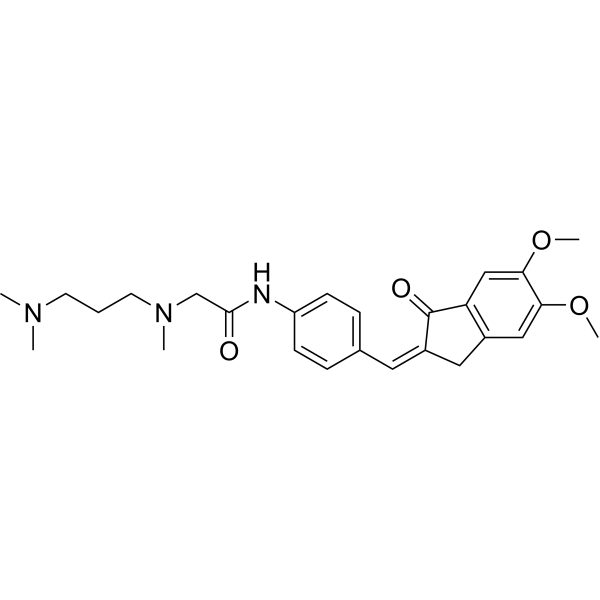
BuChE-IN-11 (Compound 3b-1) is an selective BuChE inhibitor with an IC50 of 0.44 μM for hBuChE. BuChE-IN-11 has high blood-brain barrier permeability and exhibits strong antioxidant activity due to its free radical scavenging properties. BuChE-IN-11 interacts with the choline binding site, acetyl binding site, and peripheral anionic site, exhibiting submicromolar BuChE inhibitory activity and preventing β-amyloid (Aβ) self-aggregation. BuChE-IN-11 holds promise for research in the field of Alzheimer's disease .
loading...
    loading...
Cat. No.: HY-152114
AChE/BChE/MAO-B-IN-4, an indan-1-one derivative, is a potent MAO-B inhibitor with an IC50 of 0.0393 μM for human MAO-B. AChE/BChE/MAO-B-IN-4 is a potent AChE and BChE enzyme inhibitor, with IC50s of 0.0458 μM and 0.075 μM for human AChE and BChE enzyme, respectively. AChE/BChE/MAO-B-IN-4 shows significant antioxidant activity and prevent β-amyloid plaque aggregation. AChE/BChE/MAO-B-IN-4 has the potential for Alzheimer's disease (AD) research .
loading...
    loading...
Cat. No.: HY-158978
Multitarget AD inhibitor-2 (Compound VN-19) is a multitargeting inhibitor acetylcholinesterase (AChE, IC50=0.14 μM), butyrylcholinesterase (BChE, IC50=11.6 μM), monoamine oxidase B (MAO B, IC50=0.45 μM). Multitarget AD inhibitor-2 inhibits self-induced aggregation of amyloid beta protein Aβ1-42 (inhibition rate is 47.3% at 20 μM), and downregulates the level of ROS in SH-SY5Y (80 inhibition rate at 25 μM). Multitarget AD inhibitor-2 ameliorates the cognitive decline in Scopolamine (HY-N0296)-induced Alzheimer’s Disease zebrafish models .
loading...
    loading...
Cat. No.: HY-180997
Target:  

Amyloid-β

Research Areas:  

Neurological Disease

Aβ aggregation-IN-5 is a brain-penetrant amyloid-β aggregation inhibitor. Aβ aggregation-IN-5 inhibits Aβ aggregation/oligomerization, rescues cells from AB/ROS toxicity and reduces microglial activation/NO production. Aβ aggregation-IN-5 reduces amyloid burden, neuroinflammation, microglial activation in APP/PSEN1 mice. Aβ aggregation-IN-5 can be used for the research of Alzheimer's disease .
loading...
    loading...
Cat. No.: HY-173282
Target:  

Amyloid-β

Research Areas:  

Neurological Disease

Aβ aggregation-IN-2 (Compound 8i) is an inhibitor of amyloid-β protein (Aβ42) aggregation, showing approximately 91% inhibition of Aβ42 aggregation at 25 μM. It also exhibits Aβ42 disaggregation effects and antioxidant activity. Aβ aggregation-IN-2 can be used for research in the field of Alzheimer's disease .
loading...
    loading...
Cat. No.: HY-182304
CAS No.: 1338489-62-5
CLR01 sodium is a blood-brain barrier-permeable anti-aggregation agent. CLR01 sodium inhibits the de novo aggregation of Amyloid-β 40/42, α-synuclein, IAPP, tau protein and SOD1. CLR01 sodium reduces amyloid plaque burden in the cortex of triple-transgenic mice and improves the memory and motor abilities of these mice. CLR01 sodium can be used in research related to Alzheimer's disease, Parkinson's disease, and amyotrophic lateral sclerosis (ALS) .
loading...
    loading...
Cat. No.: HY-161658
Target:  

Amyloid-β

Research Areas:  

Neurological Disease

N-Caffeoyldopamine (Compound 6i) is an amyloid-beta aggregation inhibitor. N-Caffeoyldopamine can inhibit Aβ aggregation to form nano-rod-like structures, thereby preventing β-sheet formation. N-Caffeoyldopamine can be used for Alzheimer's disease research .
loading...
    loading...
Cat. No.: HY-P1388F1
Synonyms: CY5-Ahx-amyloid β-peptide (1-42) (rat/mouse)
Research Areas:  

Neurological Disease

CY5-β-Amyloid (1-42), (rat/mouse) (CY5-Ahx-Amyloid β-peptide (1-42) (rat/mouse)) is a far-red fluorescent dye Cy5-labeled β-Amyloid (1-42), (rat/mouse) (HY-P1388) (Ex/Em ≈ 651 nm/670 nm). CY5-β-Amyloid (1-42), (rat/mouse) can be used in the basic research of Alzheimer's disease (AD) and related neurodegenerative diseases to monitor the aggregation, distribution and interaction of Aβ peptide segments in real time.
loading...
    loading...
Cat. No.: HY-P10192
CAS No.: 717122-86-6
Synonyms: ABri peptide (1-23); ABri23
Target:  

Amyloid-β

Research Areas:  

Neurological Disease

Amyloid Bri Protein (1-23) (ABri peptide (1-23); ABri23) is a physiological 23-amino-acid peptide released from the C-terminus of the type II transmembrane protein Bri2 (ITM2B, Integral Membrane Protein 2B) following cleavage by the furin protease. Amyloid Bri Protein (1-23) interacts with the extracellular Brichos domain of Bri2 during Bri2 biosynthesis. Amyloid Bri Protein (1-23) interacts with amyloid β peptide (Aβ1-40, thereby inhibiting its aggregation and fibril formation. Amyloid Bri Protein (1-23) can be used in studies related to Alzheimer's disease and familial British dementia .
loading...
    loading...
Cat. No.: HY-180425
CAS No.: 3611-72-1
Research Areas:  

Metabolic Disease

Cloridarol is a human islet amyloid peptide (hIAPP) inhibitor that prevents its abnormal misfolding and aggregation. Cloridarol can increase cell viability, inhibit apoptosis, and protect islet β-cells from hIAPP-induced cell toxicity. Cloridarol can be used for the research of type 2 diabetes (T2D) .
loading...
    loading...
Cat. No.: HY-D3439
Research Areas:  

Neurological Disease

Phazr-N3 is a near-infrared (NIR) environment-sensitive fluorescent probe used to monitor the entire aggregation process of Aβ42 (amyloid-β42) from monomers/early aggregates to mature fibrils and plaques. Phazr-N3 binds Aβ42 in a structure-independent manner, exhibits low micromolar affinity (Kd = 6.6 μM) for free, disordered Aβ42 under non-aggregating conditions, and produces a solvatochromic fluorescence shift driven by local polarity changes during aggregation. Phazr-N3 uses a 580/680 nm excitation/emission setting in Aβ aggregation [1].
loading...
    loading...
Cat. No.: HY-P12277
CAS No.: 1644159-87-4
TT-1 is an acetylcholinesterase inhibitor (human IC50 = 18.6 μM) and an amyloid β (1-42) aggregation inhibitor with antioxidant capacity, and it exerts antitumor effects by downregulating ADAM10 expression, upregulating MICA, and activating the intrinsic mitochondrial apoptosis pathway. TT-1 can be used for research on Alzheimer's disease, liver cancer, and epilepsy .
loading...
    loading...
Cat. No.: HY-117710A
CAS No.: 1531586-58-9
AD-35 free base is an orally active, blood-brain barrier-permeable acetylcholinesterase inhibitor with an IC50 of 793 nM. AD-35 free base inhibits metal-induced amyloid-β aggregation and disassembles preformed amyloid-β aggregates. In rat models of cognitive impairment, AD-35 free base attenuates Aβ25-35-induced astrocyte activation, TNF-α and IL-1β release, inhibits ERK phosphorylation, and alleviates learning and memory deficits. AD-35 free base can be used for research on Alzheimer's disease .
loading...
    loading...
Cat. No.: HY-P10534A
ccβ acetate is a 17-residue peptide that folds into a coiled-coil trimer at low temperatures and aggregates to form amyloid fibrils at high temperatures. ccβ acetate serves as a simple model system for investigating α-helix to β-sheet conformational transitions and template-mediated aggregation processes associated with prion and amyloidogenic diseases. ccβ acetate can be used in studies of prion diseases and Alzheimer's disease .
loading...
    loading...
Cat. No.: HY-N21596
CAS No.: 142878-03-3
Toddacoumaquinone is a coumarin-naphthoquinone dimer found in the roots of Toddalia asiatica. Toddacoumaquinone inhibits acetylcholinesterase (AChE) and β-amyloid (Aβ1-42) aggregation, with an IC50 of 46 μM against electric eel acetylcholinesterase. Toddacoumaquinone exerts antiviral effects against herpes simplex virus type 1 and herpes simplex virus type 2 (HSV). Toddacoumaquinone is used in research related to Alzheimer's disease and herpesvirus infections .
loading...
    loading...
Cat. No.: HY-182893
CAS No.: 1919889-97-6
SK-129 is a blood-brain barrier-permeable inhibitor of α-synuclein (αS) oligomers with a Kd of 221 nM. SK-129 preferentially binds to neurotoxic αS oligomers over physiological αS monomers, inhibits αS aggregation, blocks the interaction and co-aggregation of αS with tau protein, and prevents the maturation of αS-tau condensates into amyloid aggregates. SK-129 reduces ROS production, rescues dopaminergic neuron degeneration, improves motor function, restores endogenous dopamine synthesis, increases the number of Tyrosine Hydroxylase-positive neurons, prevents brain histopathological changes, alleviates neuroinflammation, and improves survival rates in relevant models. SK-129 can be used in research related to Parkinson's disease (PD) and Lewy body dementia (LBD) .
loading...
    loading...
Cat. No.: HY-187320S
[U- 15N]-Aβ(1-40)/[U- 15N]-Aβ(1-42) is the 15N-labeled Aβ(1-40) and Aβ(1-42). Abnormal levels and aggregation of beta-amyloid (Aβ) in the brain are considered key factors in the pathogenesis of Alzheimer's disease (AD). This isotope can be used in NMR studies of disease mechanisms and in mass spectrometry analysis.
loading...
    loading...
Cat. No.: HY-183375
Research Areas:  

Neurological Disease

AChE/BuChE/BACE-1-IN-1 is a blood-brain barrier-permeable multi-target inhibitor of AChE/BuChE/BACE, with IC50 values of 0.387 μM, 0.430 μM, and 0.531 μM against AChE, BuChE, and BACE-1, respectively. AChE/BuChE/BACE-1-IN-1 reduces the aggregation of β-amyloid protein (Aβ) and hyperphosphorylated tau protein (p-tau). AChE/BuChE/BACE-1-IN-1 can be used for the research of Alzheimer's disease .
loading...
    loading...
Cat. No.: HY-101855R
CAS No.: 882697-00-9
Synonyms: Anle138b (Standard)
Research Areas:  

Neurological Disease

Emrusolmin (Standard) (Anle138b (Standard)) is the analytical standard of Emrusolmin (HY-101855). This product is intended for research and analytical applications. Emrusolmin (Anle138b), an oligomeric aggregation inhibitor, blocks the formation of pathological aggregates of prion protein (PrPSc) and of α-synuclein (α-syn). Emrusolmin strongly inhibits oligomer accumulation, neuronal degeneration, and disease progression in vivo. Emrusolmin has low toxicity and an excellent oral bioavailability and blood-brain-barrier penetration. Emrusolmin blocks Aβ channels and rescues disease phenotypes in a mouse model for amyloid pathology .
loading...
    loading...
Cat. No.: HY-175523
MAO-B-IN-48 is a selective MAO-B inhibitor (IC50 = 0.09 μM, Ki = 0.02 μM). MAO-B-IN-48 exhibits inhibitory activity against hBChE (IC50 = 1.10 μM, Ki = 0.43 μM) and AChE (IC50 = 0.56 μM, Ki = 0.14 μM). MAO-B-IN-48 suppresses self-induced aggregation of toxic β-amyloid peptides and exerts antioxidant activity, including DPPH radical scavenging, CUPRAC copper ion reduction, and superoxide anion scavenging. MAO-B-IN-48 can be used for the study of Alzheimer's disease (AD) .
loading...
    loading...

