1. Search Result
Search Result
Results for "

C1q

" in MedChemExpress (MCE) Product Catalog:

15

Inhibitors & Agonists

4

Biochemical Assay Reagents

2

Peptides

8

Inhibitory Antibodies

15

Recombinant Proteins

5

Antibodies

2

Oligonucleotides

Cat. No. Product Name Target Research Areas Chemical Structure
  • HY-NP0194A

    Complement System Cardiovascular Disease Infection Neurological Disease Metabolic Disease Inflammation/Immunology
    C1q Protein (mouse) is a complement protein and is a recognition molecule of the classical pathway, performs a diverse range of complement and non-complement functions. C1q Protein (mouse) binds various ligands derived from self, non-self, and altered self and modulate the functions of immune
    and non-immune cells. C1q Protein (mouse) can be used for the research of mutiple disease [1].
    C1q Protein (mouse)
  • HY-P990545
    Tanruprubart
    5 Publications Verification

    ANX005

    Complement System Neurological Disease
    Tanruprubart (ANX005) is a C1q inhibitor and C1q depleter. Tanruprubart is a human antibody expressed in CHO cells, with huIgG1 heavy chains and huκ light chains, and its predicted molecular weight (MW) is 145 kDa. For the isotype control of Tanruprubart, refer to Human IgG1 kappa, Isotype Control (HY-P99001). The IC50 of Tanruprubart is 346 ng/mL for humans and 259 ng/mL for rats; its EC50 is 3.8 ng/mL for humans, 5.2 ng/mL for rats, and 9.9 ng/mL for mice. Tanruprubart is applicable to the research of Guillain-Barré syndrome and Alzheimer's disease [1].
    Tanruprubart
  • HY-NP0194C

    Complement System Inflammation/Immunology
    C1q Protein (rat) is a complement protein and is a recognition molecule of the classical pathway, performs a diverse range of complement and non-complement functions. C1q Protein (rat) binds various ligands derived from self, non-self, and altered self and modulate the functions of immune
    and non-immune cells. C1q Protein (rat) can be used for the research of mutiple disease [1].
    C1q Protein (rat)
  • HY-112307A

    Liposome Cardiovascular Disease Inflammation/Immunology
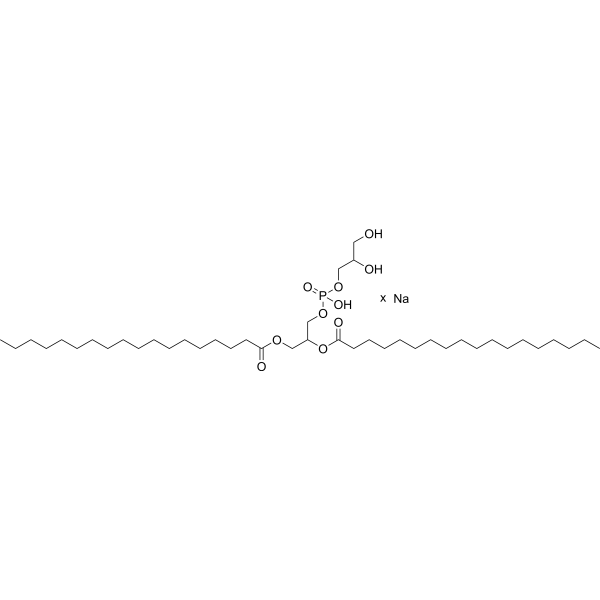
    (Rac)-1,2-Distearoyl-sn-Glycero-3-Phosphatidylglycerol (sodium) is an anionic phospholipid, can be studied for drug delivery and the synthesis of liposomes. 1,2-Distearoyl-sn-Glycero-3-Phosphatidylglycerol-containing liposomes can induce Tregs that are specific for the liposomes’ cargo. 1,2-Distearoyl-sn-Glycero-3-Phosphatidylglycerol is taken up by antigen-presenting cells mediated via complement component 1q (C1q) [1].
    (Rac)-1,2-Distearoyl-sn-Glycero-3-Phosphatidylglycerol sodium
  • HY-P991055

    RG-6234; RO-7425781

    CD3 Inflammation/Immunology
    Forimtamig (RG-6324) is a GPRC5DxCD3 T-cell-engaging bispecific antibody. Forimtamig has a 2 + 1 format, comprising two high-affinity GPRC5D binding moieties and one CD3 binder. Forimtamig further features a P329G LALA mutated Fc domain that inhibits Fcγ receptor and C1q binding, yet retains binding to the neonatal Fc receptor. The isotype control for Forimtamig can refer to Human IgG1 kappa, Isotype Control (HY-P99001) [1].
    Forimtamig
  • HY-P991069

    HIV Infection
    VRC-01 is a broadly neutralizing IgG1 monoclonal antibody that targets HIV-1 envelope glycoprotein gp120 Protein. VRC-01 blocks HIV-1 viral entry by mimicking CD4 receptor interaction with HIV-1 gp120 and neutralizes broad HIV-1 clades. VRC-01 can be used for the research of HIV-1 infection [1] .
    VRC-01
  • HY-P10827

    Complement System Inflammation/Immunology
    PIC1 PA, a 15 amino-acid peptide, is a potent PIC1 analog that inhibits classical pathway mediated complement activation. PIC1 PA functionally disrupts the C1s-C1r-C1r-C1s/MASPs interaction with collagen-like region (CLR) of C1q/MBL, respectively. PIC1 PA specifically binds to the CLR of C1q and bounds to purified C1q with a mean equilibrium dissociation constant (KD) of 33.3 nM [1].
    PIC1 PA
  • HY-NP0194B

    Complement System Inflammation/Immunology
    C1q Protein (rabbit) is a complement protein and is a recognition molecule of the classical pathway, performs a diverse range of complement and non-complement functions. C1q Protein (rabbit) binds various ligands derived from self, non-self, and altered self and modulate the functions of immune
    and non-immune cells. C1q Protein (rabbit) can be used for the research of mutiple disease [1].
    C1q Protein (rabbit)
  • HY-P10827A

    Complement System Inflammation/Immunology
    PIC1 PA TFA is the trifluoroacetate salt form of PIC1 PA (HY-P10827). PIC1 PA TFA is a 15-amino acid peptide that is a potent PIC1 analog that inhibits classical complement activation [1].
    PIC1 PA TFA
  • HY-P991886

    Complement System Neurological Disease
    ANX-M1 is a blood-brain barrier-permeable anti-C1q antibody. ANX-M1 can slow down the progression of retinal degeneration following photo-oxidative damage. ANX-M1 has been incorporated into nanocarriers to evaluate its brain delivery efficacy in a mouse model of Alzheimer's disease. ANX-M1 is applicable for research on age-related macular degeneration and Alzheimer's disease [1] .
    ANX-M1 (Human IgG1)
  • HY-P992142

    ANX-007

    Complement System Metabolic Disease
    Vonaprument is an intravitreally injected C1q antibody fragment, which is a human monoclonal antibody. Vonaprument is applicable to research related to age-related macular degeneration [1].
    Vonaprument
  • HY-P991922

    Fc Receptor (FcR) Complement System Radionuclide-Drug Conjugates (RDCs) Cancer
    AKIR001 is a high-affinity human IgG1 antibody targeting CD44v6. AKIR001 carries LALA-silencing mutations in its FcγR-binding domain to reduce FcγR and C1q interactions, minimizing tissue interactions and limiting CDC and ADCC risks. [ 177Lu] radiolabeled AKIR001, namely [ 177Lu]Lu-AKIR001, has anticancer activity against epidermoid carcinoma [1].
    AKIR001
  • HY-P992474

    Interleukin Related STAT CCR Fc Receptor (FcR) Inflammation/Immunology
    TAVO101 is a humanized anti-TSLP antibody with an EC50 of 0.19 nM against hTSLP. TAVO101 inhibits STAT5 activation and CCL17 release. TAVO101 carries Fc region mutations that enhance its binding to FcRn while reducing its binding to FcγRI, FcγRIIIA and C1q, thereby attenuating effector functions. TAVO101 reduces the levels of inflammatory markers, cell infiltration and histopathological damage in preclinical models of asthma, psoriasis and atopic dermatitis. TAVO101 can be used for research related to asthma, psoriasis and atopic dermatitis [1] .
    TAVO101
  • HY-P992482

    Drug Derivative Influenza Virus Fc Receptor (FcR) Complement System Infection
    VIR-2482 is a monoclonal antibody targeting influenza A hemagglutinin (HA). VIR-2482 is generated by introducing LS mutations (M428L/N434S) into the Fc region of MEDI8852 (HY-P991446). VIR-2482 binds to the conserved HA stem epitope across all 18 influenza A HA subtypes, neutralizes a broad spectrum of H1N1 and H3N2 strains, binds to FcγRIIIa, FcγRIIa and C1q, and induces antibody-dependent cellular cytotoxicity and complement-dependent cytotoxicity. VIR-2482 reduces morbidity and mortality caused by seasonal influenza A strains and provides prophylactic protection in mice. VIR-2482 can be used in research related to influenza A disease [1] .
    VIR-2482
  • HY-RS18747

    Small Interfering RNA (siRNA) Others

    C1qa Mouse Pre-designed siRNA Set A contains three designed siRNAs for C1qa gene (Mouse), as well as a negative control, a positive control, and a FAM-labeled negative control.

    C1qa Mouse Pre-designed siRNA Set A
    C1qa Mouse Pre-designed siRNA Set A

Inquiry Online

Your information is safe with us. * Required Fields.

Salutation


Country or Region *

Applicant Name *


Organization Name *

Department *


Email Address *


Product Name *

Cat. No.


Requested quantity *

Phone Number *


Remarks

Inquiry Online

Inquiry Information

Product Name:
Cat. No.:
Quantity:
MCE Japan Authorized Agent:

