18 Results for "

H226

" in MedChemExpress (MCE) Product Catalog:
Products (18)

18 Results for "H226" in MCE Product Catalog:

1
1 Cited Publications
Cat. No.: HY-P11143A
Research Areas:  

Cancer

IL4RPep-1 acetate is an interleukin-4 receptor (IL-4R) binding agent. IL4RPep-1 acetate preferentially binds to cells with high levels of IL-4R expression compared to those with low levels of expression. IL4RPep-1 acetate-labeled liposomes containing Doxorubicin (HY-15142A) are internalized by cells more efficiently. IL4RPep-1 acetate-labeled liposomes accumulate more effectively within H226 tumors .
loading...
    loading...
Cat. No.: HY-175357
CAS No.: 2957895-40-6
Target:  

YAP

Research Areas:  

Cancer

YAP/TEAD-IN-2 (Compound T-1) is a YAP/TEAD inhibitor. YAP/TEAD-IN-2 inhibits the luciferase activity driven by YAP/TEAD in 293T cells. YAP/TEAD-IN-2 exhibits strong anti-proliferative activity against human pleural mesothelioma NCI-H226 cells. YAP/TEAD-IN-2 can be used for the study of diseases associated with Hippo pathway dysregulation, particularly cancers .
loading...
    loading...
Cat. No.: HY-P99299
CAS No.: 845816-02-6
Synonyms: HGS-ETR 2; ETR2-ST01

Target:  

Apoptosis

Research Areas:  

Cancer

Lexatumumab (HGS-ETR 2) is a human agonistic TRAIL receptor 2 (TRAIL-R2, DR5, APO-2) IgG4κ type monoclonal antibody. Lexatumumab induces apoptosis in malignant mesothelioma. Lexatumumab can be used for malignant pleural mesothelioma (MPM) research .
loading...
    loading...
Cat. No.: HY-174275
CAS No.: 2762619-63-4
Target:  

YAP

Research Areas:  

Inflammation/Immunology Cancer

TEAD1/3/4-IN-1 is an orally active inhibitor of TEAD1/3/4. TEAD1/3/4-IN-1 inhibits the YAP/TAZ-TEAD interaction, with its EC50 being 2 nM. TEAD1/3/4-IN-1 has anti-proliferative activity against NCI-H226 cells. TEAD1/3/4-IN-1 can be used in the research of lung squamous cell carcinoma .
loading...
    loading...
Cat. No.: HY-147208
CAS No.: 2738542-58-8
Purity:  99.87%
Target:  

YAP

Research Areas:  

Cancer

MSC-4106 is an orally active and potent inhibitor of YAP/TAZ-TEAD. MSC-4106 inhibits TEAD1 or TEAD3 auto-palmitoylation and shows inhibitory effect on NCI-H226 tumor xenograft model .
loading...
    loading...
Cat. No.: HY-179395
CAS No.: 3074990-47-6
Target:  

YAP

Research Areas:  

Cancer

TEAD-IN-23 (Compound 22) is an efficient pan-TEAD inhibitor with an IC50 of 10 nM. TEAD-IN-23 exhibits potent anti-proliferative activity in both NCI-H226 and MSTO-211H. TEAD-IN-23 causes complete tumor regression in the MSTO-211H xenograft tumor model. TEAD-IN-23 can be used for the study of mesothelioma and hepatocellular carcinoma .
loading...
    loading...
Cat. No.: HY-15782
CAS No.: 1428623-14-6
Research Areas:  

Cancer

YH16899 binds Lysyl-tRNA synthetase (KRS), and inhibits membrane translocation of KRS. YH16899 impares the interaction of KRS with 67LR. YH16899 inhibits tumor metastasis in mouse models .
loading...
    loading...
Cat. No.: HY-170764
CAS No.: 2738550-24-6
Target:  

YAP

Research Areas:  

Cancer

M3686 (Compound 29) is a potent, selective TEAD1 inhibitor with an IC50 value of 51 nM. M3686 also shows weaker binding activity on TEAD3. M3686 potently inhibits cell viability against YAP-dependent NCI-H226 cell line with an IC50 value of 0.06 uM. M3686 shows strong anti-tumor effects in the NCI-H226 xenograft model .
loading...
    loading...
Cat. No.: HY-120786
CAS No.: 1215208-59-5
Purity:  99.67%
Synonyms: 6-(3′,4′,5′-Trimethoxybenzoyl)quinoline
Research Areas:  

Cancer

MPT0B014 is a tubulin polymerization inhibitor. MPT0B014 induces cancer cell apoptosis. MPT0B014 can be used for the research of cancer .
loading...
    loading...
Cat. No.: HY-159912
CAS No.: 3027484-09-6
Target:  

YAP

Research Areas:  

Cancer

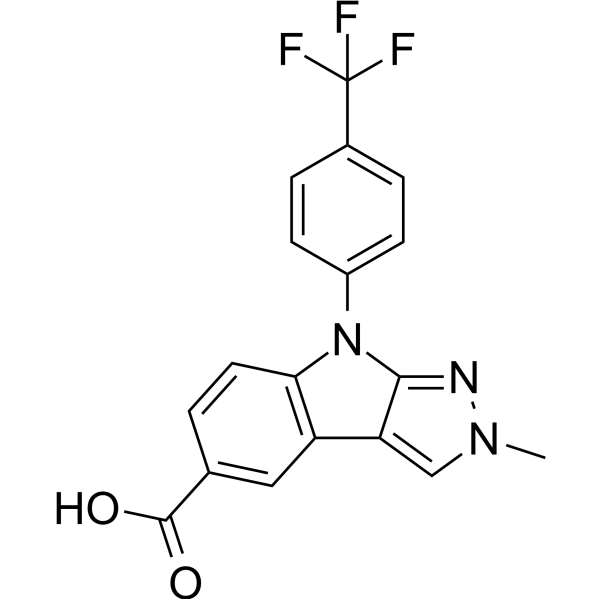
pan-TEAD-IN-1 (Compound 3) is an orally active pan-TEAD inhibitor targeting the palmitoylation site of TEAD, disrupting its interaction with the coactivators YAP/TAZ, thereby suppressing the transcriptional upregulation of oncogenes (e.g., Ctgf and Cyr61) in the Hippo signaling pathway. pan-TEAD-IN-1 exhibits excellent activity with a luciferase IC50 of 0.36 nM and an H226 cell IC50 of 1.52 nM. It also shows favorable pharmacokinetics (AUC0–∞ = 228.7 μg/mL·min, T1/2 = 183.9 min). In TEAD-dependent xenograft mouse models, pan-TEAD-IN-1 significantly inhibited tumor growth, showing promise for research in TEAD-dependent cancers .
loading...
    loading...
Cat. No.: HY-N12004
CAS No.: 154083-99-5
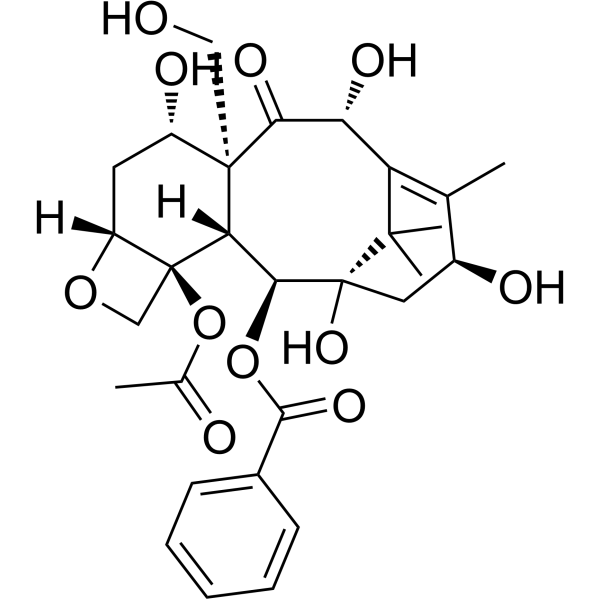
19-Hydroxy-10-deacetylbaccatin III (compound 13) is a taxane with potential antitumor activity. 19-Hydroxy-10-deacetylbaccatin III has weak cytotoxicity against A498 and NCI-H226 cell lines. The study found that the inhibition rates of 30 μg/mL 19-Hydroxy-10-deacetylbaccatin III on A498, NCI-H226 and PC-3 were 16.6% and 32% respectively .
loading...
    loading...
Cat. No.: HY-159119
Research Areas:  

Cancer

hDHODH-IN-15 (Compound H19) is an inhibitor for human dihydroguanylate dehydrogenase (hDHODH) with an IC50 of 0.21 µM. hDHODH-IN-15 exhibits cytotoxicity in cancer cells NCI-H226, HCT-116, and MDA-MB-231, with IC50 of 0.95-2.81 µM. hDHODH-IN-15 induces ferroptosis in HCT-116, and exhibits antitumor efficacy .
loading...
    loading...
Cat. No.: HY-W778562
CAS No.: 92950-42-0
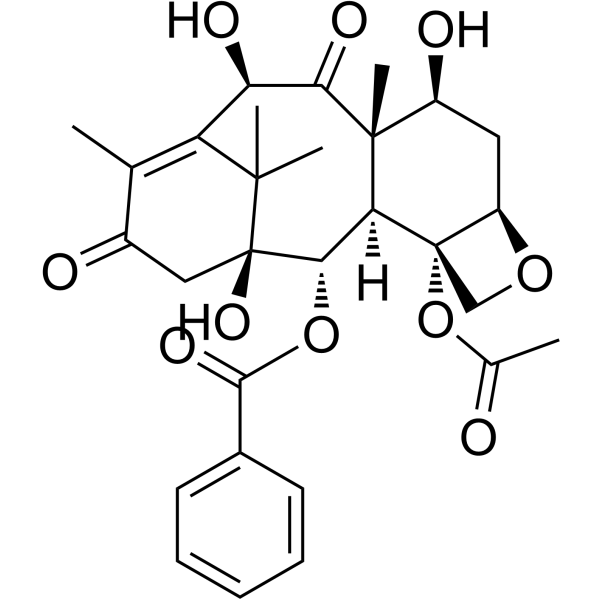
10-Deacetyl-13-oxobaccatin III is an taxane that can be isolated from Taxus sumatrana. 10-Deacetyl-13-oxobaccatin III (30 μg/mL) shows cytotoxicity against A498, NCI-H226, A549, PC-3 cells, with inhibition a rate of 29.7%, 49.2%, 43.9%, 65.3% .
loading...
    loading...
Cat. No.: HY-P11143
CAS No.: 1900734-29-3
Research Areas:  

Cancer

IL4RPep-1 is an interleukin-4 receptor (IL-4R) binding agent. IL4RPep-1 preferentially binds to cells with high levels of IL-4R expression compared to those with low levels of expression. IL4RPep-1-labeled liposomes containing Doxorubicin (HY-15142A) are internalized by cells more efficiently. IL4RPep-1-labeled liposomes accumulate more effectively within H226 tumors .
loading...
    loading...
Cat. No.: HY-163732
Target:  

YAP

Research Areas:  

Cancer

TEAD-IN-16 (compound BC-011) is a potent inhibitor of TEAD, with the IC50 of 72.43 μM. TEAD-IN-16 plays an important role in cancer research .
loading...
    loading...
Cat. No.: HY-122241
CAS No.: 328069-91-6
Target:  

PKC

Research Areas:  

Cancer

MT477 is a potent protein kinase C (PKC) inhibitor. MT477 induces apoptosis and necrosis. MT477 decreases the protein expression of Ras-GTP, p-Erk1/2, p-Elk1. MT477 shows antitumor activity .
loading...
    loading...
Cat. No.: HY-N17816
CAS No.: 571-72-2
Tambulin is an orally active flavonol compound found in Zanthoxylum armatum. Tambulin can inhibit cell proliferation, induce apoptosis and inhibit ROS production. Tambulin upregulates cleaved caspase-3, cleaved caspase-9, and Bax, downregulates Bcl-2 levels. Tambulin can stimulate glucose-dependent insulin secretion and induce endothelium-independent vasorelaxation. Tambulin binds to succinate dehydrogenase (SDH) (Ki = 11.02 μM) and shows significant ferric reducing power. Tambulin can enhances oxidative stress resistance, reduces, lipofuscin deposits, lipid levels, α-synuclein levels, improves locomotary behavior, and dopamine levels in in age-synchronized L1 hermaphrodite Caenorhabditis elegans models of ageing and Parkinson's disease. Tambulin can be used for the researches of Parkinson's disease, lung squamous cell carcinoma, and diabetes .
loading...
    loading...
Cat. No.: HY-182360
Cytisine-Platinum(IV) Prodrug-1 is a Pt(IV) prodrug incorporating the natural compound Cytisine (HY-N0175) with antiproliferative activity against tumor cells. Cytisine-Platinum(IV) Prodrug-1 promotes calcium transfer across the IP3R1-GRP75-VDAC1 axis to drive mitochondrial calcium overload. Cytisine-Platinum(IV) Prodrug-1 initiates unfolded protein response via PERK, eIF2α, ATF4, and CHOP to modulate Bcl-2 and Bax, triggering apoptosis. Cytisine-Platinum(IV) Prodrug-1 induces mitochondrial dysfunction, ROS production, reduced ATP synthesis, DNA damage, and S-phase cell cycle arrest. Cytisine-Platinum(IV) Prodrug-1 activates the cGAS-STING pathway, reduces PD-L1 expression, drives immunogenic cell death. Cytisine-Platinum(IV) Prodrug-1 exhibits high physiological stability, efficient cellular accumulation, and enhanced platinum-DNA binding, and inhibits tumor growth in mouse models with reduced systemic toxicity. Cytisine-Platinum(IV) Prodrug-1 can be used for the research of lung cancer .
loading...
    loading...
  • 1

